Burn a drop of petrol, push a piston, twist a crankshaft, and the road pushes you forward. A petrol car burns fuel inside its engine. The hot gas pushes pistons, the pistons turn a crankshaft, and the spin travels through the gearbox, driveshaft and differential to the wheels.
Burn a drop of petrol, push a piston, twist a crankshaft, and the road pushes you forward. Take a car apart in 3D, fire a four-cylinder engine in slow motion, and see what torque and horsepower really mean.
CarClearOpened 12 Jul 202615 min to playFree · no sign-up
In 60 seconds
Fuel in, motion out
A petrol car burns fuel inside its engine. The hot gas pushes pistons, the pistons turn a crankshaft, and the spin travels through the gearbox, driveshaft and differential to the wheels. The tyres push back on the road, and the road pushes the car forward.
Suck, squeeze, bang, blow
Each cylinder repeats four strokes over two turns of the crank: it draws in air and a mist of petrol, squeezes it about ten times, fires it with a spark, and pushes the burnt gas out. Four cylinders firing 1-3-4-2 give the crank a push every half turn.
Torque twists, power is twist times speed
Torque is twisting force: force times lever arm, in newton metres. Power is torque times rotation speed: kW = N·m × rpm ÷ 9,549, and one horsepower is 745.7 W. Past the torque peak, rpm rises faster than torque falls, so peak power comes at higher rpm.
Gears trade speed for twist
An engine only works between about 800 and 6,500 rpm, so gears map that band to different road speeds. First gear multiplies torque about 15 times with the final drive; fifth lets the engine loaf at motorway speed. The differential lets the outer wheel turn faster in a corner.
Drag decides top speed and fuel use
The tyres' push fights rolling resistance, hills and air drag, which grows with speed squared. Spare force accelerates the car (F = ma). At top speed all the power goes into drag, and the power needed grows with speed cubed, which is why motorway driving burns so much fuel.
Electric: full torque, one gear
An electric car stores energy in a battery, and an inverter feeds a motor that gives full torque from standstill and spins to about 16,000 rpm, so one gear is enough. It turns about 85 to 90% of its energy into motion, against about a quarter for petrol, and its motor recharges the battery when braking.
Burn fuel, push pistons, turn a shaft, and let the wheels push the road.
A petrol car is a machine for turning fuel into motion. Follow the chain: petrol from the fuel tank burns inside the engine. The hot gas pushes pistons down, and they turn a crankshaft.
The spinning crankshaft goes into the gearbox, which picks how many engine turns make one wheel turn. In this car a long driveshaft carries the spin to the back, where the differential turns it sideways and splits it between the two axles. The tyres push backwards on the road, and the road pushes the car forwards.
Around that chain sit the helpers. The radiator gets rid of spare heat. The exhaust carries burnt gas away, through a catalytic converter that cleans it. A 12-volt battery starts the engine and runs the lights. Brakes, steering and springs let you stop, turn and ride over bumps.
Four strokes of a piston turn burning petrol into a spinning crankshaft.
Inside each cylinder a piston slides up and down. A connecting rod joins it to the crankshaft, which turns the up-and-down into round-and-round. Each cylinder repeats four strokes, taking two turns of the crank:
1. Intake. The piston slides down and the intake valve opens. Air rushes in and an injector sprays in a mist of petrol: about 1 g of fuel for every 14.7 g of air. 2. Compression. Both valves close and the piston squeezes the mixture into about a tenth of the space. That is the compression ratio, 10.5 : 1 here. 3. Power. The spark plug fires just before the top. The mixture burns, the pressure leaps, and the gas shoves the piston down. This is the only stroke that makes work. 4. Exhaust. The exhaust valve opens and the piston pushes the burnt gas out.
Two camshafts, turning at half the crank's speed, open the valves at the right moments. With four cylinders firing in the order 1-3-4-2, one of them is always on its power stroke, so the crank gets a push every half turn. Water flows through passages in the block and takes spare heat to the radiator.
Torque is how hard the engine twists. Power is how fast it can keep twisting.
Torque is twisting force. Push on a wrench and the twist on the bolt is your push times the length of the handle: torque = force × lever arm, measured in newton metres (N·m). Push 200 N on a 0.5 m handle and you make 100 N·m. A longer handle gives more twist for the same push.
Inside the engine, the burning gas pushes the piston, the rod pushes the crank pin, and the crank throw is the wrench. At the very top the rod points straight at the centre, so there is no lever arm and no twist. A little later the arm is longest and the twist is huge.
Power is how much work you do each second: power = torque × speed. In numbers, kW = N·m × rpm ÷ 9,549. One horsepower is 745.7 W, a unit James Watt picked in the 1780s to compare his steam engines with horses.
An engine's torque rises, peaks and falls as it spins faster: at high rpm there is less time to fill each cylinder with air. But power keeps climbing past the torque peak, because the rpm is still going up faster than the torque is falling. That's why peak power comes at a higher rpm than peak torque.
Trade speed for twist, disconnect the engine, and let the wheels turn at different speeds.
A petrol engine only works between about 800 rpm (idle) and 6,500 rpm (the redline), and it's strongest in the middle. The wheels need to turn anywhere from 0 to about 2,000 rpm. Gears bridge the gap.
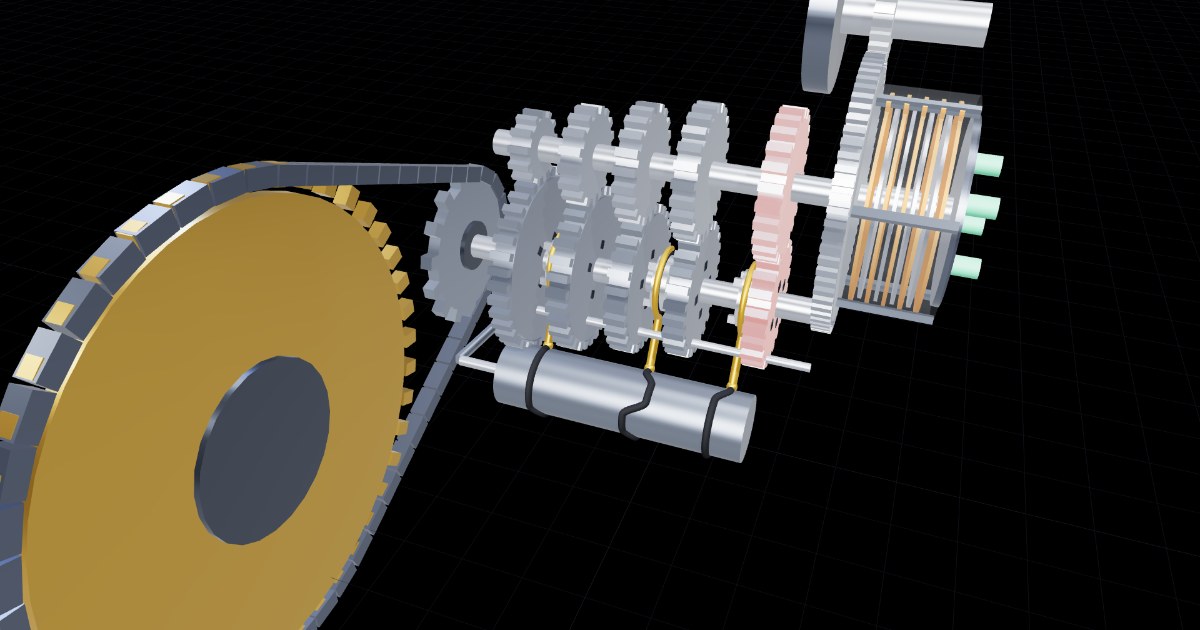
A small gear driving a big one turns it slower but with more twist. First gear here has 10 teeth driving 36: the output turns 3.6 times slower and with 3.6 times the torque, enough to pull away up a hill. Fifth gear has 26 teeth driving 20, so the engine can loaf along at motorway speed. A last pair, the final drive (41 teeth to 10), slows everything another 4.1 times. So:
wheel torque = engine torque × gear ratio × final drive × efficiency, and the push on the road is that torque ÷ the tyre's radius.
The clutch is two plates squeezed together by springs. Press the pedal and they part, so the engine can keep turning while the car stops or you change gear. An automatic uses a fluid-filled torque converter instead.
In a corner the outside wheel travels further than the inside one, so it must turn faster. The differential lets it: little spider gears inside start to spin, speeding one side up exactly as much as they slow the other.
The tyres push; air, tyres and hills push back. Whatever is left over speeds you up.
All that engine torque ends up as one thing: a push where the tyres meet the road. Three things push back.
Rolling resistance. Tyres squash a little as they roll, which wastes energy. It is about 1% of the car's weight, roughly 150 N, at any speed. Air drag. The car has to shove air out of the way: drag = ½ × air density × Cd × frontal area × speed². Double the speed and the drag is four times bigger. Hills. Going up a 10% slope, about a tenth of the car's weight pulls it back.
Whatever push is left over makes the car speed up: F = m × a, so acceleration = spare force ÷ mass. A heavier car speeds up more slowly with the same engine. At top speed there is no spare force left: the engine's whole power goes into pushing air.
Drag is also why fuel use climbs so fast on the motorway. The power needed is force × speed, so it grows with speed cubed. Stopping costs energy too: brakes turn all the car's motion energy, ½mv², into heat.
A big battery, one motor, one gear, and brakes that make electricity.
An electric car swaps the whole engine, fuel tank and gearbox for three parts. A battery under the floor stores the energy: 60 kWh here, the same as about 7 litres of petrol. An inverter turns the battery's direct current into the alternating current the motor needs, and controls how much flows. The electric motor drives the wheels through a single reduction gear.
A petrol engine needs to be spinning before it makes any twist. An electric motor gives its full torque from 0 rpm, then its torque falls once it reaches full power. It happily spins to 16,000 rpm, so one gear covers every speed and there's no clutch.
Lift off or brake and the motor runs backwards as a generator. That's regenerative braking: instead of all the car's motion turning into heat, much of it goes back into the battery.
The big win is efficiency. An EV turns about 85–90% of its battery energy into motion. A petrol engine turns only about a quarter of its fuel's energy into motion; the rest leaves as heat. At 100 km/h this EV uses about 15 kWh per 100 km, while the petrol car burns about 6.5 litres, which holds 58 kWh.
Pistons pushed down by burning fuel. Burning fuel makes hot, high-pressure gas that shoves the pistons, and the connecting rods turn the crankshaft.
In a rear-wheel-drive car, what carries the spin from the gearbox to the back axle?
The driveshaft. The driveshaft is a spinning tube running under the car to the differential.
What finally pushes the car forwards?
The road, pushing back on the tyres. The tyres push backwards on the road. The road pushes the tyres forwards just as hard, and that moves the car.
Which stroke actually pushes the car along?
Power. Only on the power stroke does burning gas push the piston. The other three strokes are paid for by the crank’s spin.
How many times does the crankshaft turn for one complete four-stroke cycle?
Twice. Each stroke is half a turn, so four strokes take two full turns. The camshafts turn once in that time.
Why fire the cylinders 1-3-4-2 instead of all together?
So the crank gets an even push every half turn and runs smoothly. Four cylinders, one power stroke every 180° of crank rotation: steady pushes instead of one big kick.
You push 100 N on a wrench 0.4 m long. What torque do you make?
40 N·m. Torque = force × lever arm = 100 N × 0.4 m = 40 N·m.
An engine makes 200 N·m at 3,000 rpm. Roughly what power is that?
Why does peak power come at higher rpm than peak torque?
Power is torque × rpm, and rpm keeps rising faster than torque falls. Past the torque peak, torque falls slowly while rpm keeps rising, so their product still grows for a while.
First gear is a 10-tooth gear driving a 36-tooth gear. What does that do?
Slows the output 3.6 times and multiplies the torque 3.6 times. The big gear turns once for every 3.6 turns of the small one, and trades that speed for 3.6 times the twist (less a little friction).
Why does a car need several gears?
The engine only works well in a narrow band of rpm, but the wheels need a huge range of speeds. Roughly 800 to 6,500 rpm has to cover everything from creeping to motorway speed. Each gear maps that band to a different range of road speeds.
In a left turn, what does the differential do?
Lets the right (outer) wheel turn faster than the left (inner) one. The outer wheel has further to go. The spider gears spin and share the speed out, so neither tyre is dragged.
You double your speed from 50 to 100 km/h. What happens to the air drag?
It becomes four times bigger. Drag grows with speed squared: 2 × 2 = 4.
What sets a car’s top speed on a flat road?
The speed where drag and rolling resistance use up all the engine’s power. At top speed there’s no spare force left to accelerate: the engine’s power all goes into fighting drag.
Two cars have the same engine, but one is twice as heavy. With the same spare force, the heavy one…
Accelerates at half the rate. a = F ÷ m. Double the mass, half the acceleration.
Why does an electric car usually need only one gear?
The motor gives full torque from standstill and can spin very fast. Strong from 0 rpm and happy up to about 16,000 rpm, a motor covers every road speed with one fixed ratio.
What does regenerative braking do?
Uses the motor as a generator to put energy back in the battery. Slowing the car spins the motor, which then generates electricity instead of wasting all the motion as heat.
Roughly how much of a petrol car’s fuel energy ends up moving the car?
About a quarter. Most of the energy leaves as heat through the radiator and exhaust. An electric drive wastes far less.
Words worth knowing
Four-stroke cycle
Intake, compression, power and exhaust: the four piston strokes, over two crank turns, that make each bang in a petrol engine.
Compression ratio
How much the mixture is squeezed before it burns: the cylinder's largest volume divided by its smallest, about 10 to 1 in a petrol engine.
Torque
Twisting force: force times the length of the lever arm, measured in newton metres (N·m) or pound-feet (lb·ft).
Horsepower
A unit of power equal to 745.7 watts. For an engine, power is torque times rotation speed.
Gear ratio
Teeth on the driven gear divided by teeth on the driving gear: how many turns in for one turn out, and how much the torque is multiplied.
Differential
A set of gears that splits the drive between two wheels and lets them turn at different speeds in a corner.
Aerodynamic drag
The push back from the air, ½ × air density × drag coefficient × frontal area × speed². It grows four times when speed doubles.
Regenerative braking
Slowing an electric car by using its motor as a generator, putting energy back into the battery instead of wasting it as heat.
Fork it. Teach with it.
This box is plain HTML, CSS and JavaScript, with no build step and no accounts. Run it yourself and it sends nothing anywhere. The code is MIT. The words, images and videos are CC BY 4.0, so you can reuse them anywhere if you credit “Glassbox, glassbox.how/e/carclear”.