Work and power: W = F × d · P = W ÷ t. You do work when a force moves something along the direction it pushes: work = force × distance, measured in joules. Power is how fast you do that work, work ÷ time, measured in watts.
Pull a crate at an angle, wind a bucket up a well, and watch the joules pile up under a graph. Race up the stairs at 350 watts, meet Watt's horse, lift a rice sack with a lever, pulley and ramp, read your electricity bill in kilowatt-hours, and find out why holding still makes you tired but does no work.
Work and powerOpened 27 Sept 202612 min to playFree · no sign-up
In 60 seconds
Force times distance
You do work when a force moves something along its direction: W = F × d, in joules. Pull at an angle and only F cos θ counts. On a force–distance graph, the work is the area under the line. If nothing moves, no work is done.
Power is a rate
Power is work ÷ time, in watts. Running up 3 m of stairs in 5 s, a 60 kg student makes about 350 W. A cyclist holds 100 to 250 W. Watt's mill horse did 33,000 foot-pounds a minute: 1 hp = 745.7 W.
Machines trade force for distance
Levers, pulleys, ramps and gears let a small force do a big job, but only by moving further. Work in = work out, minus friction. A bike chain is about 97% efficient; a petrol engine about 30%.
Paying for work
Electricity is sold by the kilowatt-hour: 1 kWh = 3.6 MJ. A 1.5 kW AC for 6 hours a day uses 270 units a month. Food is energy too: 2,000 kcal a day is 8.4 MJ, an average of about 97 W.
Myths and limits
Carrying a bag level does no work on it: the force is at 90° to the motion. More power doesn't mean more work, just faster work. Brakes do negative work. And holding still tires you because myosin heads keep burning ATP without moving anything.
Where you'll meet it
W = F × d · P = W ÷ t
work = force × distance moved along the force, in joules; power = work ÷ time, in watts. One joule is 1 newton pushed through 1 metre, and one watt is one joule every second
Running up the stairs
A 60 kg student climbing one floor, 3 m, in 5 s does about 1,770 J of work at about 350 W. Few people can keep that up for more than a minute.
Cycling to school
Riding at 20 km/h on the flat takes about 80 W at the pedals, mostly to push the air aside. Most riders can hold 100 to 250 W for an hour.
A bicycle's low gear works like a lever: each pedal stroke pushes less hard but you turn the pedals more times. The work to climb the hill stays the same.
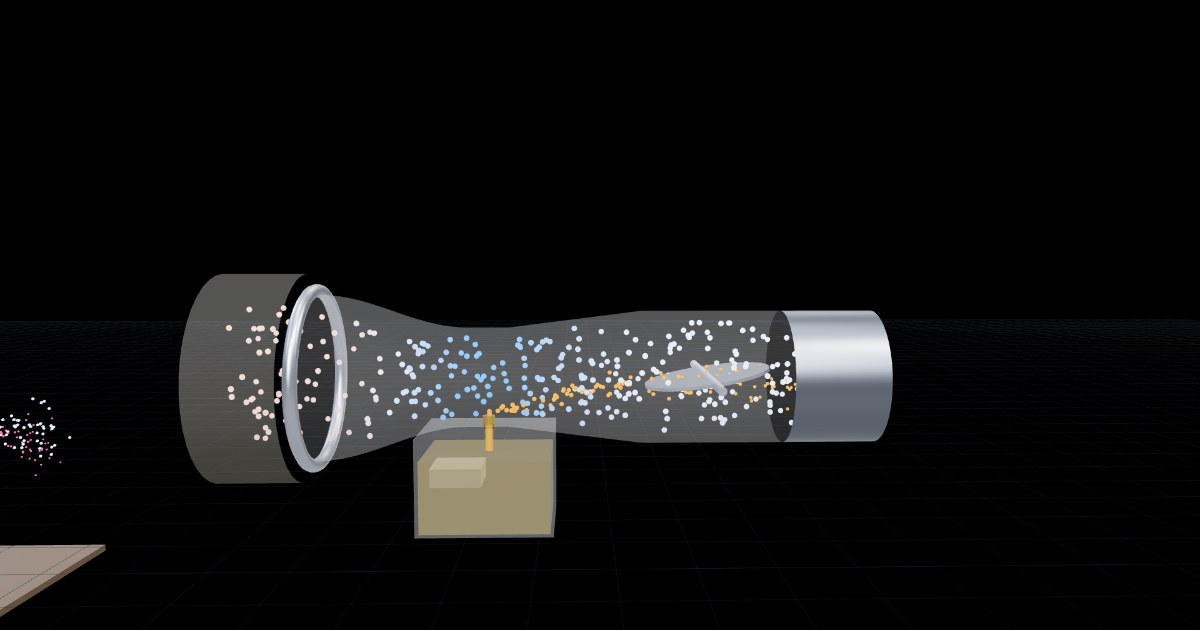
A 1.2 litre hatchback makes about 90 hp, some 67 kW, and a 2.0 litre engine about 110 kW. Yet a petrol engine turns only about 30% of its fuel's energy into work.
A 1,200 kg car at 100 km/h carries about 460 kJ of kinetic energy. Hard braking removes all of it in about 56 m and turns it into heat in the brake discs.
Pull, lift and stretch, and watch the joules pile up under a graph.
In physics, work has a precise meaning: you do work on something when you push or pull it and it moves along the direction of your push. Work = force × distance, W = F × d.
Work is measured in joules (J). One joule is a push of 1 newton over 1 metre: about lifting an apple from the floor onto a table. Drag a crate 5 m with 200 N and you do 1,000 J of work.
Pull at an angle and only the part of the force along the motion counts: W = F d cos θ. The upward part of a slanting pull moves nothing, so it does no work. And if nothing moves, no work is done at all, however hard you strain.
Draw the force against the distance and the work is the area under the graph. For a steady force it is a rectangle; for a spring, whose force grows as you stretch it, a triangle, W = ½ k x².
Power is how fast you do work: P = W ÷ t, measured in watts (W). One watt is one joule every second. The same job done in half the time needs twice the power. Work is the energy you hand over, so this is the start of the story in EnergyClear.
How many watts can a person, a cyclist and a horse put out?
You are a machine too. Run up a flight of stairs and you lift your own weight: the work is m g h, and your power is that work divided by the time. A 60 kg student climbing 3 m in 5 s does about 1,770 J of work at about 350 W. Few people can keep that up for more than a minute.
On a bicycle the legs push against rolling resistance, the slope and the air. Power is also force × speed, P = F v, and air drag grows with the square of the speed, so the power needed climbs steeply. Riding to school at 20 km/h takes about 80 W; most people can hold 100 to 250 W for an hour (see CycleClear). Your muscles are only about a quarter efficient, so your body burns about four times that.
In the 1780s James Watt needed a way to sell his steam engines, so he measured mill horses. A horse walking round a 12 ft arm, 144 times an hour, pulling with 180 pounds-force, did about 32,600 foot-pounds of work a minute. He rounded it up to 33,000: 1 horsepower = 745.7 W. The unit of power is named after him.
Machines put horses to shame. A 750 W mixer grinder is about 1 hp (see MixerClear). A Splendor motorcycle makes about 8 hp and a Pulsar 150 about 14 hp (see MotorcycleClear). A 1.2 litre hatchback makes about 90 hp, some 67 kW, and CarClear's 2.0 litre engine about 110 kW.
Levers, pulleys and ramps make the push smaller, never the work.
A simple machine lets a small force do a big job. But it can’t make work out of nothing. If it halves the force you need, you must push twice as far. With no friction, work in = work out: Fin × din = Fout × dout. Galileo spelled this out around 1600: what you gain in force, you lose in distance.
A lever with a long handle lets you lift a sack with a fraction of its weight, but your end swings much further. A pulley block hangs the load on several strands of rope, so each carries a share, and you pull out that many times more rope. A ramp lets you push a load up gradually instead of lifting it straight. Bicycle gears do the same: a low gear makes hills easier by making you pedal more turns (see CycleClear).
The force a machine multiplies by is its mechanical advantage. Real machines lose some work to friction, which ends up as heat. Efficiency = useful work out ÷ work in. A bicycle chain is about 97% efficient and an electric car’s motor about 90%, but a petrol engine turns only about 30% of its fuel into work (see CarClear). That lost energy is not destroyed: it heats things up, as EnergyClear shows.
Your electricity bill and your lunch are both counted in energy.
The electricity board doesn’t charge you for power. It charges for energy: how many joules your appliances use. Energy = power × time. Joules are tiny, so the bill counts kilowatt-hours (kWh), the “units” on your bill: 1,000 W running for one hour. 1 kWh = 3.6 MJ, 3.6 million joules.
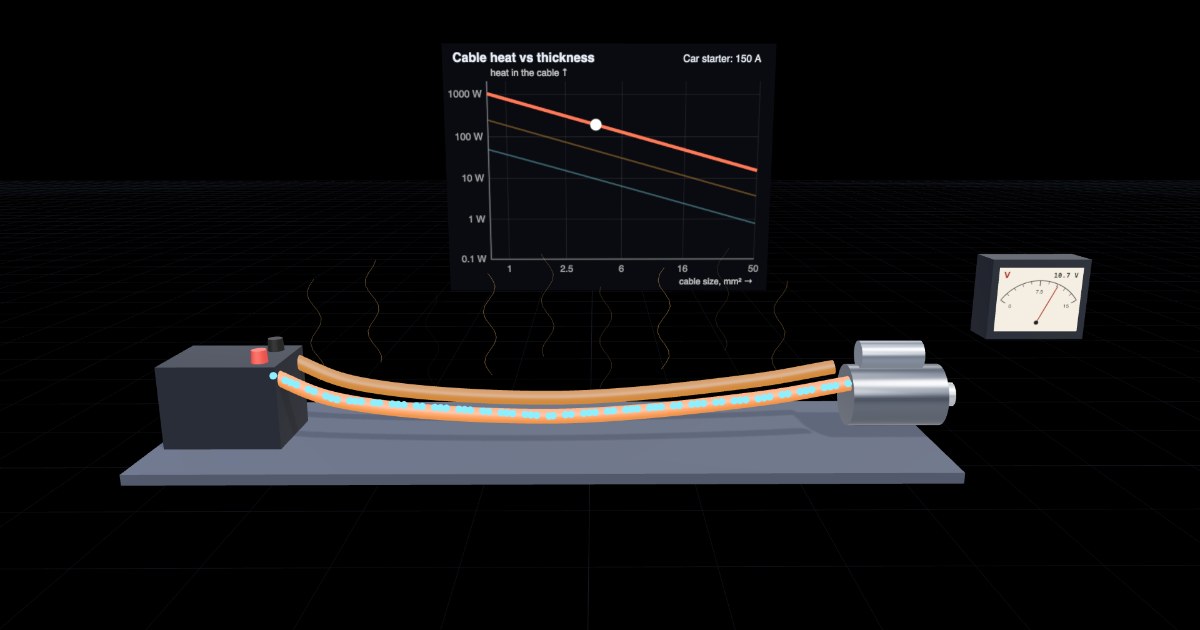
A ceiling fan draws about 75 W (a BLDC fan about 30 W, see FanClear). A 1.5 ton AC draws about 1,500 W, twenty fans’ worth (see ACClear). A geyser heats with a 2,000 W element (see WaterHeaterClear), so half an hour a day uses as much as a fan running for 13 hours. What decides the bill is watts × hours.
The meter measures it. In an older meter an aluminium disc spins faster the more power you draw, turning a fixed number of times for every kWh. Modern meters blink a light instead. BEE’s star labels tell you how many units a year an appliance needs.
Food is energy too. The food Calorie on a packet is a kilocalorie: 4,184 J. A 2,000 kcal day is 8.4 MJ, about 2.3 kWh. Spread over 24 hours, that is about 97 W: you run on roughly the power of an old light bulb.
Carrying a bag, fast and slow lifts, braking, and tired muscles.
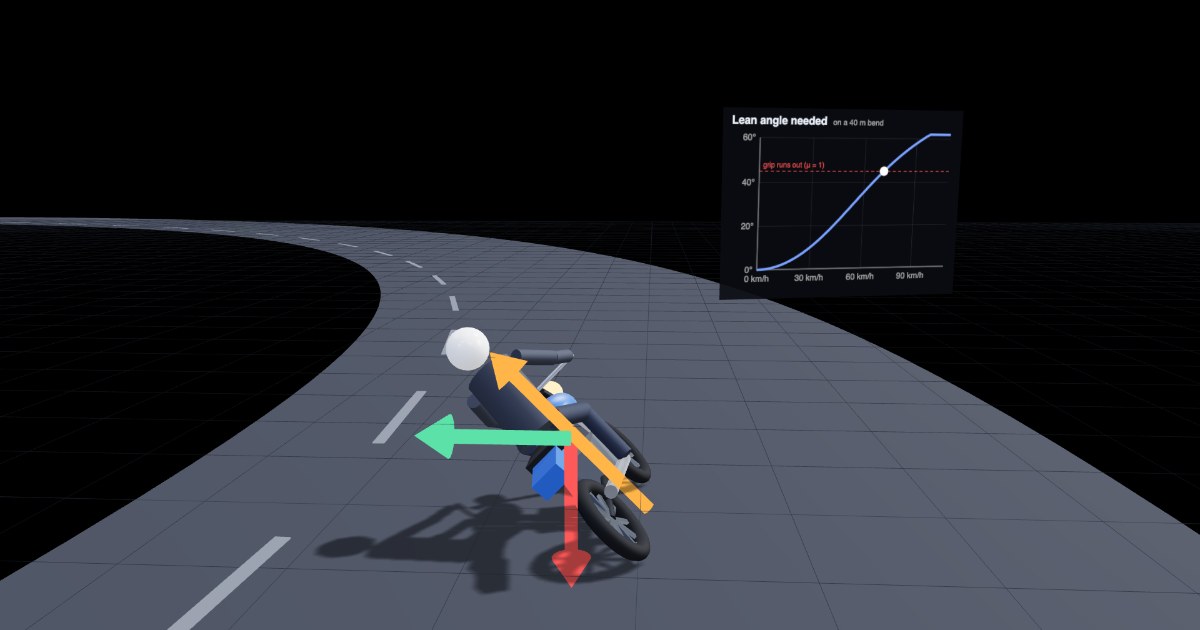
Myth: carrying a bag across a room is work. Not on the bag! Your hand pulls up, but the bag moves sideways. The force is at 90° to the motion, cos 90° = 0, so the work on the bag is zero. Lift it onto a shelf and you do work; lower it and you do negative work: the bag hands energy back to you.
Myth: more power means more work. Power is a rate, not an amount. A hand winch and an electric hoist lifting the same bucket to the same height do exactly the same work. The hoist just does it faster, so its power is higher.
Negative work. When a force points against the motion, its work is negative: it takes energy away. Brakes do this. The road pushes the tyres backwards while the car rolls forwards, removing all of the car’s kinetic energy, ½ m v², and turning it into heat in the brake discs. Twice the speed means four times the energy to get rid of (see CarClear and EnergyClear).
Why does holding still make you tired? Inside each muscle fibre, millions of tiny myosin heads grab a thin filament called actin, pull, let go and grab again. Every cycle burns one molecule of ATP. When you hold a bucket still, the heads keep cycling to keep up the pull, but nothing moves. You burn energy without doing any work on the bucket, and it all becomes heat.
You push a box 4 m across the floor with a steady 50 N. How much work do you do?
200 J. Work = force × distance = 50 N × 4 m = 200 J.
You pull a suitcase 10 m with 100 N along a handle that slants up at 60°. How much work goes into moving it along?
500 J. Only the part along the motion counts: 100 × cos 60° = 50 N, and 50 N × 10 m = 500 J. The upward part does no work.
A student lifts a 10 kg bucket 2 m in 4 s. What is her power?
49 W. Work = m g h = 10 × 9.81 × 2 ≈ 196 J. Power = 196 J ÷ 4 s ≈ 49 W.
A 50 kg girl runs up 6 m of stairs in 10 s. About how much power does she need?
300 W. Work = m g h = 50 × 9.81 × 6 ≈ 2,940 J. Power = 2,940 J ÷ 10 s ≈ 294 W.
Why does riding a bicycle twice as fast take far more than twice the power?
Air drag grows with the square of the speed, and power is force × speed. Drag ∝ v², and P = F × v, so the power to beat the air grows with v³. Twice as fast takes about eight times the power against the air.
What is 1 horsepower in watts?
745.7 W. Watt fixed 1 hp at 33,000 foot-pounds per minute, which is 745.7 W. A 750 W mixer grinder is about 1 hp.
A pulley block has 4 strands holding a 400 N load. With no friction, how hard must you pull, and how much rope do you pull to lift it 1 m?
100 N, 4 m. Each strand carries a quarter: 100 N. But all four strands must shorten by 1 m, so you pull out 4 m of rope. 100 N × 4 m = 400 N × 1 m.
Why can’t any machine give out more work than you put in?
Energy can’t be created: work in = work out, minus friction. Work is energy handed over, and energy is conserved. The best a machine can do is pass all of it on; friction always takes a little as heat.
A petrol engine is about 30% efficient. Out of 100 J of fuel energy, how much becomes work?
30 J. Efficiency = work out ÷ energy in, so 30% of 100 J is 30 J. The other 70 J leaves as heat in the exhaust and the radiator.
How many joules are there in 1 kWh?
3.6 million J. 1 kWh = 1,000 W × 3,600 s = 3,600,000 J = 3.6 MJ.
A 2,000 W geyser runs for 30 minutes a day. How many units does it use in a 30-day month?
30 units. 2 kW × 0.5 h = 1 kWh a day, and 30 days make 30 kWh, or 30 units.
You eat about 2,000 kcal a day. What is your average power?
About 97 W. 2,000 × 4,184 J = 8.4 MJ, divided by 86,400 seconds in a day ≈ 97 W.
You carry a 5 kg bag 10 m along a level corridor at a steady pace. How much work does your hand do on the bag?
0 J. Your hand pulls straight up, but the bag moves sideways. At 90°, cos θ = 0, so the work on the bag is zero.
A car brakes to a stop. What work do the brakes (through the road) do on the car?
Negative work, taking away its kinetic energy as heat. The friction force points backwards while the car moves forwards, so its work is negative: −½ m v². That energy ends up as heat in the discs and pads.
Why does your arm tire when you hold a heavy bag perfectly still?
Myosin heads keep cycling and burning ATP to keep up the pull, even though nothing moves. The muscle has to keep pulling, and it does that by constantly grabbing and releasing. Each cycle uses ATP. No work is done on the bag; the energy becomes heat.
Words worth knowing
Work
Energy handed over by a force that moves something: force × distance moved along the force.
Joule (J)
The unit of work and energy: a force of 1 newton acting over 1 metre.
Power
How fast work is done: work ÷ time, or force × speed.
Watt (W)
The unit of power: one joule every second.
Horsepower (hp)
James Watt's unit of power: 33,000 foot-pounds per minute, 745.7 W.
Kilowatt-hour (kWh)
1,000 W for one hour: 3.6 MJ. One 'unit' on an electricity bill.
Mechanical advantage
How many times a machine multiplies your force. It always costs the same factor in distance.
Efficiency
Useful work out ÷ energy in. The rest is lost, mostly as heat.
Fork it. Teach with it.
This box is plain HTML, CSS and JavaScript, with no build step and no accounts. Run it yourself and it sends nothing anywhere. The code is MIT. The words, images and videos are CC BY 4.0, so you can reuse them anywhere if you credit “Glassbox, glassbox.how/e/workclear”.