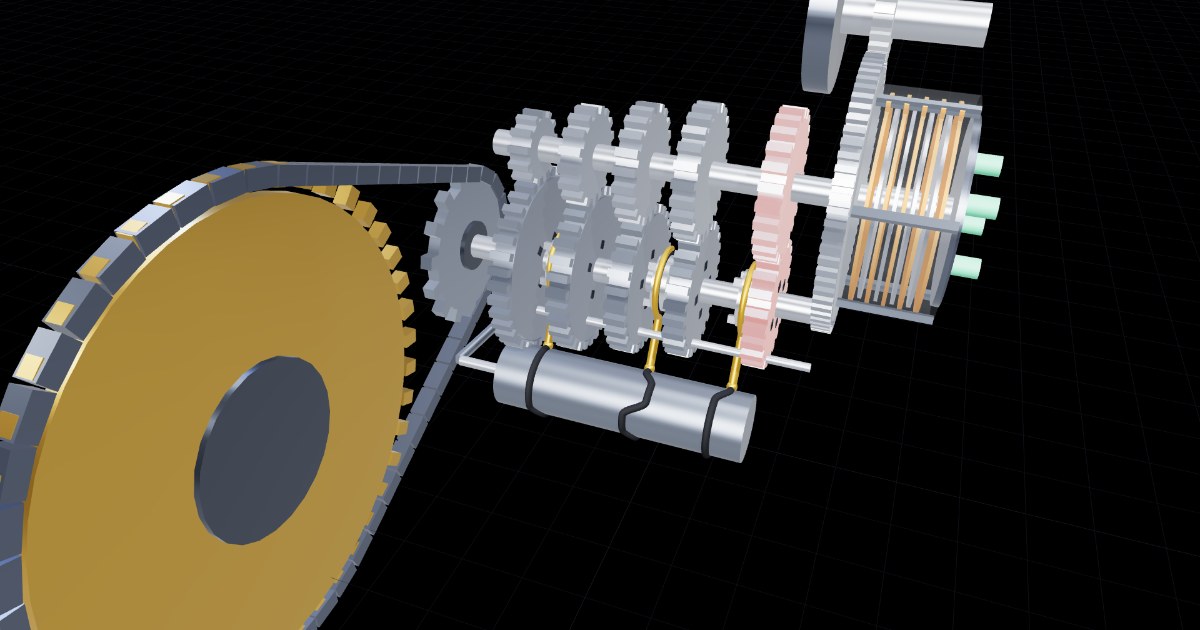
A motor that spins 20,000 times a minute, blades whose tips hit 200 km/h, and ribs that stop your chutney riding round the jar. A mixer grinder is a heavy base holding an upright electric motor, with a jar on top.
A motor that spins 20,000 times a minute, blades whose tips hit 200 km/h, and ribs that stop your chutney riding round the jar. Take India's favourite kitchen machine apart in 3D.
MixerClearOpened 21 Jul 202612 min to playFree · no sign-up
In 60 seconds
A fast motor under a jar of blades
A mixer grinder is a heavy base holding an upright electric motor, with a jar on top. The jar's blades sit on a short shaft through a sealed bushing, and a rubber coupler links them to the motor when you set the jar down. A speed switch, a cooling fan, suction feet and an overload switch complete it.
A motor that runs on AC because both halves flip
The universal motor sends the same current through its field coils and, via carbon brushes and a commutator, through its spinning armature. When the mains flips 100 times a second, both magnets flip together, so the push never changes direction. It races at about 20,000 rpm empty and slows under load while drawing more current.
Tiny blades, racing-car tip speed
The tip speed of a blade is v = ω × r. At 18,000 rpm a tip 3 cm from the centre moves at about 57 m/s, roughly 200 km/h. The blades smash and shear the food, and bits get smaller fast at first, then more slowly, since each step finer needs more energy.
Ribs stop the whole load spinning
On its own, the load swirls round with the blade, forming a vortex, and the blade slips through food that is already moving. Ribs on the jar wall break the swirl into an up-and-down loop, so food keeps falling back into the blades. A little water, or pulse mode, helps thick loads flow back.
Every watt ends up as heat
Current heats the windings, and the work done on the food heats the food: Q = P × t. A heavy load draws more current, and heating grows with current squared, so mixers are rated for short runs. A bimetal overload switch opens if the windings get too hot, and you reset it under the base.
A gram of imbalance shakes it hard
A lump spinning with the blade pulls on the machine with F = m r ω². One gram at the blade tip at 17,000 rpm pulls with about 110 N, more than three times the mixer's weight, so it walks. Suction feet, a secure lid and the max line keep it safe.
A very fast motor in the base, a jar with blades on top, and a rubber coupler between them.
A mixer grinder, the "mixie" in most Indian kitchens, has two halves. The heavy base holds an electric motor standing on its end. The jar sits on top, with the blades fixed in its floor.
The motor is a universal motor: copper field coils on the outside, a spinning armature in the middle, and two carbon brushes that rub on a ring of copper bars called the commutator. A cooling fan on the bottom of the shaft pulls air through the base.
The top of the shaft ends in a rubber coupler. The jar has a matching coupler under it, so the blades lock onto the motor when you set the jar down. A bushing and seal let the blade shaft turn without the jar leaking.
The speed switch has 1, 2, 3 and P for pulse. A thermal overload protector cuts the power if the motor gets too hot, and vacuum feet grip the counter.
Why a motor with brushes runs on AC, and why it slows down when the jar is full.
A mixer needs a motor that is small, light and very fast: around 18,000 to 22,000 rpm with nothing in the jar. That is the job of the universal motor.
Current flows through the field coils, which turn the iron into a magnet. Then it flows through a carbon brush, into the armature coils, and out through the other brush. The magnet pushes on the current in the armature wires, and the armature turns. As it turns, the commutator keeps swapping which coils are connected, so the push always goes the same way round.
Here is the clever part. Mains electricity flips direction 100 times a second. But the field coils and the armature are wired in a line, in series, so the same current flows through both. When it flips, both the magnet and the armature current flip, and two flips cancel out. The push stays the same way. That's why it's called universal: it runs on AC or DC.
Load it up and it slows down. A slower armature makes less back-voltage, so more current flows, giving more push, but also more heat.
Small blades, huge tip speed, and bits that get smaller every second.
Mixer blades are only 6 to 8 cm across, but they spin about 300 times a second. The speed of a blade's tip is v = ω × r: how fast it turns times how far the tip is from the centre. At 18,000 rpm a tip 3 cm out moves at about 57 m/s, roughly 200 km/h, as fast as a racing car.
At that speed the blade doesn't really slice. It smashes bits of food and shears them between the edge and the rest of the load. Each hit breaks bits into smaller bits, so the size falls quickly at first and then more and more slowly. Engineers describe this with Rittinger's law: making bits twice as fine needs about twice the energy again.
Each jar has its own blade. The dry jar has flat, sharp blades that mill spices and dal into powder. The chutney jar has tips bent up, to churn wet food and throw it up the wall. The liquidiser has four wings, two up and two down, to stir a whole jar of liquid.
Stop the whole load from spinning, and it keeps falling back into the blades.
Spin a blade in a jar and it drags the food round with it. Soon the whole load is swirling, pressed against the wall, with a dip in the middle: a vortex. The blade just slips through food that is already moving with it, and bits at the top never come down to be cut.
That's why jars have ribs on the inside wall, called flow breakers. They stop the swirl. The blade flings food outwards, it hits the ribs and climbs the wall, rolls back across the top and falls down the middle into the blades again. Every bit gets many turns at the blades.
Thick food makes it worse. A dry chutney sticks to the wall and the blades dig an air pocket under it. A splash of water lets it flow back. Pulse mode helps too: each stop lets the load slump back onto the blades.
Where the power goes, why spices get hot, and what the red button under the base is for.
Every watt a mixer draws ends up as heat. Some warms the motor: current through the copper windings heats them, just like a heater. The rest does work on the food, and that work turns into heat in the food. So Q = P × t: 200 W into a jar of spices for one minute is 12,000 joules, enough to make 100 g of cumin and its steel jar almost 30 °C hotter.
That's why dry grinding in short bursts keeps spices tasting fresh: their flavour lives in oils that escape when they get hot. It's also why batter warms up in a mixie.
A heavy load slows the motor and makes it draw more current, and the heat in the windings grows with current squared. Mixers are made for short runs: manuals say to grind in bursts and let the motor rest, and many say never more than a few minutes at a time. Here we try 30 seconds on, one minute off. Run one too long and the windings could burn, so a thermal overload switch sits against them. Inside is a bimetal strip: two metals that expand by different amounts, so it bends as it warms and snaps a contact open. Once it cools, you press the reset button under the base.
A lump of a gram shakes the whole machine. Suction feet, lids and fill lines keep it in check.
A spinning blade has to be balanced. Stick a lump on one wing and, as it whirls round, it pulls the whole machine towards itself, 300 times a second. The force is F = m × r × ω². Because ω is squared, speed makes it huge: just 1 gram at the blade tip at 17,000 rpm pulls with about 110 newtons, more than three times the mixer's own weight.
That shaking makes the mixer walk across the counter. Its vacuum feet are soft rubber cups: press the mixer down and they suck onto a smooth counter, adding grip.
Mixers are loud, often 85 to 95 dB up close, louder than a busy road. The noise climbs steeply with speed, and a shaking jar rattles louder still.
Some rules: keep the lid on (some mixers have a lid interlock that won't start without it). Don't fill past the max line: the load climbs the wall when it spins and pushes the lid. And don't run it empty: the motor races to top speed with nothing to cushion the blades, which wears the bushing and coupler.
The jar’s coupler locks onto a coupler on the motor shaft. The rubber coupler on the motor shaft meshes with the nylon one under the jar, so the blades turn with the motor.
What do the carbon brushes do?
Carry current into the spinning armature. They press on the commutator and pass current to the coils that are spinning.
What happens when the overload protector trips?
The power is cut until the motor cools and you press reset. It is a heat-sensitive switch that protects the windings from burning.
Why does a universal motor keep turning the same way on AC?
The field and armature currents flip together, so the push keeps its direction. In series, one current flows through both. Flip it and both magnets flip, and the push stays the same way.
You put a heavy load in the jar. What happens to the motor?
It slows down and draws more current. Slower spinning means less back-voltage, so more current flows. More current gives more push, and more heat.
Speed 1 uses more turns of the field coil than speed 3. Why is it slower?
More turns make a stronger magnet, so a lower speed makes enough back-voltage. A stronger field means the armature makes the same back-voltage at a lower speed, so it settles slower.
A blade tip 3 cm from the centre turns at 18,000 rpm. Roughly how fast is the tip moving?
About 200 km/h. v = ωr = (18,000 × 2π / 60) × 0.03 ≈ 57 m/s, which is about 200 km/h.
Why does grinding slow down as the powder gets finer?
Each halving of size needs more energy than the last. Finer bits mean far more new surface to break, so each step costs more energy.
Why does the chutney jar’s blade have its tips bent up?
To lift and churn wet food so it keeps circulating. Upturned tips fling the wet load up the wall, so it falls back into the blades again.
What do the ribs inside a jar do?
Stop the load swirling, so it keeps falling back into the blades. Without them the whole load spins with the blade and the blade has little to cut.
Your chutney just spins round the wall with an empty hole in the middle. What helps?
Add a little water, or use pulse. Water lets the paste flow back to the blades, and each pulse lets it slump back down.
Why does a swirling liquid’s surface dip in the middle?
Spinning liquid is flung outwards, so it piles up at the wall. Every bit of liquid needs a push towards the centre to go round; the higher level at the wall provides it.
You grind spices for one minute at 200 W into the food. How much heat goes into the jar?
12,000 J. Q = P × t = 200 W × 60 s = 12,000 J.
Why does an overloaded mixer’s motor get hot so fast?
It slows down and draws more current, and heating grows with current squared. More current, and heat ∝ I², plus a slower fan cools it less.
How does the overload switch know the motor is too hot?
A bimetal strip bends as it warms and opens a contact. The two metals expand by different amounts, so the strip curls and snaps the contact open.
A 1 g lump sits 3.5 cm from the centre at 17,000 rpm (1,780 rad/s). About how hard does it pull?
About 110 N. F = m r ω² = 0.001 × 0.035 × 1,780² ≈ 110 N.
Why should you not fill a jar past the max line?
The spinning load climbs the wall and pushes out past the lid. A swirling load rises at the wall. Too full, and it forces its way out.
What do the vacuum feet do?
Suck onto the counter so the mixer doesn’t walk. The rubber cups seal to a smooth counter and add grip against the shaking.
Words worth knowing
Universal motor
A series-wound motor with brushes and a commutator that runs on AC or DC. It is small, light and very fast.
Commutator
A ring of copper bars on the motor shaft. The carbon brushes touch different bars as it turns, switching the armature coils.
Back-voltage
The voltage a spinning armature makes against the mains. The faster it spins, the less current can flow.
Tip speed
How fast the end of a blade moves: v = ω × r, turning speed times radius.
Vortex
A swirling mass of liquid whose surface dips in the middle and rises at the edge.
Flow breakers
Ribs on the inside of a jar that stop the load swirling round with the blade.
Overload protector
A heat-sensitive bimetal switch that cuts the motor's power when its windings get too hot.
Duty cycle
How long a machine may run before it must rest, such as 30 seconds on and one minute off.
Unbalance
Mass that is not spread evenly round a spinning part, so it pulls the machine round in a circle.
Fork it. Teach with it.
This box is plain HTML, CSS and JavaScript, with no build step and no accounts. Run it yourself and it sends nothing anywhere. The code is MIT. The words, images and videos are CC BY 4.0, so you can reuse them anywhere if you credit “Glassbox, glassbox.how/e/mixerclear”.