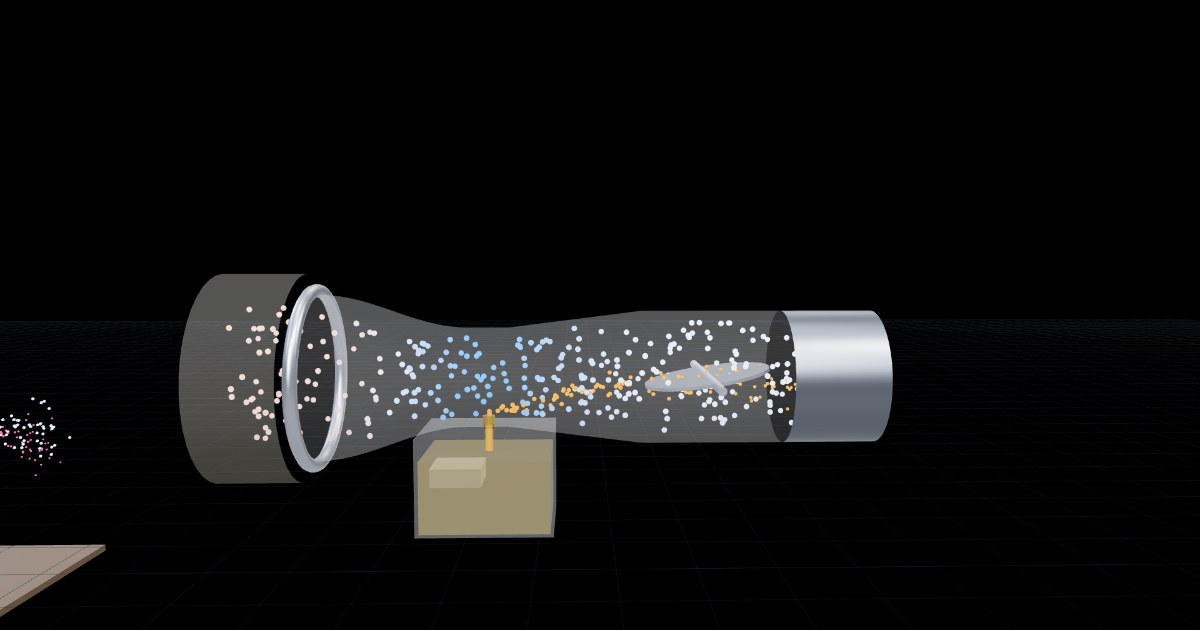
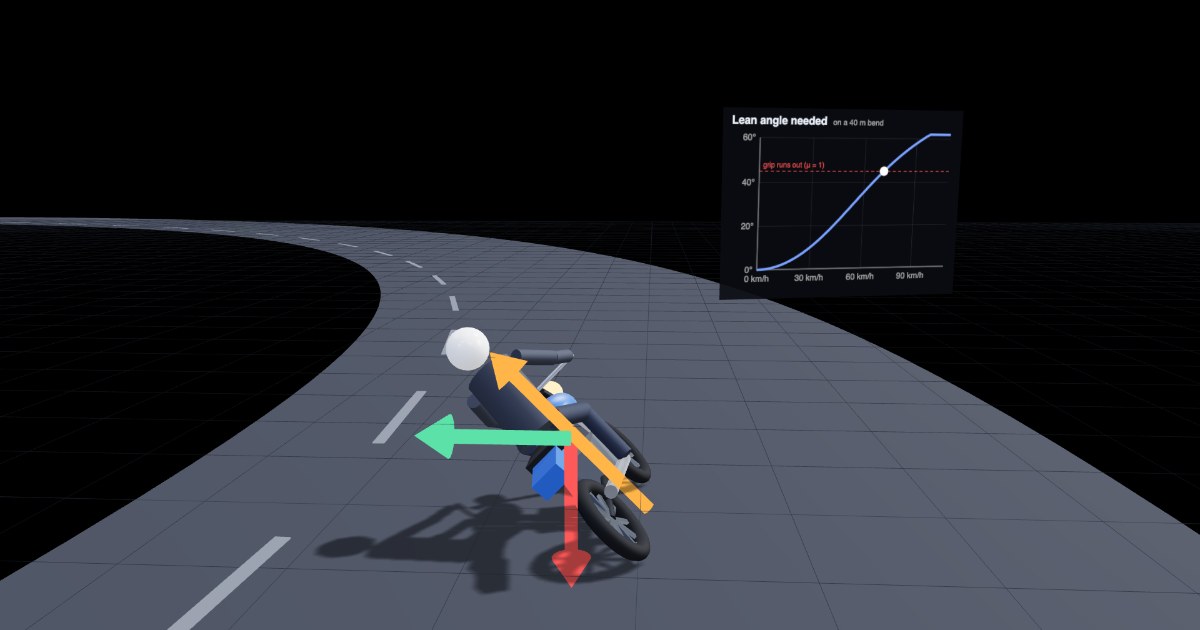
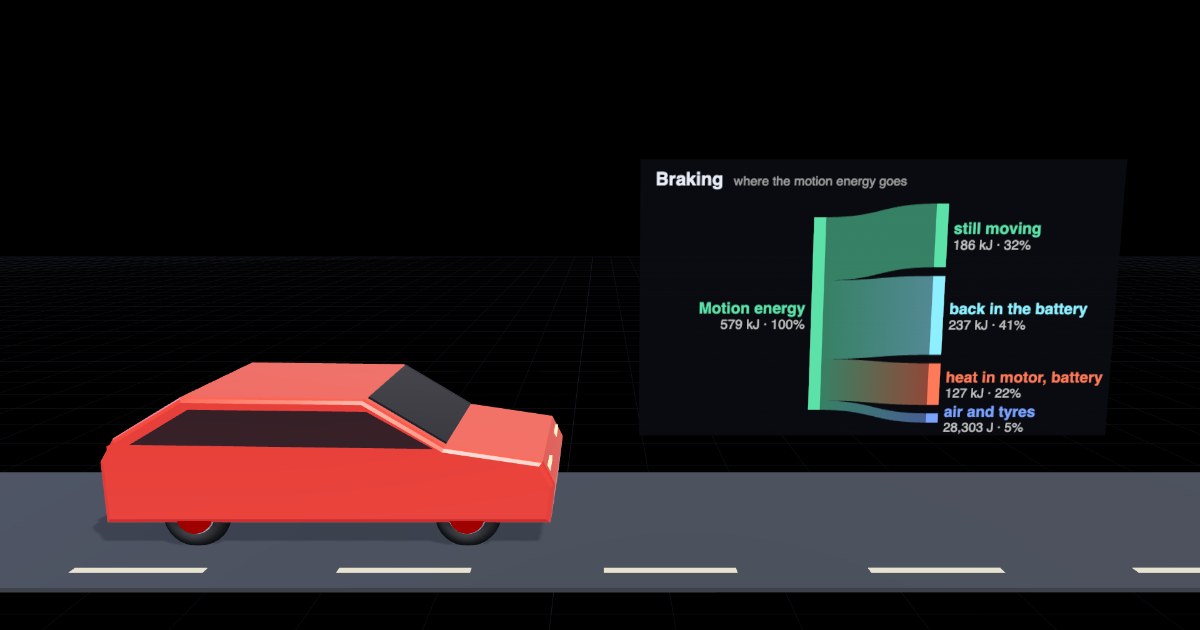
Ohm's law: V = I × R (voltage = current × resistance, so current = voltage ÷ resistance). Push harder and more current flows; make the path narrower and less flows. For a wire or resistor at a steady temperature, the current is exactly proportional to the voltage, and the number that links them is the resistance.
Twice the push, twice the flow: one line of algebra runs every heater, charger and fuse in your home. Drive electrons round a 3D circuit, see why they crawl while the light comes on instantly, and find where Ohm's law finally breaks.
Ohm's lawOpened 27 Sept 202612 min to playFree · no sign-up
In 60 seconds
Voltage pushes, resistance holds back
Current is how much charge flows each second. It equals the push, voltage, divided by the resistance: I = V ÷ R. Double the voltage and the current doubles; double the resistance and it halves. On a current–voltage graph that is a straight line.
Resistance turns electricity into heat
The heat made each second is P = I² × R, or V² ÷ R. A 1,500 W air fryer element is about 35 Ω. The cord carries the same current but has 500 times less resistance, so the element glows and the cord stays cool.
Low voltage needs fat cables
For the same power, a 12 V battery must push twenty times the current of a 230 V socket. Cable heat grows with current squared, so inverter and car starter cables are as thick as a finger.
MCBs guard wires, RCCBs guard you
Too many heaters on one circuit push the current past 16 A and an MCB trips to save the wire. Your body is a resistor too: wet skin lets 230 V drive a deadly current, so an RCCB cuts the power when 30 mA leaks away.
Where the straight line bends
A bulb filament's resistance rises about 14 times as it heats, so it surges at switch-on. LEDs barely conduct until about 2 V, then shoot up, so they need a resistor. And below 4.2 K mercury's resistance drops to exactly zero.
Where you'll meet it
V = I × R
voltage = current × resistance, so current = voltage ÷ resistance
The air fryer's heating element
A 1,500 W element on 230 V must have R = 230² ÷ 1,500, about 35 Ω. The same current flows through the cord, but the element has about 500 times its resistance, so it takes almost all the heat.
A resistive regulator slows a fan by adding a resistor in series. On low speed it can burn nearly as much power as the fan uses; capacitor and electronic regulators waste about a watt.
A spinning motor makes a back voltage that holds its current down. Jam or overload the blades and only the winding's resistance is left to limit I = V ÷ R, so the current climbs, I²R heats the coils and the thermal overload protector trips.
A red LED on a 5 V rail needs a resistor of about (5 − 2) ÷ 0.02 = 150 Ω to set 20 mA. The backlight's driver chip measures its LED current as the voltage across a tiny resistor.
A geyser, a heater and an iron on one circuit draw about 22 A. The heat in the wall wire climbs with the square of the current, so a 16 A MCB switches off to save the wire.
Wet hands and RCCBs
Dry skin can resist about 100,000 Ω, so 230 V drives a tingle of 2 mA. Wet skin can fall to about 1,000 Ω and the current to a deadly 150 mA, which is why RCCBs cut power at 30 mA.
The history
From a scientist timing his own electric shocks to an ohm fixed by the constants of nature.
Current = voltage ÷ resistance. Turn the dials and watch it hold.
Every circuit has three things. Voltage (V, in volts) is the push the battery gives. Current (I, in amps) is how much charge flows past a point each second. Resistance (R, in ohms, Ω) is how hard the wire makes it for charge to get through.
Ohm's law ties them together: V = I × R, or turned round, I = V ÷ R. Double the push and the current doubles. Double the resistance and it halves. Plot current against voltage and you get a straight line whose steepness is 1 ÷ R.
Everything that resists current gets warm. The heat each second is the power: P = V × I, which is the same as I² × R.
Here's the surprise. The electrons themselves crawl. In a 1 mm² copper wire carrying 1 amp they drift at about 0.07 mm per second, slower than a snail. But the push travels down the wire at about two thirds of the speed of light, so every electron in the loop starts moving almost at once. That's why the light comes on the instant you flip the switch.
Heaters are resistors on purpose. Old fan regulators were resistors by accident.
Push current through a resistance and it gets warm: P = I² × R. Put V = I × R into it and you get another handy form, P = V² ÷ R. A toaster, an iron, a geyser and the element in an air fryer are all just carefully chosen resistances.
Work it backwards. A 1,500 W air fryer on 230 V needs R = 230² ÷ 1,500, about 35 Ω. A 2,000 W geyser needs about 26 Ω. Less resistance means more heat here, because the voltage is fixed and more current flows.
Why does the element glow while the cord stays cool? The same current flows through both, so the heat splits in proportion to resistance. The copper cord has about 0.07 Ω; the element has 500 times more, so it gets 500 times the heat.
Old fan regulators slowed a fan by adding a resistor in series. The fan got less voltage, but the resistor burned the difference as heat, which is why those regulators ran hot. Modern capacitor or electronic regulators drop the voltage almost without waste. See FanClear.
Every wire has a little resistance. At 60 or 150 amps, a little is a lot.
A copper wire isn't a perfect conductor. Its resistance is R = ρ × L ÷ A: longer wire, more resistance; thicker wire (bigger area A), less. For 1 metre of 1 mm² copper, R is about 0.017 Ω. Tiny, until the current gets big.
The cable steals two things. It drops voltage, V = I × R, so the appliance gets less than the socket gives. And it makes heat, I² × R, and that grows with the square of the current.
Now compare. A 2 kW geyser on 230 V draws under 9 A, so ordinary 2.5 mm² house wire is fine. A home inverter's 720 W from a 12 V battery needs about 60 A, seven times more. A car's starter motor gulps around 150 A. Same power at a low voltage means a huge current, so battery cables are as thick as your finger. See UPSClear and CarClear.
An MCB protects the wires. An RCCB protects you. Both are counting amps.
Every appliance you switch on adds current: I = P ÷ V. A 2 kW geyser draws 8.7 A, a room heater another 8.7 A. The wire in the wall has a little resistance, so its heat, I² × R, climbs fast. Too much and the insulation melts.
That's the MCB's job. Inside is a bimetal strip that the current warms. A small overload bends it slowly, over seconds or minutes; a big one trips it sooner. A short circuit (almost zero resistance, so hundreds of amps) fires a small electromagnet that trips it in a few thousandths of a second. The MCB protects the wire, not you.
Your body is a resistor too. Dry skin can be around 100,000 Ω, so 230 V pushes about 2 mA: a tingle. Wet skin can fall to about 1,000 Ω. Add about 500 Ω for the inside of your body and 230 V now drives about 150 mA, enough to stop your breathing or your heart. That's why you never touch switches with wet hands.
An RCCB (or RCD) compares the current going out on the live wire with the current coming back on the neutral. If more than 30 mA goes missing, perhaps through a person to the ground, it cuts the power in a few hundredths of a second.
Hot filaments, LEDs and superconductors: where Ohm’s law stops being simple.
Ohm's law says current is proportional to voltage, as long as R stays the same. Things that obey it are called ohmic. Plenty of things don't.
A light bulb filament. Tungsten's resistance rises as it heats. A 60 W bulb has about 61 Ω cold and about 880 Ω glowing at 2,700 K, around 14 times more. So its I–V line bends over.
Myth-buster: “A bulb draws the same current the moment you switch it on.” No! For a few hundredths of a second the cold filament lets through over ten times its normal current. That surge is why old bulbs usually blow just as you flick the switch.
LEDs and diodes are far from ohmic. Below about 1.7 V a red LED passes almost nothing; a little above, the current shoots up. So an LED always needs something to limit its current. A TV's red standby light uses a simple resistor: (5 V − 2 V) ÷ 0.02 A = 150 Ω. The strings of LEDs behind the screen use a driver chip that measures current through a tiny resistor, using V = I × R, and holds it steady. See TVClear.
Superconductors. In 1911 Heike Kamerlingh Onnes cooled mercury to 4.2 K and its resistance simply vanished. A current started in a superconducting ring keeps flowing with no battery at all.
Physicists also write Ohm's law for a tiny piece of material: J = σE, current density equals conductivity times electric field. It's the same idea, a property of the stuff itself.
A 12 V battery is connected across a 4 Ω resistor. What current flows?
3 A. I = V ÷ R = 12 ÷ 4 = 3 A.
You double the resistance and keep the voltage the same. The current…
halves. I = V ÷ R, so twice the R gives half the I.
Why does a light come on the instant you flip the switch, when electrons crawl at under a millimetre per second?
The push travels through the wire almost at light speed, so all the electrons start moving at once. The wire is already full of electrons. The electric push reaches all of them in a few billionths of a second.
A 2,000 W geyser runs on 230 V. Roughly what is its element’s resistance?
26 Ω. R = V² ÷ P = 230 × 230 ÷ 2,000 ≈ 26 Ω.
Why does a heater’s element glow while its cord stays cool?
The same current flows in both, but the element has hundreds of times more resistance, so it gets that much more heat. In series the current is shared, and heat = I²R, so the bigger R takes almost all of it.
An old resistive fan regulator on step 1 feels warm. Why?
Its resistor drops part of the voltage and turns that energy into heat. The current through the resistor times the voltage across it is wasted as heat, sometimes as much as the fan itself uses.
Why do inverter and car battery cables need to be so much thicker than house wiring?
At 12 V the same power needs about 20 times the current, and cable heat grows with current squared. P = V × I, so low voltage means high current, and heat in the cable is I²R.
You double a cable’s cross-section. Its resistance…
halves. R = ρL ÷ A. Twice the area, half the resistance.
A cable has 0.01 Ω and carries 100 A. How much heat does it make?
100 W. P = I²R = 100 × 100 × 0.01 = 100 W.
Your 16 A MCB trips when the geyser, heater and iron are on together. Why?
Together they draw about 22 A, more than the wire is rated for. I = P ÷ V = 5,000 ÷ 230 ≈ 22 A, well over 16 A, so the bimetal strip bends and trips it.
Why are wet hands so much more dangerous?
Wet skin has far less resistance, so the same voltage drives far more current through you. I = V ÷ R. Skin can fall from about 100,000 Ω to about 1,000 Ω, so the current rises about 70 times.
What does an RCCB detect?
Current that leaks away instead of coming back on the neutral. If the outgoing and returning currents differ by 30 mA or more, some of it is going somewhere it shouldn’t, maybe through a person.
A bulb’s filament has 61 Ω cold and 880 Ω hot. What happens at the instant you switch it on?
A surge of over ten times the normal current, which falls as it heats. Cold, R is low, so I = V ÷ R is high. As the filament heats, R rises and the current falls.
Why does an LED need a series resistor?
Its current rises steeply with voltage, so something must set the current. An LED isn’t ohmic. The resistor takes up the spare voltage and fixes I = (V − V_LED) ÷ R.
What did Kamerlingh Onnes find in 1911?
Mercury’s resistance vanished below about 4.2 K. He discovered superconductivity: zero resistance in mercury cooled with liquid helium.
Words worth knowing
Voltage
The electrical push that drives charge round a circuit, measured in volts (V).
Current
How much electric charge flows past a point each second, measured in amps (A).
Resistance
How strongly something opposes current, measured in ohms (Ω). One volt drives one amp through one ohm.
Power
Energy per second, in watts: P = V × I = I² × R.
Drift speed
The slow average speed of electrons along a wire, well under a millimetre per second.
Resistivity
A material's own resistance for a 1 m cube; wire resistance is resistivity × length ÷ area.
Ohmic
Obeying Ohm's law: current in proportion to voltage, a straight I–V line.
Superconductor
A material whose resistance falls to exactly zero below a critical temperature.
Fork it. Teach with it.
This box is plain HTML, CSS and JavaScript, with no build step and no accounts. Run it yourself and it sends nothing anywhere. The code is MIT. The words, images and videos are CC BY 4.0, so you can reuse them anywhere if you credit “Glassbox, glassbox.how/e/ohmslawclear”.