Tilted blades, a magnetic field that spins, and a breeze that cools you without cooling the air. An electric fan is a motor with a hub of tilted blades on its shaft, a wire guard around them, and a switch or regulator to set the speed.
Tilted blades, a magnetic field that spins, and a breeze that cools you without cooling the air. Take a fan apart in 3D and see why half speed costs one eighth of the power.
FanClearOpened 9 Jul 202612 min to playFree · no sign-up
In 60 seconds
A motor, blades, a guard and a switch
An electric fan is a motor with a hub of tilted blades on its shaft, a wire guard around them, and a switch or regulator to set the speed. A desk fan also has a small gearbox that swings its head.
Tilted blades push the air
Each blade is tilted, with its leading edge higher than its trailing edge. As it sweeps round, the slope shoves air out of one side of the fan, like a propeller. Spin a ceiling fan backwards and the same blades pull air up instead.
A magnetic field that turns
In an induction motor, two sets of coils are fed so their currents peak one after the other, thanks to a capacitor. Together they make a magnetic field that rotates. It induces currents in the rotor's metal bars and drags the rotor round, always a few percent behind.
Half the speed, one eighth of the power
Airflow grows in step with a fan's speed, the push it makes grows with speed squared, and the power it needs grows with speed cubed. That is why low regulator steps save so much energy, and why BLDC fans that run on about 30 W instead of 75 W matter.
It cools you, not the room
A fan does not lower the air temperature. Its motor even adds a little heat. It feels cool because moving air strips away the warm, damp layer on your skin and helps sweat evaporate. A 1 m/s breeze feels about 3 to 4 °C cooler.
A worm gear swings the head
Behind the motor, a worm on the shaft turns a worm wheel one tooth per turn. With one more pair of gears, the motor is slowed about 240 times. A crank and a link tied to the stand turn that slow rotation into a side-to-side swing.
A motor, a few tilted blades, a wire guard and a switch.
An electric fan has surprisingly few parts. The heart is an electric motor: a ring of copper coils (the stator) that stays still, and a rotor inside it that spins. The rotor's shaft pokes out of the front.
On the shaft sits the hub with three or more blades, each one tilted like a propeller. A wire guard keeps fingers out and lets air through. A little capacitor helps the motor start.
The speed switch in the base picks how fast the motor turns. Behind the motor, a small gearbox can swing the head from side to side. Pull the knob on top and the head stays still.
Each blade is a slanted paddle that shoves air one way as it sweeps round.
Look at a fan blade from the side and you'll see it's tilted. One edge, the leading edge, is higher than the other. As the blade sweeps round, that slope scoops air and pushes it out of the other side, just like a boat's propeller pushes water.
The tilt is called the pitch. With no pitch the blades just slice through the air and move almost nothing. More pitch pushes more air each turn, but it also needs much more power, because the energy in moving air grows with the cube of its speed. Most ceiling fans use about 10 to 14 degrees.
Run the motor backwards and the same blades push air the other way. In winter, many ceiling fans turn slowly in reverse: they pull air up and spill the warm air that collects near the ceiling down the walls, without a chilly breeze on you.
Coils make a magnetic field that turns, and it drags the rotor round.
Most fans use an induction motor. Around the outside is the stator: iron poles wrapped in copper coils. Mains electricity flows back and forth 50 times a second, so each coil becomes a magnet that keeps flipping.
One set of coils on its own just flips, and a flipping field can't decide which way to turn anything. So a second set of coils is fed through a capacitor, which makes its current peak a moment later. The two sets take turns, and together they make a magnetic field that rotates.
Inside sits the rotor, a squirrel cage of metal bars. The turning field sweeps across the bars and makes currents flow in them, and those currents are pushed along by the field. The rotor chases the field but never quite catches it: it always runs a few percent slower. That gap is called slip.
Newer BLDC fans use permanent magnets on the rotor and a little circuit that switches the coils at just the right moment. They move the same air on about 28 to 35 W instead of 70 to 75 W.
Twice the speed moves twice the air, but needs eight times the power.
Turn a fan up and three things change, each in its own way. Engineers call these the fan laws.
Airflow grows in step with speed: twice the rpm, twice the air. The push (pressure) the blades make grows with speed × speed, because each bit of air is hit harder and more often. The power it takes grows with speed × speed × speed. So a fan at half speed moves half the air on only one eighth of the power.
That is why the regulator on the wall saves real energy on the low steps. It changes speed with no gears at all: it just gives the motor less voltage (old ones did this with a resistor that wasted the rest as heat; modern ones don't), or, in a BLDC fan, tells the electronics to switch the coils more slowly.
It doesn’t cool the air. It strips the warm, damp layer off your skin.
Here's the surprise: a fan does not make the air colder. Leave one running in an empty room and the room gets very slightly warmer, because all the electricity the motor uses ends up as heat.
You feel cooler because your body is warmer than the air, about 34 °C at the skin. In still air a thin blanket of warm, damp air clings to you and slows the heat down. A breeze blows that blanket away, so heat leaves you faster. That's wind chill, or convection.
The bigger effect is evaporation. Turning sweat into vapour takes a lot of heat, and it takes it from your skin. Moving air carries the damp air away so more sweat can dry. In very humid air, sweat dries slowly and the fan helps less.
A breeze of about 1 m/s feels roughly 3 to 4 °C cooler. When the air is hotter than your skin, the breeze starts heating you instead, and only drying sweat still helps.
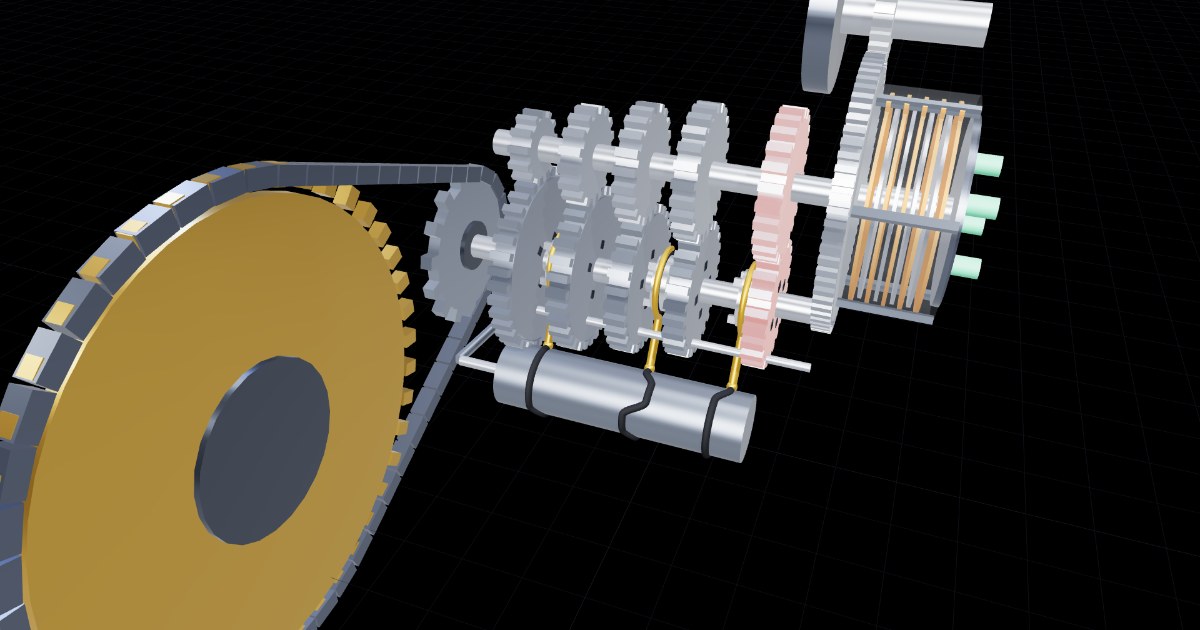
A worm gear slows the motor 240 times; a crank and a link do the rest.
The same motor that spins the blades also swings the head. Behind the motor, the shaft ends in a worm: a screw thread. Each turn of the worm nudges the worm wheel on by just one tooth, so a 60-tooth wheel turns 60 times slower. A small pinion and a bigger gear slow it 4 times more.
The slow output turns a crank under the head. A link joins the crank to a fixed lug on the stand. As the crank goes round, the link pushes and pulls, and because the head sits on a pivot, it swings to one side, stops, and swings back. Turning round and round becomes back and forth.
Pull the knob on top and a little clutch lets the worm wheel slip, so the head stays still. Some fans let you move the link to a different hole to change how wide the swing is.
Bladeless fans, like Dyson's Air Multiplier (2009), hide the blades in the base: an impeller blows air out of a thin slot in a ring, and that jet drags much more air along with it.
The rotor. The rotor spins inside the still ring of coils, the stator, and turns the shaft.
What is the guard for?
It keeps fingers away from the blades while letting air through. The wire cage is open enough for air but too tight for fingers.
At 1,300 rpm, roughly how fast do the tips of 400 mm blades move?
About 100 km/h. Each turn the tip goes π × 0.4 m ≈ 1.26 m. 1,300 turns a minute is about 27 m/s, close to 100 km/h.
Why do fan blades need to be tilted?
So that as they sweep round they push air out of one side. A flat blade slices through the air. A tilted one shoves it sideways, out of the fan.
What happens when a ceiling fan runs in reverse?
It pulls air up towards the ceiling instead of pushing it down. The same tilted blades moving the other way push air the other way.
Doubling the air speed takes about how much more power?
Eight times. The energy the air carries away each second grows with the cube of its speed: 2 × 2 × 2 = 8.
What is the capacitor for in a fan’s induction motor?
It delays the current in a second coil so the field rotates. Two coils peaking one after another make a rotating field. Without it the field only flips, and the motor can’t start.
A fan with a dead capacitor hums but won’t start. What happens if you give the blades a push?
It runs, in whichever direction you pushed it. A flipping field is like two fields turning opposite ways. Once the rotor moves, the one going its way wins.
Why does an induction rotor always turn a little slower than the field?
If it caught up, no current would be induced in the bars and there’d be no push. Currents are only induced while the field sweeps past the bars. That needs a speed difference: slip.
You halve a fan’s speed. What happens to the airflow?
It halves. Airflow grows in step with speed.
You halve a fan’s speed. What happens to the power the blades need?
It drops to an eighth. Power follows the cube of speed: ½ × ½ × ½ = ⅛.
How does a wall regulator change a ceiling fan’s speed?
By changing how much electricity reaches the motor. Less voltage (or, in a BLDC fan, slower switching) means the motor settles at a lower speed. No gears needed.
What does a fan do to the temperature of the air in a room?
Nothing, or warms it very slightly. The motor’s electricity ends up as heat. The cool feeling comes from air moving over your skin.
Why does a breeze feel cool on sweaty skin?
It helps sweat evaporate, which takes heat from your skin. Evaporation soaks up heat. Moving air carries damp air away so more sweat can dry.
When does a fan help least?
In very hot, very humid air. Humid air dries sweat slowly, and air hotter than your skin heats you as it blows past.
Why use a worm gear to swing the head?
It slows the motor down a lot in a tiny space. Each turn of the worm moves the wheel one tooth, so a 60-tooth wheel turns 60 times slower.
What turns the crank’s round-and-round motion into a side-to-side swing?
A link tied to the stand, with the head on a pivot. The link keeps the crank pin a fixed distance from the stand, so the head has to swing to make room.
The motor turns at 1,200 rpm and the gears slow it 240 times. How often does the head swing back and forth?
5 times a minute. 1,200 ÷ 240 = 5 turns of the crank a minute, and each turn is one full swing there and back.
Words worth knowing
Pitch
How steeply a blade is tilted from the plane it spins in. Ceiling fans use about 10 to 14 degrees.
Airflow
How much air a fan moves each minute, in cubic metres per minute. A 1200 mm ceiling fan moves about 200 m³/min.
Induction motor
A motor whose rotor is pushed by currents that the stator's changing magnetic field induces in it.
Capacitor
An electrical part that, in a fan motor, delays the current in one coil so the magnetic field rotates.
Slip
How far an induction motor's rotor lags behind its rotating magnetic field, usually a few percent.
BLDC motor
A brushless motor with magnets on the rotor and electronics that switch the coils. Fans with one use less than half the power.
Fan laws
For the same fan, airflow grows with speed, pressure with speed squared and power with speed cubed.
Evaporative cooling
Cooling by turning a liquid, like sweat, into vapour. The change soaks up heat from the surface.
Fork it. Teach with it.
This box is plain HTML, CSS and JavaScript, with no build step and no accounts. Run it yourself and it sends nothing anywhere. The code is MIT. The words, images and videos are CC BY 4.0, so you can reuse them anywhere if you credit “Glassbox, glassbox.how/e/fanclear”.