Chapter 1
A push or a pull, with a size and a direction
Measure forces in newtons, add them as arrows, and find what is left over.
A force is a push or a pull. Every force has a size and a direction, so we draw it as an arrow: the longer the arrow, the bigger the force. Quantities with a direction are called vectors.
Force is measured in newtons (N). One newton is the push that makes 1 kg speed up by 1 m/s every second. It is about the weight of a small apple (100 g). Lifting a 1 litre bottle of water takes about 10 N; your whole body weighs several hundred.
You can measure a force with a spring scale, or newton meter. Pull on it and the spring stretches in proportion to the force (that's Hooke's law, see HookeClear), so the marks are evenly spaced.
When several forces act on one thing, you add them as arrows: put them tip to tail, and the arrow from the start to the end is the net force (or resultant). Two equal forces in opposite directions add up to zero: the forces are balanced. A pull of 30 N and a push of 40 N at right angles add up to 50 N, not 70 N.
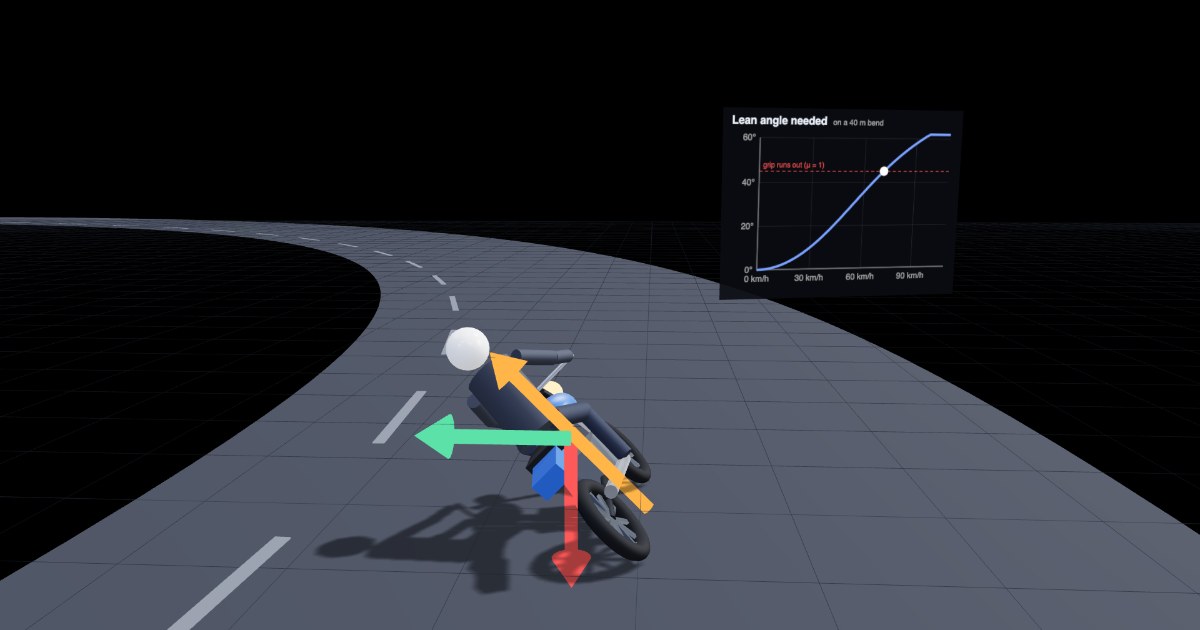
Only the net force changes how something moves: a = F ÷ m, Newton's second law (see NewtonClear). Engineers draw a free-body diagram: one object, with every force on it as an arrow. Here the table pushes up (the normal force) exactly as hard as gravity pulls down (the weight), so those two cancel.