A washing machine doesn't scrub your clothes. It lifts them and drops them about once a second, then spins them so hard the drum wall pushes 400 times harder than gravity. A front-loader has a perforated steel drum that spins inside a still outer tub that holds the water.
A washing machine doesn't scrub your clothes. It lifts them and drops them about once a second, then spins them so hard the drum wall pushes 400 times harder than gravity. Take one apart in 3D and see why it shakes, walks and loves concrete.
WasherClearOpened 17 Jul 202615 min to playFree · no sign-up
In 60 seconds
A drum inside a drum
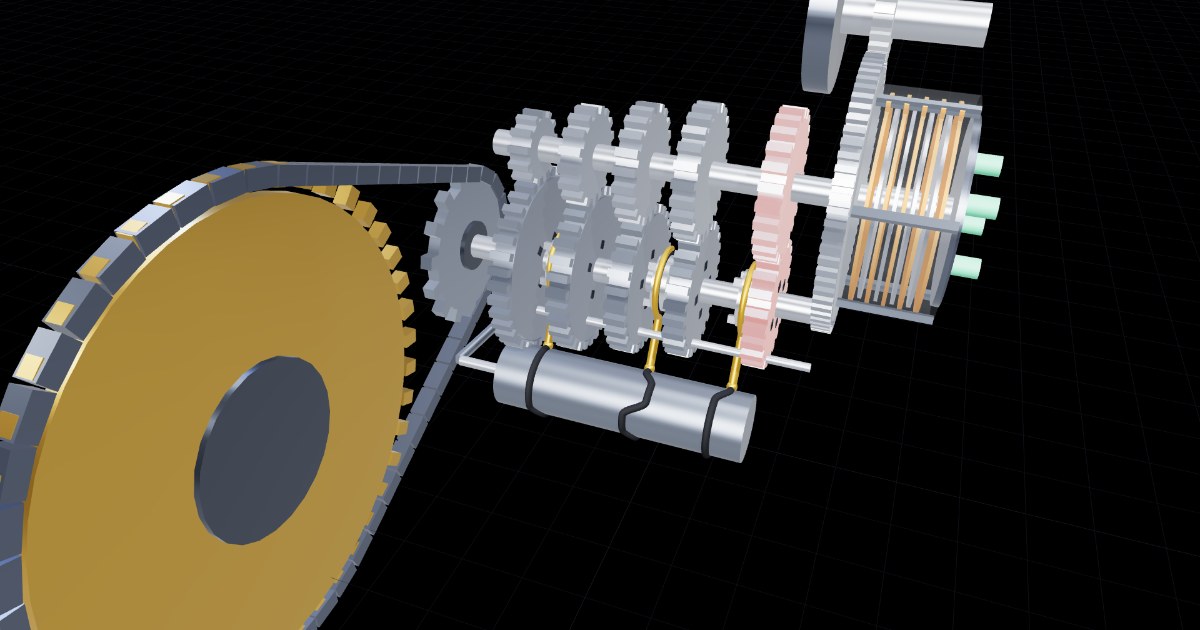
A front-loader has a perforated steel drum that spins inside a still outer tub that holds the water. The tub hangs on springs, sits on dampers and carries concrete. A motor turns the drum, directly or through a belt, while valves, a pressure sensor, a heater and a pump handle the water.
Clothes get clean by falling
Lifters carry the wet clothes up the side and gravity drops them back through the water, about once a second. Above the critical speed ω = √(g/r), about 60 rpm for a 50 cm drum, they would stick to the wall, so machines wash at 40 to 55 rpm.
Detergent grabs grease by its tail
Surfactant molecules have a water-loving head and an oil-loving tail. The tails dig into grease, roll it up and carry it away inside a micelle. Warm water and enzymes help; hard water's calcium fights back, so powders add a builder to catch it.
The spin: 400 times gravity
To swing clothes in a circle the drum wall must push them with a = ω²r. At 1,200 rpm that is about 4,000 m/s², roughly 400 g. Water has nothing pushing it round, so it flies straight out through the holes. Faster spins leave less water, but each step gains less.
Why washers shake and walk
A 1 kg clump of wet clothes at 1,000 rpm pulls on the drum with about 2,700 N. Springs, dampers and 20 to 25 kg of concrete keep the tub from passing that to the floor. The machine checks for imbalance, spreads the load or spins slower, and if too much force still gets through, it walks.
Heating is the big energy cost
Warming 15 litres from 20 to 40 °C takes about 0.35 kWh, far more than turning the drum. A cold wash saves most of the energy. Front-loaders use about 45 to 60 litres a cycle; top-loaders, which float the clothes, often 100 to 150.
A drum inside a tub, hung on springs, with a motor, a pump and a few valves.
Open up a front-loader and you find a drum inside a drum. The inner one is the drum: steel, full of small holes, with three plastic lifters (paddles) inside. It spins. Around it sits the outer tub, which holds the water and never turns.
The tub hangs on springs from the top and rests on shock absorbers below, with heavy concrete counterweights bolted on to keep it steady. A motor on the back turns the drum, either directly (direct drive) or through a belt and pulley.
Water comes in through two electric inlet valves and washes the powder out of the detergent drawer. A pressure sensor measures how deep it is, a heater and thermostat warm it, and a drain pump pushes it out. A door lock keeps the door shut and the control board runs the show.
Many homes in India use a top-loader instead: an upright basket with a spinning disc, the pulsator, in its floor.
Lifters carry the clothes up, and gravity drops them through the water.
A front-loader does not scrub. It lifts and drops. As the drum turns, the lifters carry the wet clothes up the side. Near the top they fall back through the water, slap down, get squeezed, and are lifted again, about once a second. Water and detergent are pushed through the cloth each time.
How high they get depends on speed. The wall pushes the clothes round in a circle, and that push must be at least as big as gravity at the top for them to stay on. The speed where that happens is the critical speed, ω = √(g/r). For a drum 50 cm across that is about 60 rpm. So machines wash at 40 to 55 rpm: fast enough to lift the clothes high, slow enough to let them fall.
A top-loader works differently. Its pulsator swirls the water so the clothes roll over and rub against each other. It needs the basket full of water to do it.
Molecules with a water-loving head and an oil-loving tail.
Water alone can’t shift grease: oil and water don’t mix. Detergent fixes that with a clever molecule, the surfactant. One end, the head, loves water. The other end, a long tail, hates water and loves oil.
In the wash, the tails dig into a grease stain and the heads stay out in the water. More and more crowd on until the grease rolls up into a ball and lets go of the fibre. Now it sits inside a little sphere of molecules, heads out, called a micelle, and the water carries it away.
Warm water softens grease so it rolls up faster. Enzymes in the powder snip up stains: protease for protein (blood, egg), amylase for starch, lipase for fat. But hard water fights back: its calcium grabs the heads and turns them into useless scum. So detergents add a builder that catches the calcium first.
At 1,200 rpm the drum wall pushes about 400 times harder than gravity.
After the last rinse the clothes are heavy with water. So the drum spins fast: 1,000 to 1,400 rpm on a typical front-loader, around 700 rpm on many top-loaders.
To go round in a circle, anything needs a push towards the middle. For the clothes, the drum wall gives that push. The size needed is the centripetal acceleration, a = ω²r, where ω is how fast it turns. At 1,200 rpm in a 50 cm drum that is about 4,000 m/s², roughly 400 g.
The water isn't held that firmly. Nothing pushes it round, so it keeps going straight, out through the holes, and hits the tub. Double the speed and the push is four times bigger, but the last water is stuck deep in the fibres, so each extra 200 rpm gets out less.
One lump of wet clothes at full spin pulls with thousands of newtons.
If the clothes bunch up into one wet clump, the spinning drum is lopsided. To swing that clump round in a circle the drum must pull on it with F = m·ω²·r, and the clump pulls back just as hard. A 1 kg clump at 1,000 rpm pulls with about 2,700 newtons: the weight of 275 kg, whirling round 17 times a second.
That's why the tub hangs on springs and sits on dampers, and carries 20 to 25 kg of concrete. Springs let it wobble without shaking the cabinet, dampers soak up the energy, and the extra mass means the same pull moves it less. Every tub has a speed where it shakes worst, its resonance, around 200 rpm. The machine rushes through it.
Before spinning, the control board checks for imbalance by watching the motor speed wobble. If the load is lumpy it tumbles to spread it out, or it spins slower. If too much force still gets through, the machine walks across the floor.
Heating the water uses far more energy than turning the drum.
Modern machines weigh the load. As the drum starts turning, the control board feels how hard the motor has to work, and fills with just enough water. The pressure sensor tells it when to stop.
Turning the drum takes surprisingly little energy. Heating the water takes lots. Warming 15 litres from 20 to 40 °C needs Q = m·c·ΔT = 15 kg × 4.19 kJ/kg°C × 20 °C, about 0.35 kWh. At 60 °C it is double that, so a cold wash can use a fraction of the energy.
A front-loader only needs enough water to wet the clothes, because tumbling does the work: about 45–60 litres a cycle. A top-loader has to float the load, so it often uses 100–150 litres. Energy labels, like India's BEE star label and Europe's A to G label, rate machines on this.
The outer tub. The drum is full of holes. The still outer tub around it holds the water.
Why is there a block of concrete inside a washing machine?
To add weight to the tub so it shakes less. A heavier tub is pushed around less by a lumpy load, so it wobbles less.
What does an inlet valve do?
Opens with electricity to let tap water in. It is a solenoid valve: current through a coil pulls it open.
How does a front-loader mainly move the clothes?
It lifts them and lets them fall through the water. The lifters raise the clothes, and they drop back through the water again and again.
For a drum of radius 0.25 m, about what is the critical speed?
60 rpm. ω = √(g/r) = √(9.81/0.25) ≈ 6.3 rad/s, which is about 60 turns a minute.
Why does a machine wash at about 50 rpm and not 100 rpm?
At 100 rpm the clothes stick to the wall and stop falling. Above the critical speed the wall holds the clothes all the way round, so they stop tumbling.
Which end of a surfactant molecule sticks into the grease?
The oil-loving tail. The tail hates water and loves oil, so it buries itself in the grease.
What is a micelle?
A tiny ball of surfactant molecules with oil trapped inside. Tails point in around the oil, heads point out into the water.
Why does hard water make detergent work worse?
Its calcium grabs surfactant molecules and makes scum. Each calcium ion ties up two surfactant molecules. A builder catches the calcium first.
What pushes the clothes round in a circle during the spin?
The drum wall. The wall pushes them towards the centre. The water has nothing holding it, so it flies out through the holes.
You double the spin speed. What happens to the push at the wall?
It becomes four times as big. a = ω²r, so twice the speed gives 2 × 2 = 4 times the acceleration.
Why does going from 1,400 to 1,600 rpm remove so little extra water?
The last water is held tightly inside the fibres. Easy water flies off first. What’s left is trapped in tiny gaps in the fibres, which takes much more force to pull out.
A 1 kg clump sits 0.25 m from the middle of a drum turning at 1,000 rpm. About how hard does it pull?
2,700 N. ω ≈ 105 rad/s, so F = 1 × 105² × 0.25 ≈ 2,700 N.
Why is there concrete in the tub?
More mass means the same pull moves it less. The wobble is the pull divided by the mass it acts on, so heavier means steadier.
What does a machine do if it senses a lopsided load?
Tumbles to spread it out, or spins slower. Spreading the clothes evens out the mass; a slower spin makes the pull smaller.
What uses most of the energy in a 60 °C wash?
Heating the water. Warming water takes a lot of energy: 4.19 kJ for every kilogram and every degree.
About how much energy warms 15 L of water from 20 °C to 40 °C?
0.35 kWh. 15 × 4.19 × 20 ≈ 1,260 kJ, and 1 kWh = 3,600 kJ, so about 0.35 kWh.
Why does a front-loader use less water than a top-loader?
It lifts and drops the clothes instead of floating them. Tumbling only needs the clothes wet, not swimming.
Words worth knowing
Drum and tub
The perforated steel drum holds and spins the clothes; the still outer tub around it holds the water.
Lifters
Ribs inside the drum that carry clothes up so they can fall back through the water.
Critical speed
The drum speed at which clothes stay pinned to the wall all the way round: ω = √(g/r), about 60 rpm for a 50 cm drum.
Surfactant
A molecule with a water-loving head and an oil-loving tail: the working part of soap and detergent.
Micelle
A tiny ball of surfactant molecules, tails in and heads out, that can carry oil away in water.
Centripetal acceleration
The push towards the centre that keeps something moving in a circle: a = ω²r.
Resonance
The speed at which a tub on springs naturally shakes the most, around 200 rpm in a front-loader.
Counterweight
Concrete bolted to the tub so an uneven load moves it less.
Specific heat
The energy to warm 1 kg by 1 °C: 4.19 kJ for water, which is why hot washes cost so much.
Fork it. Teach with it.
This box is plain HTML, CSS and JavaScript, with no build step and no accounts. Run it yourself and it sends nothing anywhere. The code is MIT. The words, images and videos are CC BY 4.0, so you can reuse them anywhere if you credit “Glassbox, glassbox.how/e/washerclear”.