Hooke's law: F = k × x. A spring stretches in proportion to the force pulling it: twice the pull, twice the stretch. The number that links them, k, says how stiff the spring is, and the rule holds until you stretch it past its elastic limit.
Pull twice as hard and a spring stretches twice as far. That one line from 1676 weighs your onions, clicks your pen, carries your car and tunes your guitar. Hang masses on 3D springs, bounce a car over a speed breaker, jump off a bridge on a bungee, and stretch steel until it snaps.
Hooke's lawOpened 27 Sept 202612 min to playFree · no sign-up
In 60 seconds
Twice the pull, twice the stretch
A spring stretches in proportion to the force on it: F = k × x. The spring constant k is its stiffness in newtons per metre. Plot force against stretch and you get a straight line whose slope is k. Springs end to end get softer; side by side, stiffer.
Springs store energy and keep time
A stretched spring stores ½ k x², the area under the line. Let a mass bounce on it and each swing takes 2π √(m ÷ k), however big the bounce. That steady beat is why springs regulate watches.
Weighing and clicking
Because stretch is proportional to load, a spring balance can have evenly spaced marks. It measures force, so on the Moon 6 kg of onions reads 1 kg. A click pen's spring pushes back with about 2 N.
Riding on springs
A car's corner spring squeezes about 10 cm under its share of the weight and would bounce about 1.5 times a second, so a damper turns the bounce into heat. A bungee cord stores all the energy of a fall as ½ k x².
Past the elastic limit
Steel obeys Hooke's law only to about 0.1 % stretch. Beyond its yield point it stays stretched, then necks and breaks. Rubber never follows a straight line. And for the same force, a softer spring stores more energy, not less.
Where you'll meet it
F = k × x
force = spring constant × extension: pull twice as hard and it stretches twice as far
The click pen's spring
A small spring round the refill is squeezed about 8 mm when the tip is out, so it pushes back with about 2 N. Click again and it snaps the refill back inside.
About 225 kg rests on each corner spring of a small hatchback. At 22,000 N/m it squeezes about 10 cm, and each passenger adds under a centimetre more on that corner.
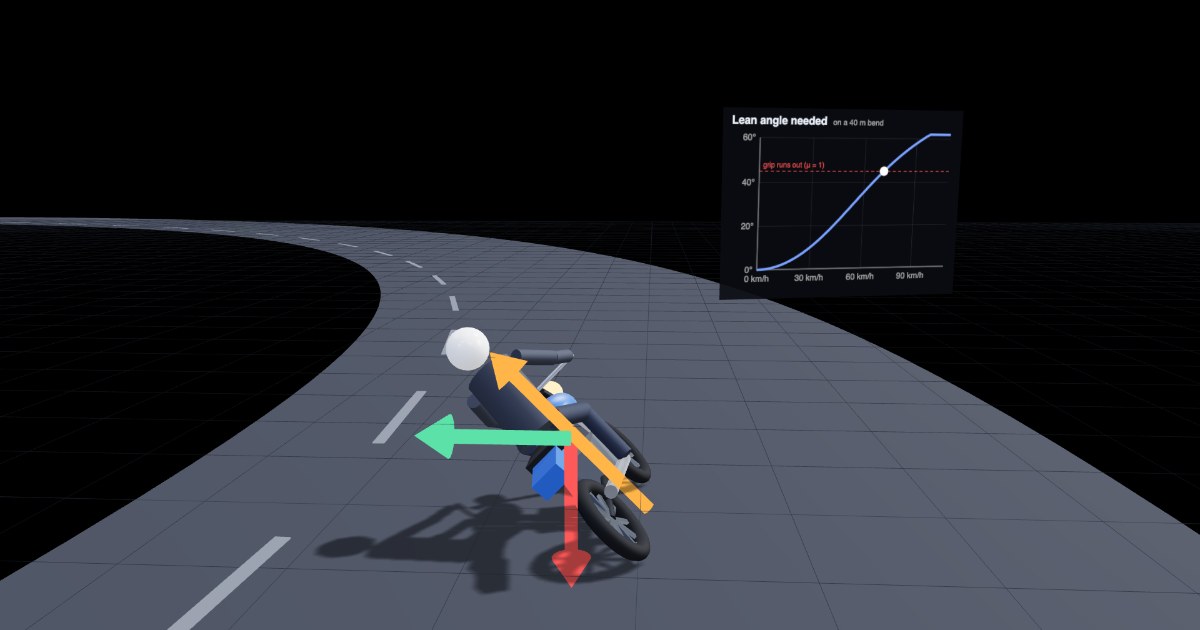
Telescopic forks and rear shocks hold coil springs that squeeze in step with the load, usually set so the bike sags a quarter to a third of its travel with a rider on board. Dampers stop them bouncing.
Each spoke is a stiff steel spring pulled tight, often to about 1,000 N. As the wheel rolls, the spokes at the bottom lose a little tension and spring back, which is how a thin wire wheel carries a rider.
A brass tongue fixed at one end is a tiny diving-board spring. Its stiffness grows with its thickness cubed, and it sings at (1/2π) √(k ÷ m). Solder on the tip lowers the note.
Turning the peg stretches a steel string by a few millimetres. By Hooke's law its tension rises about 13.5 N per millimetre, and the pitch rises with the square root of the tension.
Each piano string is stretched to a tension of roughly 700 to 900 N, only a fraction of a percent of stretch. The frame holds about 20 tonnes of pull in all.
Tightening the straps stretches the skin and raises its tension, and the pitch rises with the square root of the tension. Pressing the bayan's skin with the palm does the same on the fly.
A market spring balance has evenly spaced marks because stretch is proportional to load. A bungee cord is a long, soft spring that stores the fall's energy as ½ k x².
The history
From twisted-sinew catapults to silicon springs in your phone, by way of a 1676 anagram.
Force = stiffness × stretch. Hang masses on springs and watch it hold.
Hang a mass on a spring and it stretches. Hang twice the mass and it stretches twice as far. Three times the mass, three times the stretch. That is Hooke's law: F = k × x.
F is the force pulling the spring, in newtons. A 100 g mass pulls with about 1 N. x is the extension, how much longer the spring gets. k is the spring constant, the stiffness: how many newtons it takes to stretch the spring by one metre. Plot force against extension and you get a straight line whose steepness is k.
Stretching a spring stores energy: E = ½ k x². On the chart it is the area of the triangle under the line. That energy is what flings a catapult and bounces a mass back up.
Join springs end to end (in series) and each one carries the whole load, so the stretches add: two springs act like one spring half as stiff. Hang them side by side (in parallel) and they share the load: two act like one twice as stiff.
Pull the mass down and let go, and it bounces. One swing takes T = 2π √(m ÷ k), and the surprise is what's missing: the size of the swing. Big bounce or small, the timing is the same. That's why springs keep time in watches, and it is the start of Waves and resonance.
A market balance and a click pen: both trust F = k × x.
A spring balance is Hooke's law turned into a tool. Hang a bag of onions on the hook and the spring stretches in proportion to the pull. Because the stretch is proportional to the force, every extra kilogram moves the pointer the same distance, so the scale can be printed with evenly spaced marks. Richard Salter was making spring balances in England by about 1770, and the hanging balance is still used in markets and for weighing luggage.
Our balance reads 10 kg over 10 cm of stretch, so its spring has k = 98.1 N ÷ 0.1 m ≈ 980 N/m.
Here's the catch: a spring feels force, not mass. Take it to the Moon, where gravity is about a sixth as strong, and 6 kg of onions reads just 1 kg. A kitchen pan balance, which compares two masses, would read 6 kg anywhere.
Inside a click pen (see PenClear), a little spring sits round the front of the refill. Press the button and you squeeze it about 8 mm, so it pushes back with about 2 N, the weight of a small apple. The click mechanism locks the refill out. Click again, the lock lets go, and the squeezed spring snaps the tip back inside.
Car suspension and a bungee cord: stretch, store, give it back.
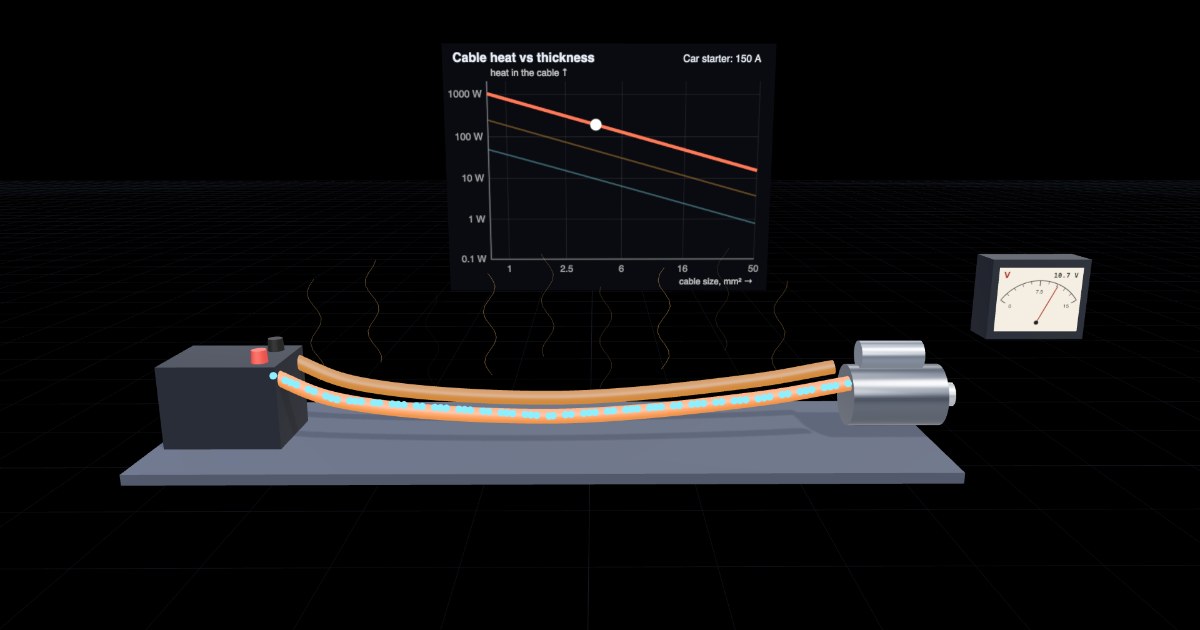
Every wheel of a car sits under a coil spring (see CarClear). A small hatchback puts about 225 kg on each one. With a spring of k = 22,000 N/m, Hooke's law says it squeezes x = F ÷ k ≈ 10 cm. Each passenger adds a little more: about 8 mm per person on this corner. Load the boot and the car sits lower in a perfectly straight-line way.
Hit a speed breaker and the spring squeezes, soaking up the jolt, then gives the energy back. On its own it would keep bouncing about 1.5 times a second, T = 2π √(m ÷ k). So every spring has a partner, the shock absorber or damper: oil forced through small holes turns the bounce into heat. Motorbikes use the same pair in their forks and rear shocks, and a washing machine hangs its drum on springs and dampers too (see MotorcycleClear and WasherClear).
A bungee cord is a very long, soft spring. Jump from a 43 m bridge on a 12 m cord and you fall freely for 12 m. Then the cord starts to stretch and pull. By the bottom, all the energy of your fall, m g h, has been stored in the cord as ½ k x². Heavier jumpers stretch it further, so crews pick a stiffer cord for them.
A harmonium reed and a guitar string are springs that keep time.
Every note of a harmonium comes from a thin brass tongue, fixed at one end over a slot (see HarmoniumClear). Push its tip and it bends in proportion to the push, F = k × x: it is a tiny diving-board spring. Let go and it swings back and forth, just like the mass on a spring in chapter 1, at f = (1/2π) √(k ÷ m).
So a reed maker has two knobs. Stiffness: a tongue's k grows with its thickness cubed and falls with its length cubed. Twice as thick is 8 times stiffer. Mass: a dab of solder at the tip adds mass and lowers the note. Scraping metal off the tip raises it.
A guitar string is a spring too, a very stiff one. Turning the tuning peg winds the string round its post and stretches it by a few millimetres. By Hooke's law the tension rises in step, about 13.5 N for every millimetre on a thin steel E string. The note climbs with the square root of the tension (see GuitarClear). A piano does the same with far thicker wire: each string pulls with 700 to 900 N (see PianoClear), and a tabla player tightens the drumhead's straps for the same reason.
Steel that stays stretched, rubber that curves, and a myth about stiff springs.
Hooke's law is a promise with small print: it holds only for small stretches. Engineers write it for materials as stress = E × strain. Stress is force per area; strain is stretch per length; E is Young's modulus, the stiffness of the stuff itself. Steel's is about 200 GPa. Rubber's is roughly 0.001 to 0.1 GPa, thousands of times floppier.
Steel. Pull a steel bar and it obeys Hooke's law perfectly, but only up to about 0.1 % stretch. That is the elastic limit, or yield point. Let go before it and the bar returns exactly to its length. Go past it and the atoms start to slide: it stays stretched (plastic deformation). Keep pulling and it can stretch 20 % or more, thin in the middle (necking) and finally break. That is why an over-stretched spring never goes back.
Rubber never had a straight line. A band stretches easily at first, then stiffens sharply near six times its length. And it pulls back less than you pulled it out: that lost energy becomes heat. Stretch a band fast against your lip and feel it warm up. A bungee cord is rubber, which is why crews test and change cords so often.
Myth-buster: “A stiffer spring stores more energy.” Not for the same force! Hang the same weight on a soft and a stiff spring: the soft one stretches further, and energy is F² ÷ 2k, so it stores more. That is why archers and catapult builders chase long, springy draws. Only when you stretch both the same distance does the stiff one win.
A spring stretches 4 cm with a 200 g mass. How far with 600 g (still within its limit)?
12 cm. Extension is proportional to force. Three times the mass, three times the stretch: 12 cm.
Two identical springs are hung end to end. Compared with one spring, the pair is…
half as stiff. Each spring carries the whole load, so each stretches the full amount and the stretches add. k_eff = k ÷ 2.
You double the mass on a bouncing spring. The time for one bounce…
grows about 1.4 times (√2). T = 2π √(m ÷ k), so doubling m multiplies T by √2 ≈ 1.41.
Why are the marks on a spring balance evenly spaced?
The stretch is proportional to the force, so each kilogram adds the same stretch. F = k × x. Double the load, double the stretch, so equal steps of load are equal steps along the scale.
You weigh 6 kg of onions with a spring balance on the Moon. It reads about…
1 kg. The spring measures force. Moon gravity is about a sixth of Earth’s, so the pull, and the reading, is about a sixth: 1 kg.
A pen spring has k = 250 N/m and is squeezed 8 mm. How hard does it push?
2 N. F = k × x = 250 N/m × 0.008 m = 2 N.
A car’s corner spring has k = 20,000 N/m. Adding 40 kg on that corner makes it sink about…
2 cm. x = F ÷ k = (40 × 9.81) ÷ 20,000 ≈ 0.02 m, about 2 cm.
What does a shock absorber do?
It turns the spring’s bouncing into heat so the car settles quickly. Springs store and return energy, so alone they bounce. The damper’s oil turns that energy into heat.
At the lowest point of a bungee jump, where has the energy of the fall gone?
Into stretch energy in the cord, ½ k x². At the bottom the jumper is still for an instant. Nearly all the height energy m g h is stored in the stretched cord.
A reed tongue is made twice as thick. Its stiffness becomes…
8 times as much. A cantilever’s stiffness grows with thickness cubed: 2³ = 8.
A tuner adds a dab of solder to a reed’s tip. The note…
goes down. f = (1/2π) √(k ÷ m). More mass at the tip, lower frequency.
A steel string stretches 13.5 N per mm. To reach 72 N of tension, how far must the peg stretch it?
About 5 mm. x = F ÷ k = 72 ÷ 13.5 ≈ 5.3 mm, about a quarter turn of the tuning post.
A steel bar is stretched past its yield point, then released. It…
stays a little longer for good. Past the elastic limit, the metal deforms plastically. It springs back only by σ ÷ E and keeps the rest of the stretch.
Steel’s Young’s modulus is about…
200 GPa. About 200 billion pascals. You need 200 MPa of stress for just 0.1 % of stretch.
Hang the same weight on a soft and a stiff spring. Which stores more energy?
The soft one. Same force: E = F² ÷ 2k. Smaller k, more energy, because the soft spring stretches further.
Words worth knowing
Hooke's law
The force on a spring is proportional to its extension: F = k × x.
Spring constant
A spring's stiffness, k, in newtons per metre: the force needed for each metre of stretch.
Extension
How much longer or shorter a spring is than its natural length.
Elastic energy
Energy stored in a stretched spring: ½ k x², the area under the force–extension line.
Period
The time for one bounce of a mass on a spring: T = 2π √(m ÷ k).
Young's modulus
A material's own stiffness: stress ÷ strain. About 200 GPa for steel.
Elastic limit
The largest stretch or stress after which a material still springs fully back.
Plastic deformation
A permanent change of shape once the elastic limit is passed.
Fork it. Teach with it.
This box is plain HTML, CSS and JavaScript, with no build step and no accounts. Run it yourself and it sends nothing anywhere. The code is MIT. The words, images and videos are CC BY 4.0, so you can reuse them anywhere if you credit “Glassbox, glassbox.how/e/hookeclear”.