How does a harmonium work?

Every note on a harmonium is a thin brass tongue buzzing through a slot, fed by air you pump with one hand. An Indian harmonium is a wooden box with a keyboard on top and a hinged bellows at the back.

Every note on a harmonium is a thin brass tongue buzzing through a slot, fed by air you pump with one hand. Take one apart in 3D, scrape a reed to tune it, pull the stops, hear why its fixed notes got it banned from All India Radio, and play it with your keyboard.

HarmoniumClearOpened 31 Jul 202612 min to playFree · no sign-up

In 60 seconds

  1. A box of reeds and a bellows

    An Indian harmonium is a wooden box with a keyboard on top and a hinged bellows at the back. Inside sit a spring-loaded reservoir of air, a reed board with rows of brass reeds in little cells, a padded valve (a pallet) under every key, and stop knobs that choose which rows get air.

  2. A brass tongue that chops the air

    Each note is a free reed: a thin brass tongue riveted over a slot. Air pushes it through, it springs back, and every swing lets out a puff. It swings at its natural frequency, f = 0.56·(t/L²)·√(E/12ρ), so a longer tongue is much lower. Makers tune by scraping: the tip to go up, the root to go down.

  3. Pump, store, squeeze

    Your hand pushes air through a one-way valve into a reservoir held shut by springs. The springs keep the wind at about 0.5 to 1.5 kPa, only 1% above the room's pressure. Every open reed lets out about 0.07 L/s, so big chords drain it fast. Pump harder and it plays louder: that is its only volume control.

  4. Pull a stop, add a voice

    Each stop opens a bank of reeds: bass an octave down, male at the key's pitch, female an octave up. Their harmonics stack and beat gently, and a musette bank tuned a few cents sharp beats a few times a second. Drone stops hold Sa and Pa without any key.

  5. Fixed notes in a sliding music

    The reeds are tuned once, usually to equal temperament: Ga is 400 cents above Sa, while the pure 5/4 Ga that singers lean to is 386. Held together they beat about ten times a second. A scale changer slides the keyboard over the reeds to change key without changing fingers.

  6. From church organ to every stage in India

    Missionaries brought pedal reed organs; in Calcutta, Dwarkanath Ghose is widely credited with the hand-pumped floor harmonium by 1875. It spread to bhajan, kirtan, qawwali, theatre and film. All India Radio banned it from 1 March 1940, and partly lifted the ban in 1971. Masters like Tulsidas Borkar made it a solo voice.

Laws at work here

The history

More than 3,000 years from a Chinese mouth organ with tiny bamboo reeds, through the parlours and churches of Europe, to the hand-pumped box that sings with India's temples, gurdwaras, qawwalis and film songs.

Read the full history
  1. 1300 BCEThe sheng: the first free reeds
  2. 1840The harmonium gets its name
  3. 1875The hand-pumped harmonium
  4. 1940All India Radio bans the harmonium
  5. 1985Nusrat's party wins over the world

The full explanation

HarmoniumClear, chapter by chapter

Chapter 1

A box of brass reeds and a bellows

Keys, valves, reeds, stops and two bellows: follow the air.

An Indian harmonium is a wooden box about the size of a small suitcase. You pump air with one hand and play the keys with the other.

At the back is the bellows, a hinged flap you swing open and shut. Each push forces air through a one-way valve into an inner reservoir, a second bellows held shut by springs. The springs squeeze the air, so it waits under a small, steady pressure.

Above the reservoir sits the reed board: rows of little chambers called reed cells, each holding a brass reed. There is one row, or bank, of reeds for each voice. Pressing a key lifts a padded valve, the pallet, and the air rushes out through that key's reeds. Stop knobs choose which banks get air. The sound escapes through the grill.

No pipes and no strings: each note is a tiny brass tongue buzzing in a slot. Unlike a flute, where the air in a tube sets the note (see FluteClear), here the reed sets it.
Try “Inside the box” in the interactive model →

Chapter 2

A brass tongue that chops the air

Every note is a tiny springboard swinging through a slot.

Each reed is a thin brass tongue, riveted at one end over a slot cut in a brass plate. The tongue fits the slot so closely that you can barely see light around it.

Air under pressure pushes the tongue into the slot. Like a diving board, it bends, then springs back, overshoots and swings through again. Each time the tongue leaves the slot, a gap opens and a puff of air escapes. Hundreds of puffs a second are the sound. It is called a free reed because the tongue swings freely through its slot, instead of beating against a frame like a clarinet reed. How fast the air squeezes through the gap follows Bernoulli's rule (see BernoulliClear).

The tongue swings at its own natural frequency, like a ruler twanged on a desk. For a strip clamped at one end, f = 0.56 · (t / L²) · √(E / 12ρ): thicker is higher, and longer is much lower, because length counts twice. Brass gives about 580 × t / L².

Makers tune a reed by scraping it. Scrape near the tip and you remove weight where it swings most, so the pitch goes up. Scrape near the root and you weaken the spring, so the pitch goes down.

Try “The free reed” in the interactive model →

Chapter 3

Pump, store, squeeze

A spring-loaded reservoir turns uneven pumping into steady wind.

Your hand can't push air perfectly evenly. So a harmonium has two bellows. The one you pump, at the back, swings open to suck in room air through a flap valve, then you push it shut and the air is forced through a one-way valve into the reservoir inside.

The reservoir is a second bellows held shut by springs. As it fills, its top board rises and the springs push back harder. Their push, spread over the board, is the wind pressure: about 0.5 to 1.5 kilopascals, the weight of a 5 to 15 cm column of water. That is only about 1% above the air around us, but it is plenty to make a reed speak.

Every open reed lets air out, about a tenth of a litre each second. Hold a chord on three banks and nine reeds drain the reservoir quickly, so you must pump faster. Stop pumping and the springs keep the sound going for a few seconds, then the pressure falls and the reeds stop speaking. Pump harder and the reservoir sits fuller, the pressure rises, and the harmonium plays louder: that is its only volume control.

Try “Bellows and pressure” in the interactive model →

Chapter 4

Pull a stop, add a voice

Bass, male and female reeds, a sharp musette and humming drones.

Under every key sit several reeds, one in each bank. The stop knobs slide shutters that let air into a whole bank, or keep it out.

On a three-reed harmonium the banks are named like voices. The male reeds sound the note you see on the key. The bass reeds sound an octave lower, with long, heavy tongues. The female reeds sound an octave higher. Add them together and one key plays two or three reeds at once, for a fuller, richer sound.

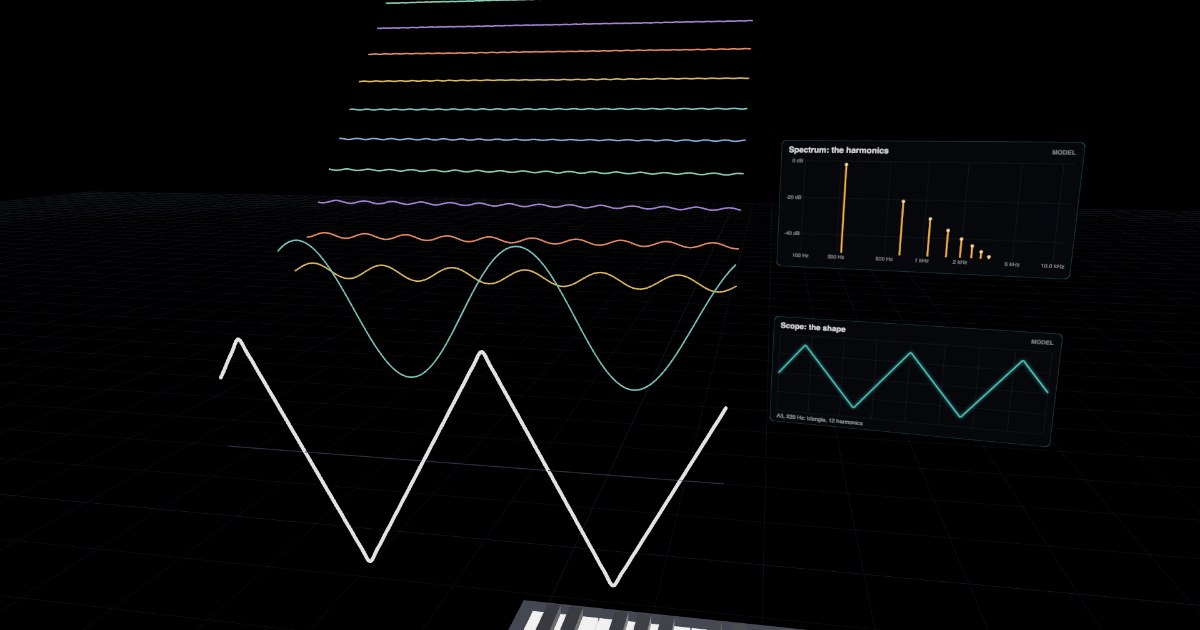
Each reed gives a whole ladder of harmonics: 2, 3, 4 … times its frequency. An octave bank adds reeds whose harmonics land right on top of the male reed's, so the chart gets taller rather than more crowded. Reeds are never tuned exactly the same, so their harmonics beat slowly against each other and the sound shimmers. Some harmoniums add a second male bank tuned a few cents sharp on purpose. This musette gives a wavy, accordion-like beat of a few times a second.

Drone stops open extra reeds that sound all by themselves while the stop is out, usually Sa and the Pa below it, so a singer always hears the home note.

Try “Stops and banks” in the interactive model →

Chapter 5

Twelve fixed notes, and the notes in between

Equal temperament, pure intervals, and the scale changer.

A singer or a sarangi player can slide to any pitch. A harmonium can't: each key has reeds tuned once, in the factory. Most are tuned to equal temperament (12-TET), the same system as a piano, where every semitone is exactly 100 cents (see PianoClear).

Equal temperament is a clever compromise. It lets you play in any key, but only the octave is truly pure. The pure intervals, which singers settle into naturally, are simple ratios: Pa is 3/2 of Sa (702 cents), Ga is 5/4 (386 cents, not 400). Hindustani music goes further, with shrutis, finer pitches that shift from raga to raga, and slides (meend) between notes.

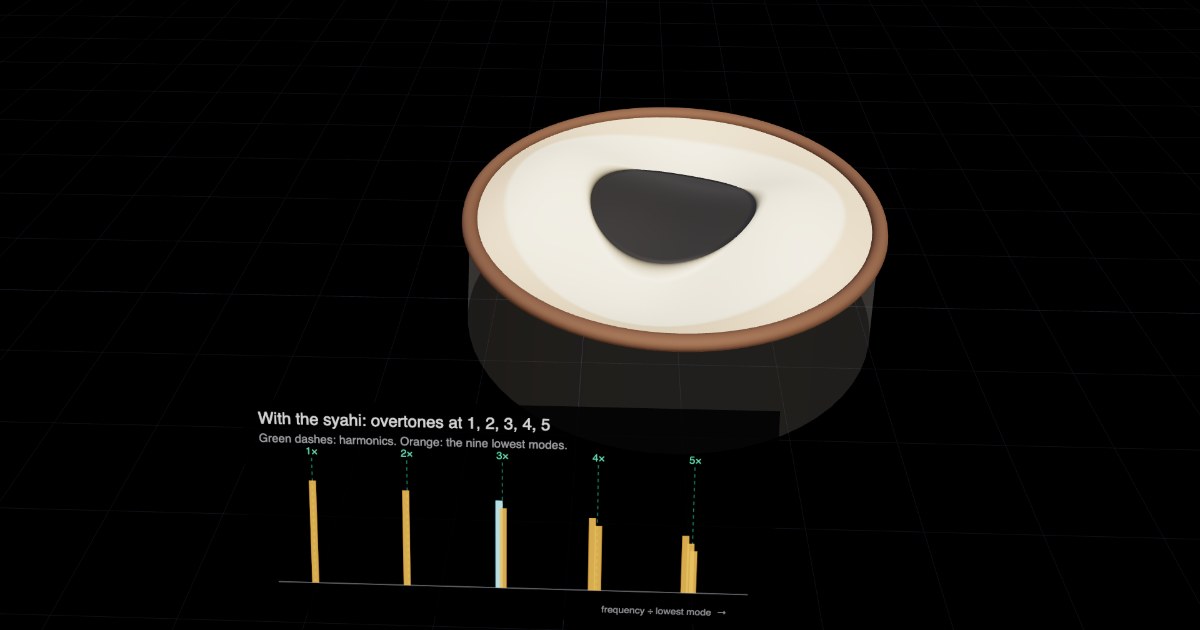
When two notes are a little off a pure ratio, their harmonics clash and beat. An equal-tempered Sa and Ga on a harmonium beat about ten times a second. This is why many musicians, including Rabindranath Tagore and the British critics behind the 1940 ban on All India Radio, called it the wrong instrument for Indian music. Players answer with how they play: short notes, graces, and following the singer.

Many harmoniums have a scale changer: the whole keyboard slides sideways over the reed board, so the key you play as Sa can sound a different reed. You keep your fingering and the singer gets their own pitch.

Try “Tuning and shrutis” in the interactive model →

Chapter 6

From church organ to every stage in India

Pumped with one hand, played on the floor, heard in every kind of music.

European reed organs stood on the floor with foot pedals. Missionaries and traders brought them to India in the 1800s, but Indian musicians sit on the floor. In Calcutta, Dwarkanath Ghose of Dwarkin & Son, who opened his firm in 1875, is widely credited with the answer: a small box with a bellows at the back pumped by hand, and drone stops for Indian music.

It was cheap, easy to carry, loud enough for a crowd and always in tune with itself. Within a few decades it was everywhere: bhajan and kirtan, the Sikh kirtan of the gurdwaras, Sufi qawwali (think of Nusrat Fateh Ali Khan's party), Marathi and Parsi theatre, and later film songs.

Not everyone was happy. Its fixed, equal-tempered notes can't glide or match the shrutis, and from 1 March 1940 All India Radio banned it from its music broadcasts. The ban was only partly lifted in 1971. Meanwhile great players showed what it could do: Govindrao Tembe, Appa Jalgaonkar, Manohar Chimote, and Tulsidas Borkar, who received the Padma Shri in 2016.

Try “The harmonium in India” in the interactive model →

Test yourself

Frequently asked

What actually makes the sound in a harmonium?

Small brass reeds buzzing in slots. Each note is a brass tongue that swings through a slot and chops the airflow into puffs.

What does the spring-loaded reservoir do?

It stores air and keeps its pressure steady between pumps. The springs squeeze the stored air, so the pressure stays steady even between strokes of the bellows.

What happens when you press a key?

A pallet valve opens and air flows through that key’s reeds. The key lifts a padded pallet. Air under pressure escapes through the reeds for that note, and they sound.

A reed tongue is made twice as long, with the same thickness. What happens to its note?

It drops to a quarter, two octaves lower. f depends on t/L². Doubling L divides f by four: two octaves down.

A reed is a little flat. Where should the tuner scrape?

Near the tip. Scraping the tip removes mass where the tongue moves most, so it swings faster and the pitch rises.

Why is it called a “free” reed?

The tongue swings through its slot without hitting the frame. Unlike a clarinet reed, which beats against the mouthpiece, a free reed passes cleanly through its slot.

Why does a harmonium have a second, spring-loaded bellows inside?

To store air and keep the pressure steady between pumps. The reservoir smooths out your pumping. Its springs keep squeezing the stored air, so the wind stays steady.

You hold a chord on three reed banks instead of one. What changes?

The reservoir drains about three times faster, so you pump harder. Three banks means three times as many open reeds, and every reed lets air out.

How does a harmonium player play louder?

Pump harder so the reservoir is fuller and the pressure higher. Key speed makes no difference. More wind pressure makes the reeds swing wider and louder.

The male reed for a key plays 262 Hz. What do its bass and female reeds play?

131 Hz and 524 Hz. Bass is an octave below (half the frequency) and female an octave above (double).

A musette reed plays 3 Hz higher than the male reed. What do you hear?

One note that swells and fades 3 times a second. Two close frequencies beat. The beat rate is their difference: 3 times a second.

What does a drone stop do?

Opens a reed that keeps sounding without any key pressed. A drone reed has its own always-open valve, so it hums the home note under the music.

On an equal-tempered harmonium, how far is Ga above Sa, and how far is a pure Ga (5/4)?

400 and 386 cents. Equal temperament makes four semitones exactly 400 cents. The pure ratio 5/4 is 386 cents, 14 cents lower.

What does a scale changer do?

Slides the keyboard over the reeds so each key sounds a different reed. It moves the keys relative to the reed board by whole semitones. Same fingers, different pitch.

Why did some musicians criticise the harmonium for Indian music?

Its fixed, equal-tempered notes cannot bend or match shrutis. Its pitches are fixed and slightly impure, and it cannot slide between notes like a voice.

How is an Indian hand harmonium usually played?

Sitting on the floor, pumping with one hand and playing with the other. Indian musicians sit on the floor, so the pedal organ became a box you pump by hand from the back.

Why did All India Radio ban the harmonium from 1940?

Its fixed, equal-tempered tuning was thought wrong for Indian music. Critics said its fixed Western tuning could not play the shrutis and slides of Indian music.

Which of these does NOT usually use the harmonium?

A Carnatic veena recital. The harmonium is everywhere in North Indian and Pakistani devotional and light music, but rarely used in Carnatic concerts.

Words worth knowing

Free reed
A springy tongue that swings freely through a slot, chopping airflow into puffs. Used in harmoniums, accordions, harmonicas and the sheng.
Natural frequency
The rate an object vibrates at by itself, set by its stiffness and its mass.
Cantilever
A beam fixed at one end and free at the other, like a diving board or a reed tongue.
Reservoir
The inner, spring-loaded bellows that stores air and keeps the wind pressure steady.
Pallet
The padded valve under each key that lets air through that key's reeds.
Stop
A knob that opens or closes the air to one bank of reeds, or to a drone reed.
Beats
The slow swell and fade when two nearly equal frequencies sound together. The beat rate is their difference.
Equal temperament
Tuning where every semitone is exactly 100 cents, so every key works but only octaves are pure.
Shruti
A fine step of pitch in Indian music, finer than a semitone; tradition counts 22 in an octave.

Fork it. Teach with it.

This box is plain HTML, CSS and JavaScript, with no build step and no accounts. Run it yourself and it sends nothing anywhere. The code is MIT. The words, images and videos are CC BY 4.0, so you can reuse them anywhere if you credit “Glassbox, glassbox.how/e/harmoniumclear”.

git clone https://github.com/bdeeps/harmoniumclear.git

Built with three.js (MIT), Geist, Instrument Serif (SIL OFL 1.1).

←→ previous / next box · / search

Would you like to see the full page, with the interactive model?