Nothing inside a flute moves: a jet of breath flips in and out across a sharp edge and the air in the tube does the singing. A bansuri is a bamboo tube with a cork at the top, a hole to blow across and six burnt finger holes.
Nothing inside a flute moves: a jet of breath flips in and out across a sharp edge and the air in the tube does the singing. Play a bamboo bansuri and a silver concert flute in 3D, cover the holes, and blow hard enough to jump an octave.
FluteClearOpened 29 Jul 202612 min to playFree · no sign-up
In 60 seconds
A tube, a hole and some fingers
A bansuri is a bamboo tube with a cork at the top, a hole to blow across and six burnt finger holes. A concert flute is the same idea in silver, in three joints, with Theobald Boehm's padded keys to close holes too big and far apart for bare fingers.
A reed made of air
You blow across the hole, not into it. The thin jet of breath hits the far edge and flips in and out of the tube hundreds of times a second, in step with the air inside. Nothing solid vibrates: the jet is an air reed. Its speed comes from your mouth pressure, U = √(2p/ρ).
The air column sets the note
A flute is open at both ends, so its air rings with a pressure node at each end and half a wavelength along the tube: f = v/2L, plus small end corrections. It also rings at 2f, 3f and 4f. A clarinet, closed at one end, only has the odd ones and sounds an octave lower.
Open a hole, shorten the tube
An open finger hole lets the wave out, so the pipe acts as if it ends just past the hole and the note rises. A smaller or half-covered hole lets less out, so the note sits lower: bansuri players use half-holes for komal notes and slides.
Blow harder, jump an octave
The jet has to cross the hole in the right time for a mode. Blow faster, or bring your lips closer to the edge, and the flute jumps to its second mode, an octave up, then to a twelfth and two octaves. That is how six holes cover more than two octaves.
Bamboo, ragas and keys
A bansuri is named by its Sa, with the top three holes closed. Pannalal Ghosh made the long bansuri a concert instrument and Hariprasad Chaurasia took it round the world. Its music lives between the notes, in meend and gamak. Boehm's keys of 1847 took the other road: a clean chromatic scale.
A tube, a hole to blow across, and holes for your fingers.
A flute is one of the simplest instruments there is: a tube of air with a hole to blow across. Nothing inside it moves. The sound is made by the air itself.
The Indian bansuri is a single length of bamboo. Near the top is the embouchure hole you blow across. Above it a cork or plug closes the tube. Below it are six finger holes, burnt through with a hot iron rod, and the far end is simply open.
The Western concert flute is the same idea in silver, in three parts. The head joint has a curved lip plate around the embouchure hole, with a cork and a crown at the end. The body and the foot joint carry Theobald Boehm's keys: padded cups that close holes too big and too far apart for bare fingers.
The edge tone: breath split on a sharp edge drives the air in the tube.
You don't blow into a flute. You blow across it. Your lips make a thin, flat jet of air that crosses the embouchure hole and hits its sharp far edge.
A jet hitting an edge is unstable. The smallest wobble grows as it travels, so the jet swings to one side of the edge, then the other: into the tube, then out over the top. That flip-flop is called an edge tone. On its own it is a faint hiss or whistle.
Inside a flute the tube takes charge. Air sloshing in and out of the hole pushes the jet at just the right moments, and the jet pumps the tube back in step. The jet works like a reed made of air, an air reed: no solid part vibrates at all. How fast the jet goes comes from your mouth pressure (Bernoulli's rule, U = √(2p/ρ), see Bernoulli's principle). The jet's journey time across the gap has to suit the note, so a faster jet or lips closer to the edge pick a higher mode.
The note comes from the air inside the tube. Squeeze the air at one spot and the squeeze races along at the speed of sound, about 343 m/s at 20 °C, reflects at the ends and comes back. When the timing is right the reflections line up into a standing wave: the air sloshes back and forth in step.
A flute is open at both ends. The far end is open, and the embouchure hole acts like an open end too. At an open end the air can move freely but the pressure can't build up, so the pressure is zero there (a node). The simplest wave fits half a wavelength in the tube, so f = v / 2L. The air also sticks out a little past each end, so we add an end correction of about 0.6 × the tube's radius.
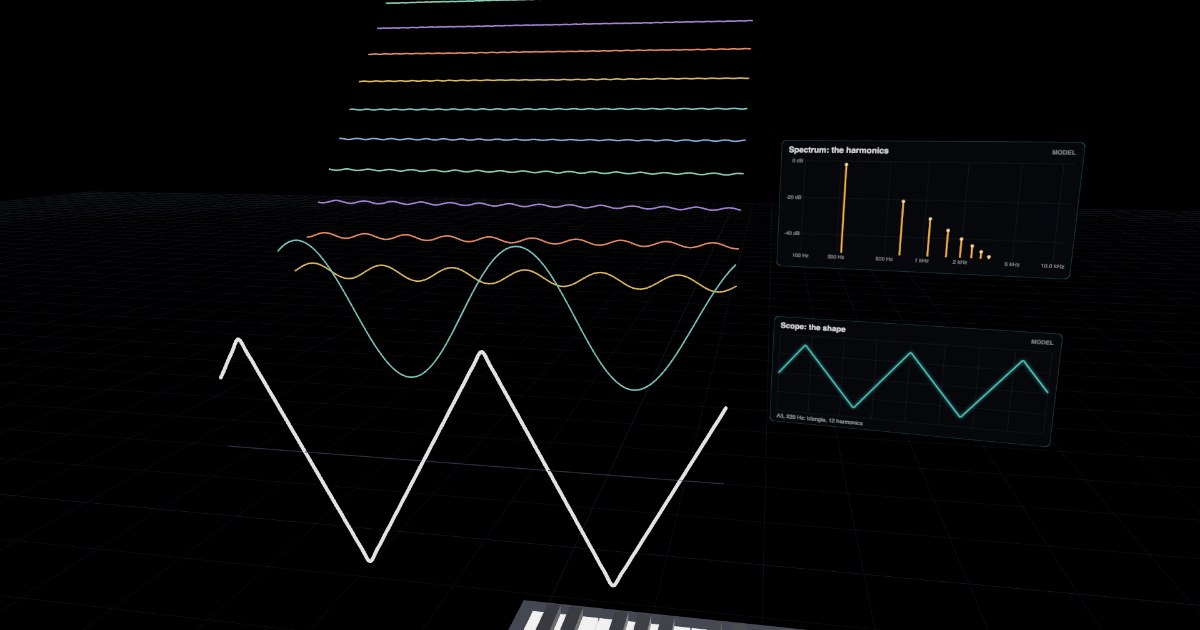
The same tube can also hold 2, 3, 4… half-waves: the harmonics 2f, 3f, 4f. A clarinet is closed at the mouthpiece end, so it only fits a quarter wave and its odd multiples: f = v/4L, then 3f, 5f. That's why a clarinet sounds an octave lower than a flute of the same length. Warm breath makes sound travel faster, so a flute goes sharp as it warms up. (For more on standing waves, see Waves and resonance, and for how notes are named, PianoClear.)
With every hole closed, the bansuri's air column runs the full length of the bamboo and plays its lowest note. Open a hole and the sound wave inside finds an easy way out. The pipe now acts as if it ends a little past that hole, so it is shorter and the note is higher.
That's why the notes climb as you lift your fingers from the bottom up. On a bansuri, the top three holes closed give Sa, the home note. Lift one more finger each time for Re, Ga, Ma. Close all six and you get Pa below Sa; open them one by one from the bottom for Dha and Ni.
A small hole doesn't let the wave out as easily as a big one, so the tube seems longer: the note is lower. Half-holing uses this. Cover part of the next hole and the pitch slides down in between, which is how a bansuri player finds komal (flat) notes like komal Ga. Closing a hole below an open one (a cross-fingering) also pulls the note down a little. At high frequencies the waves stop noticing the open holes and run past them: above the tone-hole cutoff the tube lets sound out all along, which shapes the flute's tone.
Same fingers, faster jet: the tube’s next mode takes over.
Keep your fingers still and blow a little harder. Suddenly the flute jumps up an octave. This is overblowing, and it's how a flute gets its second and third octaves with the same few holes.
The tube can ring in several modes: the whole length (mode 1), halves (mode 2, twice the frequency), thirds (mode 3) and so on. Which one sounds is picked by the jet. A faster jet crosses the hole sooner, and that timing suits a higher mode. So with more breath, and lips a little closer to the edge, the flute climbs: mode 2 is an octave up, mode 3 is an octave and a fifth (a twelfth), mode 4 is two octaves.
On the concert flute, Boehm's tapered head joint keeps the upper modes well lined up with the lowest one, and players use special fingerings for the third octave. The bansuri is a plain bamboo tube with no lip plate, so the player's lips alone set the jet's length and angle. Its second octave needs a steadier, more precise breath: blow a bit too hard and it cracks up, too soft and it falls back down.
Bamboo, fire and breath: meend, gamak and the long flute.
A bansuri starts as a length of bamboo: straight, evenly round, with thin walls and no knots along the playing length. Makers dry it for months so it won't crack. The finger holes aren't drilled but burnt through with a red-hot iron rod, which leaves smooth, sealed edges. The tube is oiled and bound with silk thread so it doesn't split.
A bansuri is named by its Sa, the note with the top three holes closed. The E bass bansuri gives Sa = E. A bigger bamboo gives a lower Sa and a deeper voice. In the 1930s and 1940s Pannalal Ghosh made the bansuri a concert instrument for ragas: he made it much longer, about 32 inches, and added a seventh hole for an extra low note. Hariprasad Chaurasia (born 1938) later carried it to concert halls all over the world.
Indian music lives between the notes. In a meend the player slides a finger slowly over a hole, so the note glides smoothly to the next. In a gamak the note is shaken hard between neighbours. The komal (flat) notes come from half-holing. The concert flute solves the same problem the other way: Theobald Boehm's keys of 1847 give every semitone its own hole, so it plays a clean chromatic scale but can't slide.
The air inside the tube. A flute has no reed and the lips don’t buzz. The column of air inside the tube vibrates, kept going by the jet of breath.
What closes the top end of a bansuri, just above the blowing hole?
A cork or plug. A cork, or a natural node of the bamboo, closes the tube a little above the embouchure hole.
Why does the concert flute need keys when the bansuri doesn’t?
Its holes are too big and too far apart for bare fingers, and it has more of them. Boehm put large holes exactly where the acoustics wants them. Padded cups on linked rods let ten fingers close them all.
Where does a flute player aim the breath?
Across the hole, at its sharp far edge. The jet crosses the hole and splits on the far edge, flipping in and out of the tube.
Why is a flute called an “air reed” instrument?
A jet of air switches the flow in and out, as a cane reed would. Nothing solid vibrates. The jet swinging across the edge is the valve.
You blow harder without changing your fingers. What can happen?
The flute jumps up to a higher mode, often an octave. A faster jet crosses the gap sooner, which suits a higher mode of the tube, so the flute jumps up.
A pipe open at both ends is 0.5 m long. Ignoring end corrections, what is its lowest note? (v = 343 m/s)
About 343 Hz. Half a wavelength fits, so λ = 1 m and f = v/λ = 343 Hz.
Which harmonics can a tube open at both ends play?
All of them: f, 2f, 3f, 4f. Any whole number of half-waves fits between two open ends. A tube closed at one end only fits odd numbers of quarter-waves.
Why does a flute go slightly sharp as it warms up?
Sound travels faster in warm air, so the frequency rises. f = v/2L, and v rises with temperature: about 0.6 m/s for every degree.
You open a finger hole near the bottom of a flute. What happens to the note?
It goes up, because the tube now acts shorter. The wave escapes at the open hole, so the air column acts as if the tube ends just past it: shorter tube, higher note.
On a bansuri, which fingering gives Sa, the home note?
The top three holes closed. Top three closed gives Sa. All six closed gives the Pa below it.
How does a bansuri player play a komal (flat) note between two holes?
By half-covering a hole, which lowers the pitch a little. A partly covered hole lets the wave out less easily, so the tube acts longer and the note is lower.
A flute plays 262 Hz. The player overblows to the next mode with the same fingers. What comes out?
524 Hz. A flute is open at both ends, so mode 2 is exactly twice mode 1: 524 Hz, one octave up.
What does the player change to overblow?
The breath: a faster jet, and lips closer to the edge. The jet’s crossing time has to suit the mode. Faster breath and a shorter gap suit a higher mode.
Mode 3 on a flute sounds how far above mode 1?
An octave and a fifth (a twelfth). Mode 3 is three times the frequency: twice is an octave, and 3/2 more is a fifth.
How are a bansuri’s finger holes usually made?
Burnt through with a red-hot iron rod. Burning gives clean, sealed edges and is less likely to split the bamboo.
An “E bansuri” is named after which note?
Its Sa, played with the top three holes closed. Bansuris are named by their Sa, the home note, which needs the top three holes closed.
What is a meend?
A smooth glide from one note to another. Sliding a finger slowly over a hole makes the pitch glide, the way a singer’s voice does.
Words worth knowing
Air reed
A jet of breath that flips in and out across a sharp edge, doing the job a cane reed does in a clarinet.
Embouchure hole
The hole a flute player blows across. The breath splits on its far edge.
Standing wave
A wave that seems to stand still in the tube, with nodes where the pressure never changes.
Open–open pipe
A tube open at both ends. Its lowest note is f = v/2L, and it has every harmonic: 2f, 3f, 4f.
End correction
The extra length a pipe seems to have because the vibrating air pokes a little way out of each open end.
Overblowing
Blowing harder with the same fingering so the tube jumps to a higher mode, often an octave up.
Half-holing
Partly covering a finger hole to bend a note down in between, used for komal notes and meend.
Boehm system
Theobald Boehm's 1847 flute: large holes placed for good tuning, closed by linked, padded keys.
Sa
The home note of Indian music. A bansuri is named by its Sa, played with the top three holes closed.
Fork it. Teach with it.
This box is plain HTML, CSS and JavaScript, with no build step and no accounts. Run it yourself and it sends nothing anywhere. The code is MIT. The words, images and videos are CC BY 4.0, so you can reuse them anywhere if you credit “Glassbox, glassbox.how/e/fluteclear”.