What are waves and resonance?

Waves and resonance: v = f × λ. A wave is a wobble that travels, carrying energy but not the stuff it moves through, and its speed is how many waves pass each second times the length of each one: v = f × λ.

Shake a rope, pluck a string, switch on a microwave: it's the same rule every time, speed = frequency × wavelength. Play with waves on a rope, in air and in light, push a swing and a washing machine into resonance, and find out what really brought down the Tacoma Narrows Bridge.

Waves and resonanceOpened 27 Sept 202614 min to playFree · no sign-up

In 60 seconds

  1. A wave carries energy, not stuff

    Shake a rope and a shape runs along it while each bit of rope only goes up and down. Each shake sends one wavelength, so v = f × λ. The speed belongs to the rope; shaking faster only packs the crests closer.

  2. Sound is squeezed air

    A loudspeaker pushes air into bunches that race away at 343 m/s. Pitch is frequency: A4 is 440 Hz with 78 cm waves. A string or pipe fixed at its ends rings only at fₙ = n v ÷ 2L, the harmonics.

  3. Light is a wave too

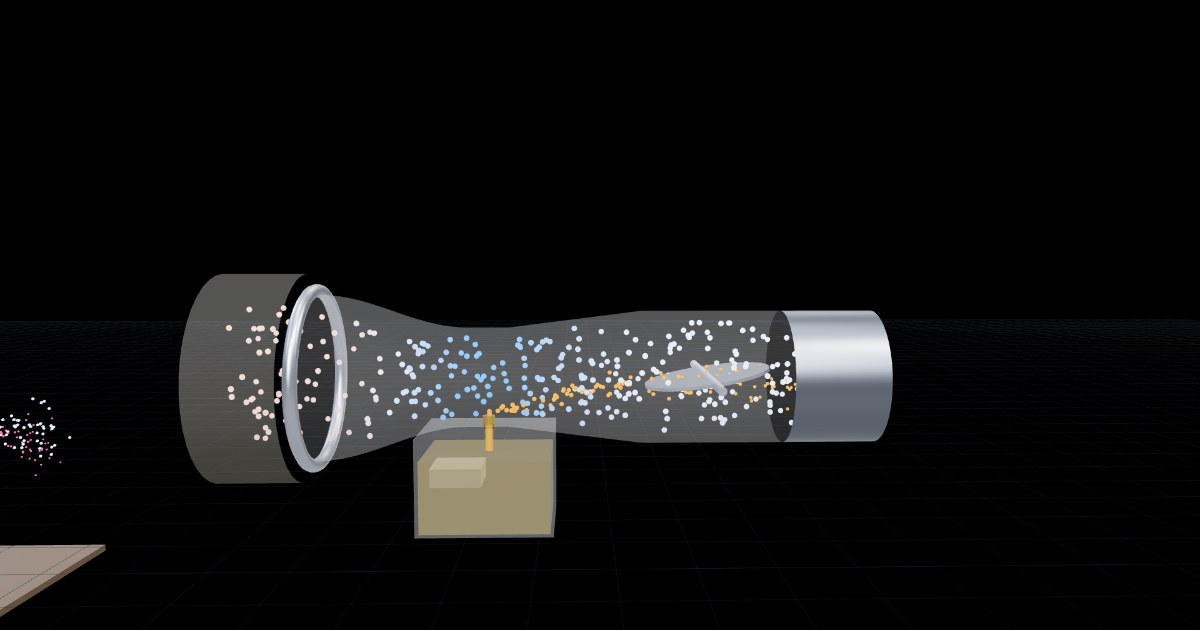
    Radio, microwaves, light and X-rays are electromagnetic waves, all at c. A microwave oven's 2.45 GHz waves are 12.2 cm long, making hot spots 6 cm apart, and the door's tiny holes turn them back while light gets out.

  4. Resonance: push in step

    Everything that can wobble has a natural frequency. Push at that rhythm, like a swing every 3 s, and small pushes add up until damping balances them. Washers shudder as they spin through it; a wine glass can shatter.

  5. Surprises and a myth

    Waves add, so they can cancel: calm lines between ripples, beats between close notes. Sound needs a medium, light doesn't. And Tacoma Narrows wasn't simple resonance: a steady wind fed a twisting flutter.

Where you'll meet it

v = f × λ

wave speed = frequency × wavelength, so for a fixed speed a higher frequency means shorter waves; and a system pushed at its own natural frequency resonates

The history

From Pythagoras's strings to ripples in spacetime: how people learned that sound, light and even gravity travel as waves.

Read the full history
  1. 530 BCEWhole-number strings sound sweet
  2. 1687Newton calculates the speed of sound
  3. 1801Light makes interference fringes
  4. 1865Light is an electromagnetic wave
  5. 1920Why the tabla sings in tune
  6. 2015Waves in space itself

The full explanation

Waves and resonance, chapter by chapter

Chapter 1

A wave carries a shape, not the stuff

Shake one end of a rope and a wave runs along it at v = f × λ.

Flick one end of a long rope and a bump runs away from your hand. Keep shaking and you send a whole train of bumps. That moving pattern is a wave. Watch the red bead: it only goes up and down. The rope stays where it is. What travels is the shape, and the energy it carries.

Three numbers describe it. The frequency, f, is how many times a second your hand shakes, in hertz (Hz). The wavelength, λ (lambda), is the distance from one crest to the next. The speed, v, is how fast a crest moves.

Each shake sends out one wavelength, and you make f of them every second. So in one second the wave moves f wavelengths: v = f × λ. That one line works for ropes, sound, light and ripples on a pond.

Here is the surprise. You can't make the wave faster by shaking faster. The speed belongs to the rope: pull it tighter, or use a lighter rope, and waves run faster, v = √(tension ÷ mass per metre). Shake faster and the crests just crowd closer together. The wavelength is the thing that gives: λ = v ÷ f.

A rope wave is transverse: the rope moves across the way the wave goes. Switch to the slinky and the coils move back and forth along the wave, bunching and spreading. That is a longitudinal wave, and it is exactly how sound moves through air.

Try “Speed = frequency × wavelength” in the interactive model →
Chapter 2

Sound is a push passed through the air

Pitch is frequency, and a string or pipe only rings at certain notes.

A loudspeaker cone jerks forward and squeezes the air in front of it. That squeezed layer pushes the next one, and so on. Then the cone pulls back and leaves a thinner patch behind. The result is a pressure wave: bunches of air (compressions) and gaps (rarefactions) running away at the speed of sound, about 343 m/s in air at 20 °C. Each bit of air only jiggles back and forth. It is a longitudinal wave, like the slinky.

Your ear hears the frequency as pitch. The A above middle C is 440 Hz, so its wavelength is 343 ÷ 440 = 78 cm. Go up an octave and the frequency doubles. People hear roughly 20 Hz to 20,000 Hz: wavelengths from 17 m down to under 2 cm. Every piano key is 1.0595 times the one below it (see PianoClear).

Now pin a string at both ends. Waves run along it, bounce off the ends and overlap. Only certain patterns survive: those that fit a whole number of half-wavelengths into the string. They are standing waves. Some points never move (nodes); others swing the most (antinodes).

That gives the harmonics: fₙ = n × v ÷ 2L. A guitar's low E string, 648 mm long, rings at 82 Hz, 165 Hz, 247 Hz… all at once, and the mix is its tone. Press a fret and you shorten L, so the pitch rises; the 12th fret halves the string and plays an octave (see GuitarClear).

A flute does the same with a column of air. Open at both ends, it follows the same rule with v = 343 m/s. Blow harder and it jumps to the second harmonic, an octave up (see FluteClear).

Try “Sound and music” in the interactive model →

Chapter 3

Light is a wave too, and so is your microwave

Electromagnetic waves all travel at c, so λ = c ÷ f.

In 1865 James Clerk Maxwell worked out that a wobbling electric field makes a wobbling magnetic field, which makes an electric field again, and the pair can travel on their own through empty space. His maths said they go at about 300,000 km/s: the speed of light. So light is an electromagnetic wave. In 1887 Heinrich Hertz made invisible ones with sparks, and radio was born.

All of them obey the same line as the rope: c = f × λ, with the same speed c. Only the frequency changes, and with it the wavelength and the name: radio, microwaves, infrared, visible light, ultraviolet, X-rays.

A microwave oven works at 2.45 GHz, so λ = 3 × 10⁸ ÷ 2.45 × 10⁹ = 12.2 cm. The waves bounce off the metal walls and form a standing wave, with hot spots about half a wavelength, 6.1 cm, apart. That's why the turntable turns (see MicrowaveClear). Stop it, melt a bar of chocolate, measure the gap between melted spots and you can work out the speed of light.

Why can you see through the door but the microwaves can't get out? The metal mesh has holes about 1–2 mm wide. A hole lets a wave through only if it is wider than about half a wavelength. Microwaves are 12 cm long, so they bounce back. Light is 0.0005 mm long and sails through.

Your TV makes every colour from tiny red, green and blue sub-pixels, about 630, 530 and 460 nanometres (see TVClear). The camera sorts light by the same wavelengths with red, green and blue filters, and its lens bends light because light slows down in glass (see CameraClear).

Try “Light, microwaves, radio” in the interactive model →

Chapter 4

Push at the right rhythm and small pushes add up

Everything that can wobble has a natural frequency. Drive it there and it resonates.

Pull a swing back and let go. It swings to and fro at its own pace, about once every 3 seconds for a 2.4 m swing. That pace is its natural frequency. Every object that can wobble has one: a guitar string, a bridge, a wine glass, a building.

Now push it. Push at a random rhythm and your pushes fight each other. Push in step with the swing, once each time it comes back, and every push adds a little more. The swing climbs higher and higher. That is resonance: driving something at its natural frequency so small pushes build a big motion.

What stops it growing forever? Damping: friction and air drag take a little energy each swing. At resonance the swing settles where the energy you add equals the energy lost. Less damping means a taller, sharper peak.

A washing machine meets resonance every spin. The tub hangs on springs, so it has a natural frequency of a few hertz. A lump of wet clothes shakes it as the drum turns. As the drum spins up through about 200 rpm, it passes that frequency and the machine shudders, then calms down at full speed. A badly unbalanced load can make it walk across the floor (see WasherClear).

A wine glass rings at one clear note when you tap it. Sing or play that exact note loudly enough and the rim flexes more and more until it cracks. Musical instruments use resonance on purpose: a tabla's black spot, the syahi, tunes its drumhead so its overtones fall into a musical series, which C. V. Raman explained in 1920 (see TablaClear). Your inner ear uses it too: each part of the cochlea resonates with a different pitch (see EarClear). Even MRI is resonance: radio waves at exactly 64 MHz tip the hydrogen nuclei in your body in a 1.5 tesla magnet (see MRIClear).

Try “Resonance” in the interactive model →

Chapter 5

When waves meet, and a famous myth

Waves add and cancel, beat, need (or don’t need) a medium, and one bridge wasn’t resonance.

When two waves meet they simply add. Crest on crest makes a bigger crest; crest on trough makes nothing at all. This is interference. Drop two pebbles in a pond and you see calm lines fanning out between the ripples, where the waves cancel. In 1801 Thomas Young used exactly this to show that light is a wave: two slits make bright and dark bands. Noise-cancelling headphones do it on purpose, playing an upside-down copy of the noise.

Two notes that are nearly the same pitch interfere in time. They drift in and out of step, so you hear a wah-wah-wah: beats, as many per second as the difference in frequency. Tune a guitar, a harmonium or a tanpura by listening for the beats to slow down and stop.

Myth-buster. In 1940 the Tacoma Narrows Bridge twisted itself apart in a 64 km/h wind, and many books say "resonance". But the wind was steady: there was no rhythm to match. The swirls of air shed by the deck came about 0.9 times a second, not the bridge's 0.2. What really happened is flutter: above a critical speed, the twisting deck bent the airflow so that the wind pushed with each twist. It is negative damping, and each twist fed the next.

Last surprise. Sound needs a medium, something to squeeze. Pump the air out of a jar and a ringing bell goes silent, as Robert Boyle and Robert Hooke showed in 1660. Light doesn't: its electric and magnetic fields carry themselves. That is why sunlight reaches us across 150 million km of empty space, while space itself is silent.

Try “Surprises and myths” in the interactive model →

Test yourself

Frequently asked

A wave on a rope travels at 8 m/s and you shake the end 4 times a second. What is its wavelength?

2 m. λ = v ÷ f = 8 ÷ 4 = 2 m. Each shake sends out one wavelength, and four of them fit into the 8 m the wave travels each second.

You start shaking the rope twice as fast. What happens?

The wavelength halves; the speed stays the same. The speed is set by the rope’s tension and weight. Shaking faster packs the crests closer: λ = v ÷ f halves.

As a wave passes, what does a bead tied to the rope do?

Moves up and down, and stays in place. The rope only moves across; the pattern and the energy travel along. The same is true of air in a sound wave, which only jiggles back and forth.

The A above middle C is 440 Hz. With sound at 343 m/s, what is its wavelength?

78 cm. λ = v ÷ f = 343 ÷ 440 ≈ 0.78 m. A low bass note has wavelengths of several metres; a whistle, a few centimetres.

A guitar string’s fundamental is 110 Hz. What is its third harmonic?

330 Hz. Harmonics are whole-number multiples: fₙ = n × f₁, so 3 × 110 = 330 Hz. Three half-waves fit on the string, with two nodes between the ends.

You press a guitar string at the 12th fret, halfway along. What happens to the note?

It rises an octave. f₁ = v ÷ 2L. Halving L doubles the frequency, and doubling the frequency is one octave up.

A microwave oven runs at 2.45 GHz. Roughly how long are its waves?

12 cm. λ = c ÷ f = 3 × 10⁸ ÷ 2.45 × 10⁹ ≈ 0.12 m. The hot spots are half of that, about 6 cm apart.

Why does the metal mesh on the oven door let light out but not microwaves?

The holes are much smaller than the microwaves’ wavelength but huge compared with light’s. A hole narrower than about half a wavelength reflects the wave. 1–2 mm holes stop 12 cm microwaves, while 0.0005 mm light waves pass easily.

What do radio waves, microwaves, light and X-rays have in common?

The same speed in a vacuum. They are all electromagnetic waves and travel at c, about 300,000 km/s. Only f and λ differ, with c = f × λ.

A swing takes 3 seconds to go there and back. How often should you push to make it go highest?

Once every 3 seconds. Its natural frequency is 1 ÷ 3 s ≈ 0.33 Hz. Pushing at that rhythm, in step with the swing, makes each push add to the motion: resonance.

Why does a washing machine often shudder briefly while spinning up, then calm down at full speed?

The drum speed passes through the tub’s natural frequency. The tub on its springs has a natural frequency of a few hertz. As the drum passes that speed, the unbalanced clothes drive it at resonance. Above it, the shaking falls again.

What limits how big a resonance gets?

Damping: energy lost each cycle. At resonance the amplitude grows until the energy lost each cycle to friction and drag equals the energy added. Less damping gives a taller, sharper peak.

Two waves meet exactly out of step: one’s crest lands on the other’s trough. What happens?

They cancel out. Waves add. A crest plus an equal trough is zero: destructive interference. Noise-cancelling headphones use it.

You play 440 Hz and 444 Hz together. What do you hear?

A note that throbs 4 times a second. Close pitches drift in and out of step, making beats at the difference: 444 − 440 = 4 per second.

What really destroyed the Tacoma Narrows Bridge in 1940?

Aeroelastic flutter: the twisting deck made the steady wind push it harder. The wind was steady and its vortex rhythm didn’t match the 0.2 Hz twist. Above a critical speed, the deck’s own motion made the wind feed the twist: flutter.

Words worth knowing

Frequency (f)
How many waves pass a point each second, in hertz (Hz).
Wavelength (λ)
The distance from one crest to the next.
Wave speed
How fast the pattern travels: v = f × λ. Set by the medium, not the source.
Standing wave
Two waves travelling opposite ways that add into a pattern of fixed nodes and antinodes.
Harmonics
The whole-number multiples of a string's or pipe's lowest frequency: fₙ = n v ÷ 2L.
Electromagnetic wave
Linked electric and magnetic fields travelling at c = 299,792 km/s, even through empty space.
Resonance
A large response when a system is driven at its own natural frequency.
Interference
Waves adding where they overlap: reinforcing in step, cancelling half a wave out of step.

Fork it. Teach with it.

This box is plain HTML, CSS and JavaScript, with no build step and no accounts. Run it yourself and it sends nothing anywhere. The code is MIT. The words, images and videos are CC BY 4.0, so you can reuse them anywhere if you credit “Glassbox, glassbox.how/e/waveclear”.

git clone https://github.com/bdeeps/waveclear.git

Built with three.js (MIT), Geist, Instrument Serif (SIL OFL 1.1).

←→ previous / next box · / search

Would you like to see the full page, with the interactive model?