Six strings pulling with 73 kg, a thin spruce top that pumps the air, and a magnet that hears steel move. A guitar's strings run from the saddle on the bridge to the nut at the top of the neck.
Six strings pulling with 73 kg, a thin spruce top that pumps the air, and a magnet that hears steel move. Pluck, fret and strum a guitar in 3D, then plug it in and push the amp until it clips.
GuitarClearOpened 28 Jul 202614 min to playFree · no sign-up
In 60 seconds
Six strings between two points
A guitar's strings run from the saddle on the bridge to the nut at the top of the neck. All six are the same length, so their notes, from E at 82.4 Hz to E at 329.6 Hz, are set by how tight and how heavy each one is: f = (1/2L)·√(T/μ). Together they pull with about 73 kg.
Where you pluck changes the tone
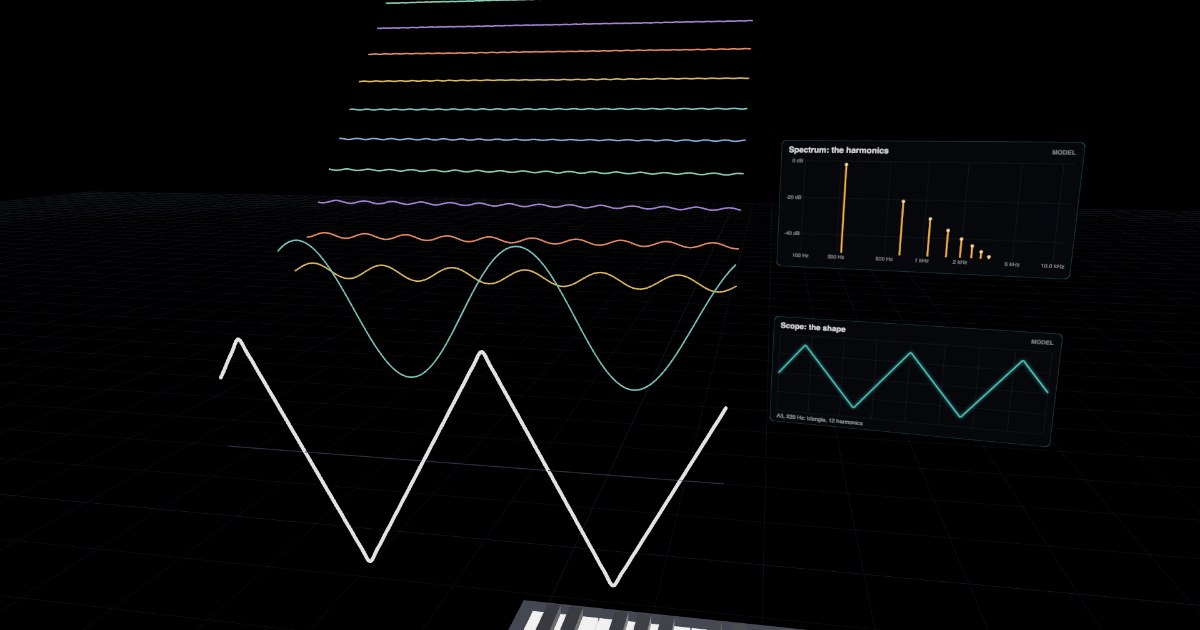
A plucked string vibrates as a whole and in halves, thirds and quarters at once. Any harmonic with a still point where you pluck goes missing, so plucking near the bridge sounds bright and plucking in the middle sounds round. Touch the string lightly at the 12th fret and only the harmonics with a node there ring: a chiming octave.
Frets divide the octave into twelve
Each fret shortens the vibrating string by the same factor, 2^(−1/12) ≈ 0.944, which raises the note one semitone. The 12th fret sits exactly halfway, 325 mm from the nut on a 650 mm classical guitar, and the frets crowd closer together as you go up.
The body does the shouting
A string alone is almost silent, because air slips around it. The bridge rocks the thin spruce top, which pumps the air like a loudspeaker, and the air in the box bounces in and out of the sound hole like air in a bottle. Together they make strong resonances near 100 Hz and 200 Hz.
A pickup is Faraday's law
An electric guitar's pickup is a magnet inside a coil of about 8,000 turns of fine wire. The moving steel string changes the magnetic flux through the coil, which makes a voltage of a few tenths of a volt. A humbucker's two reversed coils cancel mains hum but add up the string's signal.
Distortion is clipping on purpose
An amplifier makes the pickup's signal many times bigger. Push it past its limit and the tops of the wave are cut off, which adds new harmonics that were never in the string. Soft clipping, like an overdriven valve, adds them gently. Hard clipping sounds fizzier.
Six strings, a neck with frets, and a hollow wooden box. Or a solid one with magnets.
A guitar is six strings stretched between two fixed points: the saddle on the bridge and the nut at the top of the neck. At the far end, each string wraps around a tuner on the headstock. Turn it and the string gets tighter and higher.
Under the strings is the fretboard, with thin metal frets and dots called inlays to help you find your place. Inside the neck a steel truss rod stops the strings' pull from bending it.
An acoustic guitar is a hollow box. Its thin top (the soundboard) is braced underneath with strips of wood in an X, and a round sound hole lets the air inside breathe. An electric guitar has a solid body that makes little sound. Instead, magnetic pickups turn the strings' motion into electricity, sent through the output jack to an amplifier.
Length, tension and weight set the note. Where you pluck sets the tone.
Pluck a string and it springs back, overshoots and swings to and fro. The low E string does this 82 times a second: its frequency is 82.4 hertz (Hz). The six strings in standard tuning are E, A, D, G, B and E, from 82.4 Hz up to 329.6 Hz, two octaves higher.
All six strings are the same length, so the note is set by tension and weight. Marin Mersenne wrote the rule in 1636: f = (1/2L) × √(T/μ), where L is the length, T the tension and μ the mass of one metre of string. The low strings are thick and wound with bronze wire to make them heavy. Each string pulls with 10 to 14 kg. All six together pull with about 73 kg.
A string swings as a whole and in halves, thirds and quarters at once. These harmonics sit at 2, 3, 4 times the main note, and their mix is the tone. Pluck near the bridge and you get lots of high harmonics: a bright, twangy sound. Pluck in the middle and it is soft and round. Any harmonic with a still point (a node) right where you pluck goes missing, because you can't start a wave at a point that must stay still.
Touch a string lightly at the 12th fret (the middle) and pluck: only the harmonics with a node there survive, and you hear a chiming note an octave up. That is a natural harmonic. The 7th fret gives 3× the note, the 5th fret 4×.
Each fret makes the string about 6% shorter: one semitone higher.
Press a string down just behind a fret and the string now vibrates from the saddle to that fret instead of the nut. Shorter string, higher note. Each fret raises the note by one semitone, and 12 frets make an octave.
For an octave, the string must be exactly half as long, so the 12th fret sits in the middle: on a 650 mm classical guitar, 325 mm from the nut. In between, each fret shortens the string by the same factor, 2−1/12 ≈ 0.944: about 5.6% each time. That is equal temperament. Fret n sits at d = L × (1 − 2−n/12), so the frets get closer together as you go up.
Old makers used a shortcut: put each fret 1/18 of the way from the last one to the bridge. That rule of 18 plays slightly flat, so later makers used 17.817, which is almost exact.
A chord is several notes at once. Your fingers make a shape, and you strum all six strings. Pressing a string down also stretches it a little, so fretted notes go slightly sharp. To fix that, the saddle sits a millimetre or two further back than the exact scale length. That is compensation, and getting every fret in tune is called intonation.
A string alone is almost silent. A hollow wooden box pumps the air.
A string is so thin that air just slips around it as it swings. On its own, even a hard pluck is barely louder than a whisper. So the strings press down on the bridge, which is glued to the thin top. As the strings pull and push, the bridge rocks, and the top pumps in and out like a loudspeaker cone. The top is big, so it moves a lot of air.
The box helps in a second way. The air inside is a spring, and the air in the sound hole is a little plug that bounces on it, like when you blow across a bottle. This is a Helmholtz resonator. For a box of volume V and a hole of area A, it rings at f = (c/2π) × √(A / (V × L)), where c is the speed of sound and L is the hole's effective length. The air and the top shake each other, and together they make two strong resonances: the air mode near 100 Hz and the top mode near 200 Hz. They boost the low notes, which is why a big dreadnought sounds so deep.
The top is usually spruce: light, stiff along the grain and only about 2.5 mm thick. Strips of wood called braces stop it from bulging under the strings' pull. Steel-string guitars use X-bracing. Classical guitars use fan bracing, made famous by Antonio de Torres. Old parlour guitars used simple ladder bracing. A piano does the same job with a much bigger board: see PianoClear.
A magnet, a coil of hair-thin wire, and Faraday’s law.
An electric guitar's pickup is a magnet wrapped in a coil of very thin copper wire, about 8,000 turns of it. The magnet makes the steel string above it magnetic too. When the string moves towards the magnet and away, it changes how much magnetic flux passes through the coil.
A changing flux through a coil makes a voltage. That is Faraday's law: EMF = −N × dΦ/dt, where N is the number of turns and dΦ/dt how fast the flux changes (see Faraday's law). So the pickup's voltage follows the string's speed, a few tenths of a volt at most, and it wiggles at exactly the string's frequency. A cable carries it to the amp. That is why pickups need steel strings: nylon isn't magnetic.
A single coil also picks up the 50 Hz hum from mains wiring. Seth Lover's humbucker fixes this with two coils wound in opposite directions and magnets pointing opposite ways. The hum arrives at both coils the same way and cancels. The string's signal flips twice, so it adds up.
Where the pickup sits matters. It only hears the harmonics that move at its spot. A pickup a quarter of the way along the string sits on a node of the 4th harmonic, so it can't hear it. Near the neck, the pickup hears strong low harmonics: a warm, round tone. Near the bridge, every harmonic moves only a little but the high ones count more: a thin, bright tone.
Turn a whisper of voltage into a roar, and clip it on purpose.
A pickup gives out only a few tenths of a volt, far too little to move a loudspeaker. An amplifier makes it bigger. How many times bigger is the gain: a gain of 30 turns 0.2 V into 6 V. Power stages then drive the speaker, a paper cone pushed by a coil and magnet (the pickup in reverse), and the speaker pushes the air. For amps and resistance, see Ohm's law.
Every amp has a limit. Push the signal past it and the tops of the wave get cut off: clipping. A clipped wave is no longer a clean wiggle, so it contains new harmonics that weren't in the string. That is distortion, the sound of rock. Soft clipping, the gentle squash of an overdriven valve (vacuum tube), rounds the tops and adds harmonics gradually. Hard clipping slices them flat and sounds fizzier. A symmetrical clip adds only odd harmonics: 3rd, 5th, 7th.
Stand close to a loud amp and the sound can shake the strings back into motion, which the pickup hears and the amp makes louder still. That loop is feedback: a note that never dies, or a howl. Effects change the signal on the way: a delay repeats it, reverb adds the echoes of a room, and a wah pedal sweeps a narrow filter up and down, so the guitar seems to say "wah".
Which two points mark the ends of an open string’s vibrating length?
The saddle and the nut. The string is free to vibrate only between the saddle on the bridge and the nut at the top of the fretboard.
What is the truss rod for?
It stops the pull of the strings from bending the neck. Six strings pull with about 70 kg. The steel rod in the neck pushes back so the neck stays straight.
Why does an electric guitar need an amplifier?
Its solid body barely moves the air, so the pickups’ signal must be made loud by an amp and speaker. A solid body is heavy and stiff, so it makes little sound. The pickups turn string motion into a small voltage for the amp.
All six guitar strings are the same length. What makes the low E string so much lower than the high E?
It is much heavier per metre (thicker and wound). The tensions are similar, 10 to 14 kg. The low E is about 18 times heavier per metre, and √18 ≈ 4.2 is about two octaves.
You pluck a string exactly in the middle. Which harmonics go missing?
The even ones: 2nd, 4th, 6th. Every even harmonic has a node in the middle, so a pluck there can’t start it. The sound is soft and hollow.
You touch the string lightly at the 12th fret and pluck. What do you hear?
A note an octave higher: only harmonics with a node in the middle survive. Your finger stops every mode that moves at the middle. The 2nd, 4th, 6th… harmonics have a node there, so they ring on: an octave up.
On a guitar with a 650 mm scale, where is the 12th fret?
325 mm from the nut, halfway. The 12th fret is an octave, which needs half the length: 650 ÷ 2 = 325 mm.
Why do frets get closer together as you go up the neck?
Each fret takes off the same fraction (about 5.6%) of a string that keeps getting shorter. Each semitone needs the length × 0.944. 5.6% of a shorter string is a shorter step.
Why is the saddle set a little further back than the exact scale length?
Pressing a string down stretches it and makes it sharp, so a slightly longer string cancels that. Fretting pulls the string a bit tighter. A millimetre or two of extra length, called compensation, brings it back in tune.
Why is a string on its own so quiet?
It is so thin that air slips around it instead of being pushed. A string only moves a sliver of air. The top has thousands of times more area, so it pushes far more.
What happens to the air resonance if you make the sound hole bigger?
It goes up in frequency. In f = (c/2π)√(A/(V·L)), a bigger hole area A raises the frequency. A bigger box V lowers it.
What do the braces under the top do?
They stiffen the thin top so it doesn’t bulge, and shape how it vibrates. A 2.5 mm spruce top can’t take the strings’ pull alone. Braces stiffen it while keeping it light.
What makes the voltage in a pickup’s coil?
The moving steel string changing the magnetic flux through the coil. Faraday’s law: a changing flux through the coil induces an EMF. No change, no voltage.
Why does a humbucker cancel hum?
Its two coils are wound in opposite directions, so hum arriving at both cancels while the string signal adds. The hum induces opposite voltages in the two reversed coils. The magnets are reversed too, so the string’s signal comes out the same way in both.
Why does the bridge pickup sound brighter than the neck pickup?
Close to the bridge the low harmonics barely move, so the high ones make up more of the sound. The pickup hears each harmonic in proportion to how much it moves at that spot. Near the bridge, the fundamental hardly moves.
What is clipping?
The amp running out of room, so the tops of the wave are cut off. Every amp can only swing so far. Push the signal past that and the peaks are flattened.
Why does a clipped note sound different, even at the same pitch?
Flattening the wave adds new harmonics that weren’t in the string. A flat-topped wave is made of the original sine plus 3rd, 5th, 7th… harmonics. That added edge is distortion.
What causes feedback?
Sound from the speaker shakes the strings, the pickup hears it and the amp makes it louder in a loop. It is a loop: string → pickup → amp → speaker → air → string. With enough gain, it sustains or howls.
Words worth knowing
Frequency
How many times a second something vibrates, in hertz (Hz). The low E string vibrates 82.4 times a second.
Harmonic
A vibration of a string in 2, 3, 4… equal parts, at 2, 3, 4… times the main note. The mix of harmonics is the tone.
Node
A point on a vibrating string that stays still.
Equal temperament
A tuning where every semitone has the same frequency ratio, 2^(1/12), so twelve of them make an octave.
Soundboard
The thin wooden top of an acoustic guitar that the bridge shakes to push the air.
Helmholtz resonator
A box of air with a hole. The air in the hole bounces on the springy air inside, like blowing across a bottle.
Pickup
A magnet inside a coil of fine wire that turns a steel string's motion into a small voltage.
Humbucker
A pickup with two coils wound in opposite directions, so hum cancels while the string's signal adds.
Clipping
When a signal is pushed past an amplifier's limit, so the tops of the wave are cut off and new harmonics appear.
Fork it. Teach with it.
This box is plain HTML, CSS and JavaScript, with no build step and no accounts. Run it yourself and it sends nothing anywhere. The code is MIT. The words, images and videos are CC BY 4.0, so you can reuse them anywhere if you credit “Glassbox, glassbox.how/e/guitarclear”.