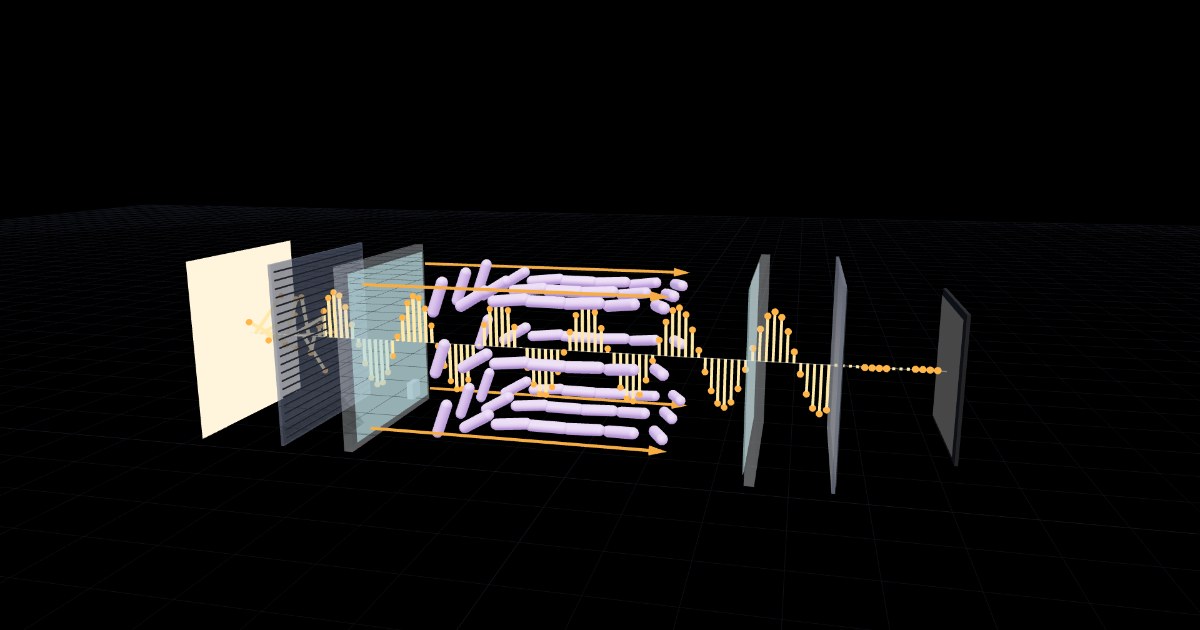
A dark box, a hole, and an upside-down world. Light travels in straight lines. A small hole lets only a thin bundle of rays through from each point of a scene, so they paint a picture on the back wall.
A dark box, a hole, and an upside-down world. Take a real camera apart in 3D and learn what aperture, shutter speed and ISO really do.
CameraClearOpened 6 Jul 202615 min to playFree · no sign-up
In 60 seconds
Every camera is a dark box with a hole
Light travels in straight lines. A small hole lets only a thin bundle of rays through from each point of a scene, so they paint a picture on the back wall. It lands upside-down because rays from the top cross over to the bottom.
A lens fixes the pinhole's trade-off
A bigger hole gives a brighter picture but a blurrier one. A lens bends every ray from one point back to one point, so you get a wide opening that is still sharp. Focusing means moving the lens until those rays meet exactly on the sensor.
Aperture is how wide the door opens
Iris blades set the size of the opening. A wide aperture (f/2) lets in lots of light and blurs the background. A narrow one (f/16) lets in little light and keeps near and far sharp. That in-focus zone is the depth of field.
Shutter speed is how long the door stays open
Two curtains slide across the sensor. A fast shutter (1/1000 s) freezes motion. A slow one (1/15 s) collects more light but smears anything that moves, including your own shaking hands.
ISO turns up the volume, and the noise
The sensor counts photons in millions of tiny wells. ISO amplifies that signal after the fact. It brightens a dark photo, but it amplifies the random grain too.
Exposure is the three working together
Aperture, shutter speed and ISO all trade against each other. Close the aperture one stop and you need twice the shutter time, or twice the ISO, for the same brightness. Every photo is a choice about which side effect you'd rather have.
Every camera is a dark box. Light from each point of the flower travels in straight light rays. A tiny pinhole lets through only a thin bundle from each point, so they paint a picture on the back wall — the sensor.
Follow the coloured rays: light from the top of the flower goes down through the hole, and light from the bottom goes up. That's why the image is upside-down.
A modern camera is a light-tight body with a lens on the front and a sensor at the back. Everything in between exists to control how much light reaches the sensor, for how long, and how sharply.
Light's journey: lens elements bend it → the aperture limits how much gets through → the shutter opens for a moment → the sensor records it.
A lens catches a whole cone of rays from each point of your subject and bends them so they meet again at a single point behind it. Focusing means moving the lens until that meeting point lands exactly on the sensor.
If they meet too early or too late, the point is recorded as a disc — the blur circle. Big disc, blurry picture.
The lens equation 1/f = 1/u + 1/v tells you where they meet: closer objects (small u) focus further back (big v), so the lens has to move forward to focus close.
The adjustable hole that controls light — and blur.
Inside every lens is an iris of overlapping blades. The hole they form is the aperture. It's measured as an f-number: the focal length divided by the hole's diameter.
So small f-number = big hole. f/1.4 is wide open; f/22 is a pinprick. Each step in the sequence f/1.4 → 2 → 2.8 → 4 → 5.6 → 8 → 11 → 16 → 22 halves the light — one stop.
With Av mode on, the camera adjusts the shutter speed to keep brightness the same, so you only see the blur change. Switch it off to see the brightness change too.
How long the light gets in — and what moves meanwhile.
The shutter is a pair of curtains in front of the sensor. The first curtain drops to start the exposure; the second follows to end it. The time between them is the shutter speed.
At very fast speeds the second curtain chases the first so closely that only a slit sweeps across the sensor — every row still gets the same tiny exposure. This is a focal-plane shutter.
Auto ISO is on, so brightness stays constant while you explore — only the blur changes.
A sensor is a grid of photosites — tiny wells that collect photons during the exposure. More light → fuller wells → brighter pixels.
Each well only measures how much light, not colour. A Bayer filter of red, green and blue squares lets each well see one colour; the camera fills in the rest. Microlenses funnel light into each well.
ISO doesn't catch more light. It amplifies what was caught (gain). In dim light a few random photons make a big difference, and amplifying them makes that randomness visible as noise.
Exposure is filling a bucket with light. The tap width is the aperture, how long it runs is the shutter speed, and the bucket size is ISO — higher ISO means a smaller bucket, filled by less light.
Many combinations fill the bucket exactly to the line. f/4 at 1/250 lets in the same light as f/5.6 at 1/125: one stop narrower, one stop longer. Those are equal EVs.
Wide-angle to telephoto: how much of the world fits.
Focal length (in mm) is how strongly a lens magnifies. Short focal lengths squeeze a wide slice of the world onto the sensor; long ones magnify a narrow slice. The orange pyramid in the 3D view is the camera's field of view.
Roughly: 14–35 mm is wide-angle, around 50 mm is "normal" (similar to your eye's central view), 85 mm and beyond is telephoto.
Only the plane of focus (yellow) is perfectly sharp. But things a little in front and behind still look sharp, because their blur circles are too small to notice. That zone — green in the 3D view — is the depth of field.
Three things make it shallower: a wider aperture, a longer focal length, and focusing closer. Reverse them for deep focus.
Everything is in your hands now: light, aperture, shutter, ISO, focal length and focus. Each assignment below is a real-world brief — read it, think about which side effects you want, set up the camera and press the red shutter button (or Space).
Real cameras also have white balance, RAW files and limited dynamic range — look them up in the glossary.
Light travels in straight lines, so rays from the top cross through the hole to the bottom. Rays from the top of the subject travel downward through the opening and land low on the sensor — and vice versa. The camera flips it back for you.
You make a pinhole bigger. What happens?
Brighter and blurrier. More light gets in, but each point of the scene now makes a bigger blob on the sensor.
What does a lens add that a pinhole can't?
A wide opening that is still sharp. A lens bends every ray from one point back to one point, so you can use a big, bright opening without blur.
In what order does light pass through the camera?
Lens → aperture → shutter → sensor. Glass focuses it, the aperture limits it, the shutter times it, and the sensor records it.
What is the lens mount for?
Attaching interchangeable lenses at the exact right distance from the sensor. The mount fixes the lens-to-sensor distance precisely and carries autofocus/aperture signals.
On the mode dial, "A" (or "Av") means…
You choose the aperture, the camera picks the shutter speed. Aperture priority: you control depth of field, the camera balances exposure with shutter speed.
An out-of-focus point of light appears on the sensor as…
A disc called the blur circle (circle of confusion). The cone of rays is cut by the sensor before or after it converges, leaving a disc.
You move closer to your subject. To stay focused, the lens must move…
Away from the sensor. 1/f = 1/u + 1/v: smaller u means bigger v, so the image forms further back and the lens must move forward.
What is the plane of focus?
The slice of the scene at the focus distance that is perfectly sharp. Only things at exactly the focus distance are perfectly sharp; depth of field extends a little either side.
Which lets in MORE light?
f/2. f/2 is a much bigger opening — six stops (64×) more light than f/16.
Going from f/4 to f/5.6 does what to the light?
Halves it. Each full stop along the f-number sequence halves the light.
You want a blurry background for a portrait. You should…
Use a wide aperture (f/1.8). Wide apertures give shallow depth of field, so the background falls out of focus.
Which shutter speed best freezes a running dog?
1/1000. 1/1000 s is so short that the dog barely moves while the shutter is open.
Going from 1/250 to 1/125 does what to the light?
Doubles it. The shutter stays open twice as long, so twice the light arrives — one stop brighter.
Hand-holding a 200 mm lens, the slowest safe shutter speed is about…
Amplifies the signal the sensor already caught. ISO is gain. The amount of light collected is set by aperture and shutter speed.
Why is high ISO noisy?
Few photons means big random variation, and amplifying it makes it visible. Photons arrive randomly. With little light the randomness is large relative to the signal, and gain magnifies it (plus the electronics' own noise).
ISO 400 → ISO 800 is…
One stop brighter. Doubling ISO doubles the amplification: one stop.
Which pair gives the SAME exposure as f/4 at 1/250?
f/5.6 at 1/125. f/5.6 is one stop less light; 1/125 is one stop more. They cancel out.
Your photo is 1 stop too dark. Which fixes it?
1/250 → 1/125. Doubling the shutter time doubles the light: one stop brighter.
The side effect of a fast shutter speed is…
More noise, unless you compensate. Less time means less light; to compensate you open the aperture (shallower DOF) or raise ISO (more noise).
Which focal length gives the WIDEST view?
16 mm. Shorter focal length = wider field of view.
A 50 mm lens on an APS-C camera (crop 1.5×) frames like…
75 mm on full frame. The smaller sensor crops the middle of the image: 50 × 1.5 = 75 mm equivalent.
What really causes "telephoto compression"?
Standing far away — perspective depends on camera position. Perspective only depends on where the camera is. A telephoto just lets you frame tightly from far away.
Which gives the SHALLOWEST depth of field?
85 mm at f/1.8, focused at 2 m. Long focal length + wide aperture + close focus all shrink depth of field.
Focusing at the hyperfocal distance makes everything sharp from…
Half the hyperfocal distance to infinity. That is the definition — and why landscape photographers love it.
Depth of field is usually…
Deeper behind the focus point than in front. Roughly a third in front and two-thirds behind at normal distances — watch the green zone.
Night, no tripod, and you need a sharp photo. Best first move?
Raise ISO and open the aperture. Without a tripod you must keep the shutter fast, so get the light from a wider aperture and more gain.
For a sharp landscape from foreground to mountains you'd pick…
f/11, focus at the hyperfocal distance. A mid-narrow aperture and hyperfocal focusing maximise depth of field.
The histogram is piled against the right edge. The photo is…
Overexposed with clipped highlights. The right edge is pure white — detail there is lost.
Words worth knowing
Camera obscura
Latin for 'dark room': a sealed space with a small hole that projects an upside-down image of the outside world.
f-number
Focal length divided by aperture diameter. Smaller numbers mean bigger openings: f/2 lets in 4x the light of f/4.
Stop
A doubling or halving of light. Photographers measure every exposure change in stops.
Depth of field
The distance range that looks acceptably sharp. Wide apertures, long lenses and close subjects make it shallow.
Focal length
How strongly a lens bends light, in millimetres. Short = wide view, long = narrow, magnified view.
Sensor noise
Random speckle from the physics of counting light. ISO amplification makes it more visible.
Fork it. Teach with it.
This box is plain HTML, CSS and JavaScript, with no build step and no accounts. Run it yourself and it sends nothing anywhere. The code is MIT. The words, images and videos are CC BY 4.0, so you can reuse them anywhere if you credit “Glassbox, glassbox.how/e/cameraclear”.