Two triangles, a chain and a wheel of thin wires, and a machine that balances itself. Most bikes use a diamond frame: two triangles sharing the seat tube. A triangle can't change shape unless one side changes length, so thin, light tubes make a stiff frame.
Two triangles, a chain and a wheel of thin wires, and a machine that balances itself. Take a bicycle apart in 3D and ride its physics.
CycleClearOpened 8 Jul 202615 min to playFree · no sign-up
In 60 seconds
A frame of two triangles
Most bikes use a diamond frame: two triangles sharing the seat tube. A triangle can't change shape unless one side changes length, so thin, light tubes make a stiff frame.
A chain links pedals to wheel
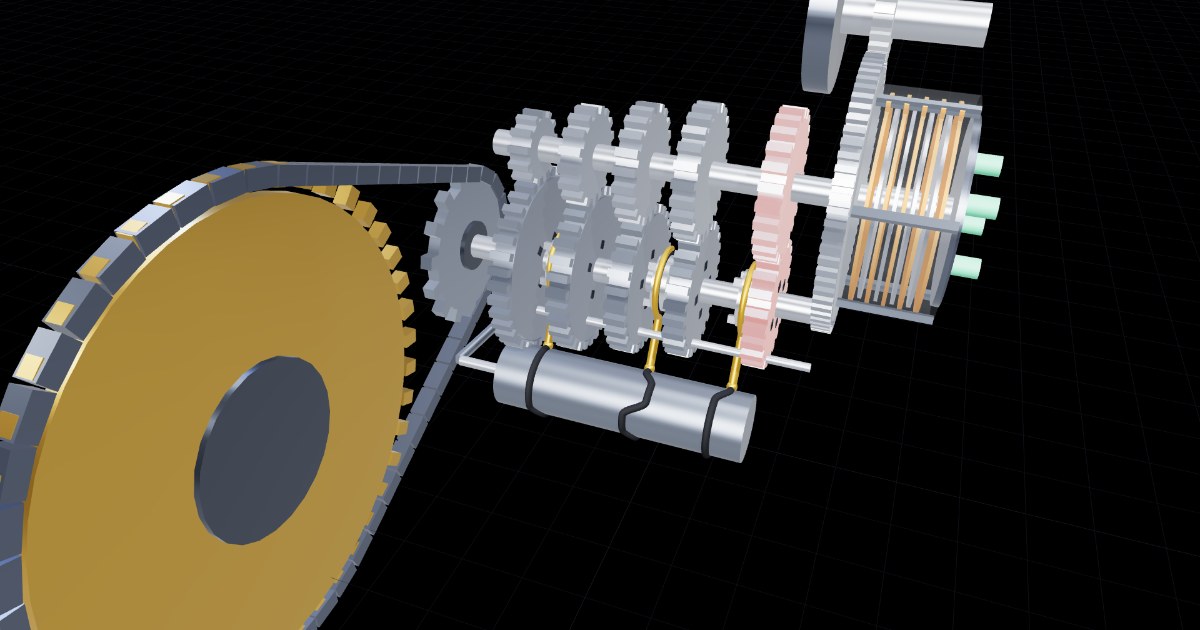
Your feet turn the cranks and the front chainring. The chain carries every tooth's movement to a small cog on the back wheel, so the wheel turns with you.
Gears trade effort for speed
The gear ratio is front teeth divided by rear teeth. A small rear cog gives more distance per pedal stroke but needs more force; a big one makes hills easier but slower.
A moving bike balances itself
When a moving bike leans, its front wheel steers into the lean, bringing the wheels back under it. Above about 15 km/h, many bikes catch every wobble on their own. Lock the handlebars and it falls.
Wheels hang on tensioned spokes
Every spoke is pulled tight to about 1,000 newtons. When you sit on the bike, only the spokes at the bottom change: they lose some tension. The rest hold the rim round.
Brakes turn motion into heat
Stopping means getting rid of kinetic energy, which grows with the square of speed. Brake pads grip a disc or rim and friction turns that energy into heat.
Two triangles, two wheels, a chain and a way to steer.
A bicycle turns the push of your legs into forward motion, while letting you steer and balance. Its parts group into a few systems:
The frame holds everything together. Most frames are a diamond: two triangles sharing the seat tube. A triangle can't change shape unless one of its sides changes length, so a frame of thin tubes is both light and stiff.
The drivetrain (pedals, cranks, chainring, chain and rear cogs) carries your effort to the back wheel. The steering (handlebars, stem, fork and front wheel) turns on bearings in the head tube. The wheels are a rim held in shape by tensioned spokes.
A chain links two sprockets; their sizes set how far each pedal stroke takes you.
Your feet turn the cranks, which turn the front chainring. The chain wraps round it and round a small cog on the rear wheel, so every tooth that passes the front also passes the back.
That makes the gear ratio simple: front teeth ÷ rear teeth. With 50 teeth in front and 25 behind, the rear wheel turns twice for every turn of the pedals. Multiply by the wheel's circumference (about 2.1 m) and you get how far one pedal stroke takes you.
A derailleur shifts the chain between cogs. Smaller rear cog: more distance per stroke, but harder to push. Bigger rear cog: easier, but you have to pedal faster.
Riding uphill, part of gravity pulls you back down the slope. On a 10% hill (up 10 m for every 100 m along), about a tenth of your weight is pulling you backwards. For a rider and bike of 85 kg, that's roughly 83 newtons at the tyre.
Gears don't reduce that work. They change how it reaches your legs. A bigger rear cog (a lower gear) multiplies the force of your push, so each stroke is easier, but you need more strokes to cover the same ground. It's the same trade as a long lever.
That's why riders change down before a climb: they keep a comfortable push and a comfortable cadence, instead of grinding a heavy gear slowly.
At speed, the front wheel steers into every fall and catches it.
A bicycle standing still falls over: its two wheels touch the ground in a line, and gravity tips it sideways. So how does a moving bike stay up, even with no rider?
When a bike starts to lean, its front wheel steers into the lean, thanks to the tilted steering axis, the front wheel's weight, and a little help from its spinning. Steering into a fall moves the wheels back under the bike and the turn swings it upright, just like balancing a broom on your hand.
Below a certain speed the correction comes too late and the bike wobbles and falls. Above it, a well-designed bike is self-stable: it catches every wobble on its own. Lock the handlebars and no speed will save it.
Spokes can only pull, yet the wheel carries your weight.
A spoke is a thin steel wire. It can't be pushed without bending, so how can 32 of them hold up a rider?
The trick is pre-tension. Every spoke is tightened to about 1,000 newtons, pulling the rim inward from all sides. The rim, squeezed evenly all round, stays perfectly round.
Sit on the bike and your weight pushes the hub down. Only the few spokes at the bottom change: they lose some tension, while the rest stay almost the same. As the wheel turns, each spoke loses tension as it passes the bottom and regains it after, hundreds of times a minute. That's why spokes eventually fail from fatigue.
Your speed has to go somewhere. Brakes turn it into heat.
A moving bike and rider carry kinetic energy: ½ × mass × speed². To stop, that energy has to go somewhere. Brakes squeeze pads against a spinning disc (or the rim), and friction turns the energy into heat.
Energy grows with the square of speed: at 40 km/h you carry four times the energy you had at 20 km/h, so you need four times the distance to stop with the same braking force.
Most braking is done by the front brake, because stopping shifts your weight forward onto the front wheel. Brake too hard and you could tip over the handlebars, which limits a bike to roughly 0.6 g of deceleration. On a wet road, friction drops and so does the best stopping force.
A triangle can’t change shape unless a side changes length, so it’s stiff. Triangles are rigid, so thin, light tubes make a stiff frame.
Which parts make up the drivetrain?
Pedals, cranks, chainring, chain and rear cogs. The drivetrain carries effort from your feet to the rear wheel.
What does the fork turn inside?
The head tube. Bearings in the head tube let the fork, front wheel and handlebars steer.
Front 50 teeth, rear 25 teeth. How many times does the wheel turn per pedal turn?
Twice. 50 ÷ 25 = 2.
Which rear cog makes pedalling uphill easier?
The biggest. A bigger rear cog lowers the ratio, so each stroke takes less force (and less distance).
At the same cadence, a higher gear ratio means…
Faster riding. More wheel turns per pedal turn means more distance per minute.
On a hill, a lower gear…
Reduces the push on each pedal stroke, but you pedal more. Gears trade force for distance; the work stays the same.
Roughly what share of your weight pulls you back on a 10% hill?
About 10%. The pull is weight × sin(angle), about 10% on a 10% gradient.
Which is the lowest (easiest) gear?
34 front, 32 rear. Smallest ring and biggest cog give the lowest ratio.
What keeps a moving bicycle from falling over?
The front wheel steering into the lean. Steering into a lean brings the wheels back under the bike. Several design features make the front wheel do this.
What happens if you lock the handlebars?
It falls over at any speed. Without steering, nothing can move the wheels under the bike.
Why do bikes wobble when very slow?
The steering correction comes too late. At low speed, steering into the lean doesn’t create enough turn to swing the bike upright.
When you sit on a bike, what happens to the spokes at the bottom of the wheel?
They lose tension. The hub pushes down on them, so they lose some of their pre-tension.
Why are spokes tightened before use?
So the rim is pulled evenly and they never go slack under load. Pre-tension lets thin wires hold weight by losing tension instead of being pushed.
With fewer spokes, each one near the bottom…
Loses more tension. The same weight is shared between fewer spokes.
You double your speed. How much further does it take to stop?
Four times as far. Energy and stopping distance grow with the square of speed.
Where does the energy go when you brake?
Into heat in the pads and disc. Friction turns kinetic energy into heat.
Why does the front brake do most of the stopping?
Braking shifts your weight onto the front wheel. More weight on the front tyre means more grip for braking.
Words worth knowing
Gear ratio
Front teeth divided by rear teeth: how many times the wheel turns for each turn of the pedals.
Cadence
How fast you pedal, in revolutions per minute.
Trail
How far behind the steering axis the front tyre touches the ground. It helps the front wheel steer into a lean.
Self-stability
A moving bicycle's ability to correct a lean without a rider.
Spoke tension
The pull built into every spoke, which lets thin wires carry a rider's weight.
Kinetic energy
The energy of motion, equal to half the mass times the speed squared.
Torque
A turning force: force multiplied by the length of the lever it pushes on.
Fork it. Teach with it.
This box is plain HTML, CSS and JavaScript, with no build step and no accounts. Run it yourself and it sends nothing anywhere. The code is MIT. The words, images and videos are CC BY 4.0, so you can reuse them anywhere if you credit “Glassbox, glassbox.how/e/cycleclear”.