The gas laws: PV = nRT. A gas is a crowd of fast molecules hitting the walls. Squeeze it and the pressure rises, heat it and it swells or pushes harder, add more and it needs more room: all of this is one rule, PV = nRT.
Squeeze a gas and it pushes back, heat it and it swells, and one short rule, PV = nRT, explains both. Push a piston, breathe like Boyle, light diesel with a squeeze, whistle a pressure cooker, fly a hot-air balloon, and turn CO₂ into a liquid.
The gas lawsOpened 27 Sept 202612 min to playFree · no sign-up
In 60 seconds
Pressure is molecules hitting walls
Air molecules fly at about 500 m/s and bounce off everything. Each bounce is a tiny push; billions of billions a second add up to pressure. More molecules, faster ones or less room all mean more pushes.
Four laws, one rule
Boyle: half the volume, twice the pressure. Charles: heat it and it swells. Gay-Lussac: heat it sealed and the pressure climbs. Avogadro: twice the gas needs twice the room. Together they are PV = nRT, with T in kelvin.
Squeeze it: lungs and engines
A bigger chest means lower pressure, so air flows in: that is breathing. Squeeze air fast, as an engine does, and it heats up: a diesel squeezes 18 times and the air passes 500 °C, enough to light the fuel.
Heat it: tyres, cookers and balloons
A hot tyre gains about 3.4 % pressure per 10 °C. A pressure cooker holds steam at 2 atm so water boils at about 120 °C. Heated air spreads thinner, so a balloon full of it floats.
Where the rule breaks
Squeeze CO₂ below 31 °C and it turns to liquid; LPG cylinders use this on purpose. For the air around you, though, PV = nRT is right to within 0.1 %. And gases don't fill jars because they are light: it is their motion.
Where you'll meet it
PV = nRT
pressure × volume = amount of gas × gas constant (8.314) × temperature in kelvin
Breathing is Boyle's law
Your diaphragm pulls down and your chest grows, so the air in your lungs drops about 100 Pa below the air outside, and air flows in. At the top of Everest the same breath holds only about a third of the oxygen.
A petrol engine squeezes its mixture about 10 times in a hundredth of a second. With no time to lose heat, the gas reaches about 400 °C before the spark. A diesel squeezes about 18 times, past 500 °C, hot enough to light the fuel with no spark at all.
A 150 cc commuter bike squeezes about 166 cc of air into 17 cc, a ratio of 9.8. The pressure climbs to about 22 bar, more than twice Boyle's 10 bar, because the fast squeeze also heats the gas.
The compressor squeezes refrigerant gas from about 10 bar to about 30 bar, and the squeeze heats it to around 90 °C or more. That hot gas is what the outdoor coil cools.
A tyre barely changes volume, so its absolute pressure rises with the kelvin temperature: about 3.4 % for every 10 °C. That is why tyre pressures should be checked cold, before a ride.
Its weight holds the steam about 1 bar above the air outside, where water boils at about 120 °C instead of 100 °C. The trapped air and steam add their pressures (Dalton's law) until they lift the weight and it whistles.
Hot air in an air fryer
Heating 6 litres of air from 25 °C to 200 °C makes it swell 1.6 times, so about a third of it is pushed out of the vent. Each gram of water from the chips becomes about 2 litres of steam, which must leave too.
As a gas, 14.2 kg of LPG would need about 200 bar to fit in a 33 L cylinder. Squeezed into a liquid, it sits at its vapour pressure, about 6 bar on a warm day, full or nearly empty.
Air at 100 °C weighs about a quarter of a kilo less per cubic metre than air at 20 °C (density = PM ÷ RT), so a 2,800 m³ envelope lifts around 700 kg. The first people ever to fly, in 1783, rode a hot-air balloon.
The history
From a tube of mercury in Florence to a number fixed forever in 2019: 400 years of learning how gases push, stretch and move.
One cylinder of air, four dials, and the rule that links them all.
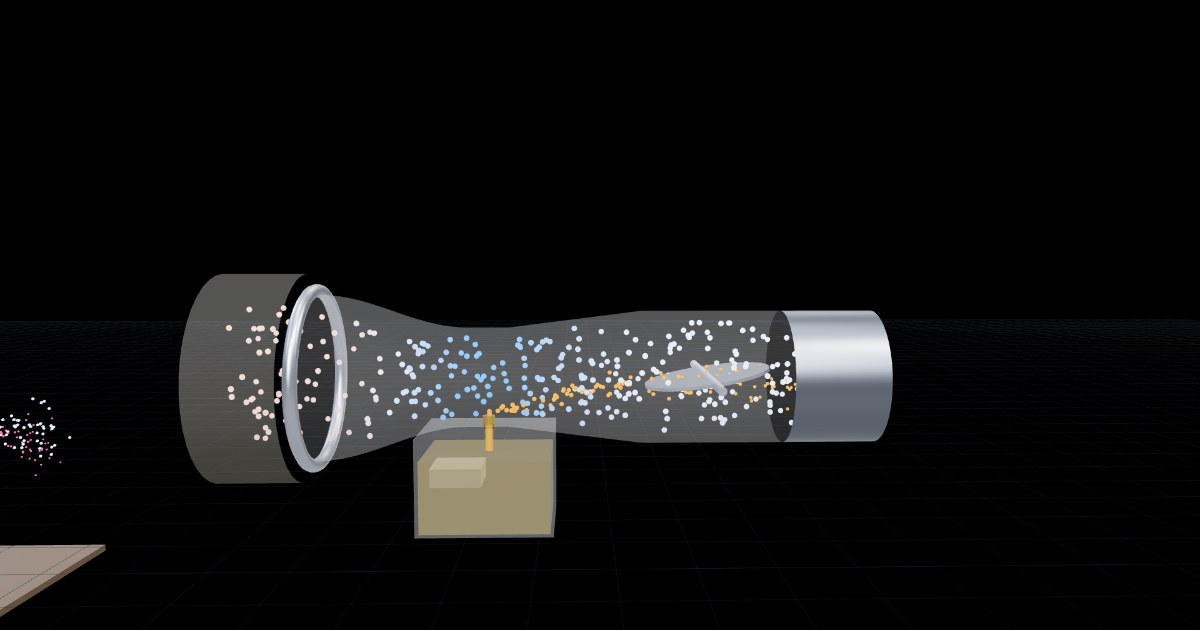
A gas is a crowd of tiny molecules flying about at the speed of a bullet, about 500 metres a second in the air around you. They bump into each other and into every wall. Each bump is a tiny push. Billions of billions of pushes every second add up to the gas's pressure.
Four things describe a gas: its pressure P, its volume V, its temperature T and how much gas n there is (counted in moles: one mole is 6 × 10²³ molecules). Change one and the others must answer.
Boyle's law: squeeze a gas into half the space and its pressure doubles, because the molecules hit the walls twice as often. Charles's law: heat a gas and it swells, because faster molecules push harder. Gay-Lussac's law: heat it in a sealed box and the pressure climbs instead. Avogadro's law: twice the molecules need twice the room.
All four are one rule: PV = nRT, the ideal gas law. R = 8.314 is the gas constant, the same for air, helium or steam. T must be in kelvin: °C + 273. Follow Charles's line down and a gas would shrink to nothing at −273 °C, absolute zero (see ThermoClear).
Your chest grows and air rushes in. An engine squeezes air so fast it gets hot enough to light diesel.
You breathe with Boyle's law. Your diaphragm, a dome of muscle under your lungs, pulls down and your ribs swing out. Your chest gets bigger, so the air in your lungs has more room. More room means lower pressure, only about 100 pascals less, a tenth of a percent. That is enough: air flows in from outside until the pressures match. Relax, the chest shrinks, the pressure rises a little, and air flows out. See LungsClear.
High in the mountains the air is thinner. Each breath still fills the same half litre, but PV = nRT says it holds fewer molecules. At the top of Everest a breath carries only about a third of the oxygen it would at sea level.
Squeeze a gas slowly and its heat has time to leak away, so Boyle's law holds: half the volume, twice the pressure. Squeeze it fast, as an engine does in about a hundredth of a second, and the work you do stays in the gas. It gets hot. That is how a diesel engine works with no spark plug: it squeezes air about 18 times until it is hotter than 500 °C, then sprays in diesel, which bursts into flame. Petrol engines squeeze about 10 times and use a spark. See CarClear and MotorcycleClear.
An AC or fridge compressor does the same to its refrigerant gas, which leaves it at around 90 °C or more. That is why the pipe out of the compressor is hot. See ACClear and FridgeClear.
Seal a gas in and heat it: the pressure climbs. That is Gay-Lussac’s law.
Seal a gas into a space that can't grow and heat it. The molecules speed up and hit the walls harder and more often, so the pressure rises. That is Gay-Lussac's law: pressure goes up in step with the temperature in kelvin.
Your tyres are a sealed space. Pump a car tyre to 32 psi on a cool morning, drive in the afternoon sun, and it can read 35 or more. Every 10 °C adds about 3.4 % to the pressure. The catch: a tyre gauge shows the pressure above the air outside, not the total. The total, the absolute pressure, is what doubles when the kelvin temperature doubles. Always check tyres cold. See CycleClear, CarClear and MotorcycleClear.
A pressure cooker is the same idea put to work. Its lid seals in air and steam. Their pressures add up (Dalton's law) and climb as it heats, until they lift the weight on the vent pipe and it whistles. The weight holds the pressure about 1 bar above the air outside, and at that pressure water only boils at about 120 °C. Food cooks in hotter water, so dal and rice are done in a fraction of the time.
Heat air and it swells, so each litre gets lighter. That is Charles’s law.
Heat air that is free to spread and it swells: that is Charles's law. Warm it from 25 °C to 100 °C and it takes up a quarter more room. The same molecules are spread through more space, so every cubic metre of hot air holds fewer of them and weighs less.
That is all a hot-air balloon needs. Its envelope holds about 2,800 m³ of air, as much as a small house. Heat it to 100 °C and each cubic metre weighs about a quarter of a kilo less than the cooler air outside, enough to lift about 650 kg: the balloon, its basket, the burner and a few people. The formula is density = P M ÷ R T, straight from PV = nRT. As the balloon climbs, the air gets thinner and the lift shrinks, so it settles at the height where lift and weight balance. The first people ever to fly, in 1783, rode a hot-air balloon.
An air fryer does the same in a box (see AirFryerClear). It heats about 6 litres of air to 200 °C. The air swells by more than half, so about a third of it is pushed out of the vent. And every gram of water that steams out of the chips turns into about 2 litres of steam, which must escape too, or the chips would steam instead of crisp.
Squeeze CO₂ and it turns to liquid. An LPG cylinder breaks the rule on purpose. And heavy gases fill jars too.
PV = nRT pretends molecules are tiny points that never pull on each other. For air around you that is almost exactly true: the error is less than 0.1 %. But squeeze a gas hard or make it cold, and the molecules get close enough to take up room and to tug on each other. Then the ideal gas law starts to fail.
In 1869 Thomas Andrews squeezed carbon dioxide in a glass tube. Below 31 °C, at about 60 bar the gas suddenly turned to liquid, and the pressure stopped rising while it did. Above 31 °C, the critical temperature, no squeeze would make a liquid. In 1873 Johannes van der Waals fixed the law with two corrections, one for the molecules' size and one for their pull. The compressibility factor Z shows how far a real gas strays: Z = 1 is ideal.
An LPG cylinder uses this on purpose. As a gas, 14.2 kg of LPG would need about 200 bar to fit in the cylinder. Squeezed, it turns to liquid, and the pressure is set only by the temperature: about 6 bar on a warm day, whether the cylinder is full or nearly empty. That is why you can't tell how much is left from the pressure. See ChimneyClear.
Myth: "gases fill their container because their molecules are light." Not so. Xenon is more than four times heavier than air, and it still fills a jar evenly. What spreads a gas out is motion: its molecules fly at hundreds of metres a second. Gravity only wins over kilometres, which is why the air thins out as you climb a mountain.
A syringe holds 60 mL of air at 1 atm. You block the tip and push the plunger to 30 mL, slowly so it stays at room temperature. What is the pressure now?
2 atm. Boyle’s law: P × V stays the same. Half the volume means twice the pressure, 2 atm. The molecules hit the walls twice as often.
A balloon holds 3 L at 27 °C (300 K). You warm it to 127 °C (400 K) at the same pressure. How big is it now?
4 L. Charles’s law in kelvin: V grows by 400 ÷ 300, so 3 L becomes 4 L. Using °C (27 → 127) would wrongly suggest almost 5 times bigger.
Where does a gas’s pressure actually come from?
Countless molecules hitting the walls and bouncing off. Kinetic theory: each molecule that bounces off a wall gives it a tiny push. More molecules, faster molecules or less room all mean more pushes, and more pressure.
What actually makes air flow into your lungs?
Your chest gets bigger, the pressure inside drops a little, and outside air pushes in. Boyle’s law: more room, lower pressure. The drop is only about 100 Pa, a tenth of a percent, but it is enough for the air outside to push its way in.
At the top of Everest, a breath of the same size holds…
About a third as many molecules. n = PV ÷ RT: the air pressure is only about a third of sea level, so the same half litre holds about a third of the molecules, and of the oxygen.
Why does a diesel engine not need a spark plug?
Squeezing air fast, about 18 times, makes it hot enough to light the diesel sprayed in. A fast squeeze has no time to lose heat, so the work of squeezing heats the air to 500 °C and more. Diesel sprayed into it catches fire by itself.
A car tyre reads 32 psi on a 20 °C morning. After a long drive it is 50 °C inside. Roughly what does the gauge read?
About 37 psi. The absolute pressure (32 + 14.7 = 46.7 psi) rises by 323 ÷ 293, to about 51.5 psi, which the gauge shows as about 37 psi. It can’t be 2.5 times, because kelvin went up only 10 %.
Why does food cook faster in a pressure cooker?
Higher pressure raises water’s boiling point to about 120 °C, so the food sits in hotter water. Water boils when its vapour pressure matches the pressure on it. At about 2 atm that takes about 120 °C, and cooking runs roughly 4 times faster than at 100 °C.
What makes a pressure cooker whistle?
Air and steam pressure lifting the weight off the vent pipe, so gas rushes out. The trapped air and steam push harder as they heat (Gay-Lussac and Dalton). When their total beats the weight, it lifts and a jet of steam screams out.
Why does a hot-air balloon rise?
The same air, heated, spreads out, so each cubic metre weighs less than the cooler air around it. It is the same air, just hotter. By Charles’s law it spreads out, so its density, P M ÷ R T, drops, and the heavier air around pushes it up.
A balloon rises and then stops climbing, with the burner steady. Why?
Higher up the air is thinner, so the difference in weight (the lift) shrinks until it matches the load. Density falls with pressure, inside and out. The lift is proportional to the difference, which shrinks as the balloon climbs, until lift equals weight.
An air fryer heats its air from 25 °C to 200 °C. Roughly what happens to the air inside?
It swells about 1.6 times, so about a third of it is pushed out of the vent. In kelvin, 473 ÷ 298 = 1.59. The box can’t grow, so the extra, about 37 % of the air, leaves through the vent.
For the air in your room, how wrong is PV = nRT?
Less than 0.1 %. At room temperature and 1 atm, air molecules are far apart and fast. The compressibility factor is about 0.999, so the ideal gas law is out by less than a tenth of a percent.
An LPG cylinder’s pressure gauge reads the same when it is full and when it is nearly empty. Why?
While any liquid is left, the pressure is its vapour pressure, which depends only on temperature. The liquid boils off to top up the gas as you use it, holding the pressure at the vapour pressure. Only the last few hundred grams, all gas, show a falling pressure.
Why does xenon, over 4 times heavier than air, still fill a jar from top to bottom?
Its molecules fly at over 200 m/s, and over 1 m gravity barely matters against that motion. Gas spreads by motion. In a 1 m jar the density difference from gravity is about 1 part in 2,000. Only over kilometres does gravity show, with a scale height of about 1.9 km for xenon.
Words worth knowing
Pressure
The push of a gas on each square metre of wall, from its molecules hitting it. Air around you is about 101 kPa.
Ideal gas law
PV = nRT: pressure × volume = moles × 8.314 × temperature in kelvin.
Kelvin
Temperature counted from absolute zero, −273.15 °C. The gas laws only work in kelvin.
Mole
A count of molecules: 6.022 × 10²³. A litre of air holds about 0.04 mol.
Boyle's law
At steady temperature, pressure × volume stays the same.
Charles's law
At steady pressure, volume grows in step with kelvin temperature.
Partial pressure
Each gas in a mixture pushes as if it were alone, and the pushes add up (Dalton's law).
Critical point
Above it, no squeeze can turn a gas into a liquid. For CO₂: 31 °C and 74 bar.
Fork it. Teach with it.
This box is plain HTML, CSS and JavaScript, with no build step and no accounts. Run it yourself and it sends nothing anywhere. The code is MIT. The words, images and videos are CC BY 4.0, so you can reuse them anywhere if you credit “Glassbox, glassbox.how/e/gaslawclear”.