How do the lungs work?

You breathe about 20,000 times a day without thinking. Air flows through your nose, throat and voice box into the windpipe, which splits into two bronchi. They branch about 23 times, ending in roughly 480 million tiny air sacs called alveoli.

You breathe about 20,000 times a day without thinking. Follow one breath from your nose to 480 million tiny air sacs, and watch oxygen slip into your blood.

LungsClearOpened 3 Aug 202615 min to playFree · no sign-up

In 60 seconds

  1. A tree of air

    Air flows through your nose, throat and voice box into the windpipe, which splits into two bronchi. They branch about 23 times, ending in roughly 480 million tiny air sacs called alveoli. The right lung has three lobes; the left has two and a notch for the heart.

  2. Breathing is Boyle's law

    Your lungs have no muscles. The diaphragm flattens and the ribs lift, so the chest gets bigger. The air inside the lungs gets more room, its pressure falls about 1 cmH2O below the air outside, and air flows in. Breathing out at rest is just the lungs springing back.

  3. Swapping gases by diffusion

    Each alveolus is wrapped in capillaries, separated from the air by a wall about 0.5 micrometres thick. Oxygen diffuses from about 100 mmHg in the air sacs into blood arriving at 40; carbon dioxide goes the other way, 46 to 40. Spread flat, the alveoli would cover about 70 square metres.

  4. Haemoglobin does the carrying

    Each haemoglobin molecule holds four oxygen molecules, and its S-shaped binding curve fills blood to about 98% in the lungs. Heat, acid and CO2 make it let go in busy muscles. On Everest the air pressure is a third of sea level, and blood carries far less.

  5. How much air you hold

    A quiet breath is about 500 mL. A full breath out after a full breath in, the vital capacity, is around 4.5 to 5 litres for a young man, and about 1.2 litres always stays behind. How fast you can blow it out shows whether airways are narrowed.

  6. Keeping lungs clean

    Mucus traps dirt and cilia sweep it up to your throat. Smoking slows the cilia, PM2.5 pollution reaches deep into the lungs, and in asthma narrowed airways make breathing much harder, because resistance grows with one over the radius to the fourth power.

Laws at work here

The history

2,000 years from ‘breath of life’ to pulse oximeters, ventilators and the fight for clean air.

Read the full history
  1. 170Galen: breathing cools the heart
  2. 1667Bellows keep a dog alive
  3. 1777Breathing is a slow fire
  4. 1952Students breathe for polio patients
  5. 1974The pulse oximeter

The full explanation

LungsClear, chapter by chapter

Chapter 1

The breathing system

From your nose to 480 million tiny air sacs, in a cage of ribs.

Every breath takes the same journey. Air comes in through your nose (or mouth), where it is warmed, wetted and filtered. It passes the pharynx (your throat) and the larynx, your voice box, where a flap called the epiglottis shuts when you swallow, so food goes down the food pipe instead.

Then comes the trachea, or windpipe: about 11 cm long, held open by C-shaped rings of cartilage. At the carina it splits into two bronchi, and these split again and again, about 23 times, into thinner and thinner bronchioles. At the very ends sit bunches of tiny air sacs, the alveoli. You have about 480 million of them.

Your two lungs are not twins. The right lung has three lobes. The left lung has two, and a dent called the cardiac notch makes room for your heart (see HeartClear). Each lung sits in a slippery two-layer bag, the pleura. Underneath is a dome of muscle, the diaphragm, and all around are the ribs with the intercostal muscles between them.
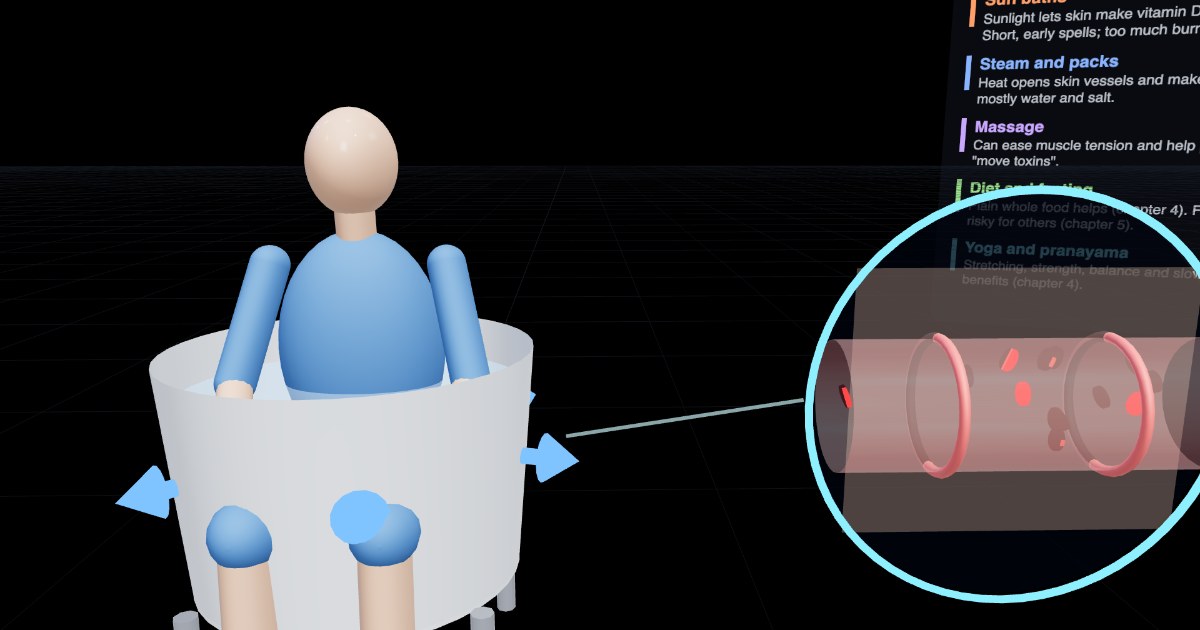
Try “Inside the chest” in the interactive model →

Chapter 2

How we breathe: Boyle’s law

Make the chest bigger, the pressure inside drops, and air rushes in.

Your lungs have no muscles of their own. They are stretchy bags that follow the chest wall, because the thin film of fluid in the pleura sticks them to it, like two wet sheets of glass.

To breathe in, the diaphragm contracts: its dome flattens and moves down. The intercostal muscles lift the ribs up and out, like a bucket handle. The chest gets bigger, so the air inside the lungs has more room. By Boyle’s law (see the gas laws), a gas given more room has a lower pressure. The pressure in your air sacs drops about 1 cmH₂O below the air outside, a change of only 0.1%, and air flows in until the pressures match again.

Breathing out at rest takes no effort at all. The muscles relax and the stretched lungs recoil like a balloon, squeezing the air back out. The bell jar on the left shows the same idea: pull the rubber sheet down and the balloons inside fill up.

A quiet breath is about 500 mL, the tidal volume. Adults at rest breathe 12 to 20 times a minute, so about 6 to 8 litres of air flow in and out every minute.

About 150 mL of each breath only fills the airways, the dead space, and never reaches the air sacs. So slow, deep breaths refresh the air sacs better than fast, shallow ones.

Try “How we breathe” in the interactive model →

Chapter 3

Swapping gases in the alveoli

Oxygen slips into the blood, carbon dioxide slips out, all by diffusion.

At the end of every airway is a bunch of tiny bubbles, the alveoli. Each is about a fifth of a millimetre across, and you have around 480 million. Spread flat, their walls would cover about 70 m², most of a badminton court, all folded into your chest.

Each alveolus is wrapped in a net of capillaries, blood vessels so narrow that red blood cells pass in single file. Between air and blood lies a wall only about 0.5 µm thick, a hundred times thinner than a sheet of paper.

No pump pushes the gases across. They diffuse, spreading from where there is more to where there is less (see diffusion and osmosis). Air in the alveoli has an oxygen partial pressure of about 100 mmHg; blood arriving from the body has only 40. So oxygen moves into the blood. Carbon dioxide goes the other way, from 46 in the blood to 40 in the air. Fick’s law says the flow grows with the area and the pressure difference, and shrinks as the wall gets thicker.

The inside of each alveolus is wet, and a wet bubble wants to collapse. Your lungs make surfactant, a soapy film that lowers the surface tension. By Laplace’s law, P = 2T/r, small bubbles need more pressure to stay open, so without surfactant small alveoli would empty into big ones.

Try “Gas exchange” in the interactive model →

Chapter 4

How blood carries oxygen

Haemoglobin grabs oxygen in the lungs and lets it go where it is needed.

Very little oxygen dissolves in blood plasma. Almost all of it rides on haemoglobin, the protein that makes red blood cells red. Each haemoglobin molecule has four parts, and each part holds an iron atom that can grab one O₂ molecule, so four in all. One red cell carries about 270 million haemoglobin molecules.

Haemoglobin is a team player. Once one oxygen sticks, the others stick more easily. That gives the oxygen–haemoglobin dissociation curve its S shape: at the 100 mmHg in your lungs the blood fills to about 97–98%, and half full needs only about 27 mmHg, the P50. On the steep middle part, small drops in oxygen let lots of it go, right where your tissues need it.

Busy muscles are warmer, more acidic and full of CO₂. All three push the curve to the right, so haemoglobin lets go of more oxygen. That is the Bohr effect.

High up, the air is thinner. At Leh (about 3,500 m) the air pressure is two-thirds of sea level, and on the summit of Everest it is about a third: 253 mmHg. Climbers breathe hard to blow off CO₂, which makes room for more oxygen in the air sacs.

A pulse oximeter shines red and infrared light through your finger. Oxygen-rich blood absorbs less red light and more infrared, so the ratio of the two pulsing signals tells the saturation, SpO₂. Most healthy people read 95% or more at sea level. Readings can be less accurate on darker skin, cold fingers or nail polish, and they are only part of the picture: if you are worried about your breathing or a reading, see a doctor.

Try “Carrying oxygen” in the interactive model →

Chapter 5

How much air your lungs hold

Blow into a spirometer and see your lung volumes drawn as a line.

A spirometer measures how much air you breathe in and out. The old kind is an upturned bell floating in water: breathe out into it and it rises. A pen draws your lung volume on a turning drum, breathing in going up.

A quiet breath, the tidal volume, is only about 500 mL. Breathe in as far as you can and you add the inspiratory reserve, about 3 litres more. Push out as hard as you can and you empty the expiratory reserve, about 1 litre. All of that together is the vital capacity, around 4.5 to 5 litres for a young adult man. Even then about 1.2 litres stays behind, the residual volume, so your lungs never collapse. The total lung capacity is about 6 litres.

Doctors often ask you to blow out as hard and fast as you can. The litres out in the first second are the FEV1; the total is the FVC. Healthy lungs push out about 70 to 85% of the total in that first second. If the airways are narrowed, as in asthma or COPD, the air comes out more slowly and the ratio drops.

Not all the air you breathe is useful. About 150 mL of every breath just fills the nose, throat and airways, the dead space, and never reaches the alveoli.

“Normal” depends on your age, height, sex and ancestry, so a single number means little on its own. Lung tests are read by doctors against the right reference for each person.

Try “Lung volumes” in the interactive model →

Chapter 6

Keeping lungs healthy

How your airways clean themselves, and what smoke, dirty air and illness do.

Every day you breathe in dust, pollen, germs and soot. Your airways clean themselves. They are lined with sticky mucus that traps particles, and millions of tiny hairs called cilia beat 10 to 15 times a second, sweeping the mucus up to your throat, where you swallow it. This is the mucociliary escalator. A cough blasts out anything stuck, with air rushing out at around 8 m/s; a sneeze can throw droplets 7 to 8 metres, so cover it with your elbow.

Smoking coats the airways in tar and slows and damages the cilia, so dirt and germs stay put. In India about 29% of adults use tobacco in some form (GATS-2, 2016–17). Smoke is the main cause of lung cancer and of COPD, a long-term illness where airways stay narrowed and alveoli are destroyed. Smoke from cooking fires can cause COPD too.

Air pollution matters just as much. The tiniest specks, PM2.5, are 30 times thinner than a hair and reach deep into the lungs. The WHO guideline is a yearly average of 5 µg/m³. India’s average is about 50, and Delhi’s is about 100, some 20 times the guideline (IQAir).

In asthma, airways swell and their muscles squeeze. Because resistance grows with 1/r⁴ (see how fluids flow), halving an airway’s radius makes it 16 times harder to breathe through. In pneumonia, an infection fills alveoli with fluid, so oxygen can’t reach the blood. Tuberculosis (TB) is caused by a germ that spreads through coughs; India has about a quarter of the world’s cases (WHO, 2025). TB is curable, and tests and treatment are free at government health centres in India.

These are general facts, not medical advice. A cough that lasts more than two weeks, breathlessness, chest pain or coughing blood are reasons to see a doctor. Moving your body helps your lungs and heart work well together (see where energy goes).

Try “Healthy lungs” in the interactive model →

Test yourself

Frequently asked

How many lobes does each lung have?

Three on the right, two on the left. The left lung is smaller, with only two lobes, because it shares space with the heart.

What stops food going into your windpipe when you swallow?

The epiglottis. The epiglottis is a flap above the larynx that folds down over the airway as you swallow.

Why are the trachea’s cartilage rings open at the back?

To let the food pipe behind it bulge when you swallow. The oesophagus runs right behind the trachea, and the soft back wall lets a mouthful of food squeeze past.

What happens to the pressure in your air sacs when your chest gets bigger?

It falls below the air outside. More volume for the same gas means lower pressure (Boyle’s law), so outside air pushes in.

Which muscle does most of the work of breathing in at rest?

The diaphragm. The diaphragm flattens as it contracts, making the chest taller. Lungs have no muscles to pull air in.

At 15 breaths a minute of 500 mL each, how much air do you breathe per minute?

7.5 L. 15 × 0.5 L = 7.5 L each minute: the minute ventilation.

What moves oxygen from the air sacs into the blood?

Diffusion, from high partial pressure to low. Alveolar air has an oxygen partial pressure near 100 mmHg, incoming blood about 40, so oxygen diffuses in.

By Fick’s law, which change slows gas exchange?

A thicker barrier. Flow is proportional to area times pressure difference, divided by thickness.

What does surfactant do?

Lowers surface tension so alveoli don’t collapse. By Laplace’s law, P = 2T/r. Lowering T keeps small alveoli open.

How many oxygen molecules can one haemoglobin molecule carry?

Four. It has four subunits, each with an iron-containing haem group that binds one O₂.

What does the Bohr effect do in a working muscle?

Helps haemoglobin release more oxygen. Acid, CO₂ and heat shift the curve right, so more oxygen is unloaded where it is needed.

Why is it harder to get oxygen on a high mountain?

The air pressure is lower, so oxygen’s partial pressure is lower. Air is still 21% oxygen, but there is less air pushing on your lungs, so less oxygen diffuses in.

What is the tidal volume?

The air in one quiet breath. A quiet breath moves about 500 mL, like a tide going in and out.

Why can you never empty your lungs completely?

About 1.2 L of residual volume always stays, holding the airways open. The chest wall and small airways stop the lungs emptying fully, so a residual volume stays.

In a hard blow, what happens to FEV1/FVC when airways are narrowed?

It falls. Narrow tubes slow the air, so less comes out in the first second compared with the total.

What do cilia do?

Beat to sweep mucus and trapped dirt up to the throat. They form the mucociliary escalator, moving mucus up and out of the lungs.

If an airway’s radius halves, how much does its resistance go up?

16 times. Resistance goes as 1/r⁴, and 2⁴ = 16.

What is the WHO’s yearly guideline for PM2.5?

5 µg/m³. Since 2021 the WHO guideline is an annual mean of 5 µg/m³; many cities are far above it.

Words worth knowing

Alveoli
The hundreds of millions of tiny air sacs at the ends of the airways, where gases pass between air and blood.
Diaphragm
The dome-shaped muscle under the lungs. It flattens to pull air in and is the main muscle of breathing.
Boyle's law
At a fixed temperature, a gas's pressure falls as its volume grows. It is why a bigger chest pulls air in.
Tidal volume
The air moved in one quiet breath, about 500 mL for an adult at rest.
Partial pressure
The share of a gas mixture's pressure due to one gas. Gases diffuse from high partial pressure to low.
Surfactant
A soapy film lining the alveoli that lowers surface tension so they don't collapse.
Haemoglobin
The iron-containing protein in red blood cells that carries up to four oxygen molecules.
Vital capacity
The most air you can breathe out after breathing in as far as you can.
PM2.5
Airborne particles smaller than 2.5 micrometres, small enough to reach the alveoli. The WHO yearly guideline is 5 micrograms per cubic metre.

Fork it. Teach with it.

This box is plain HTML, CSS and JavaScript, with no build step and no accounts. Run it yourself and it sends nothing anywhere. The code is MIT. The words, images and videos are CC BY 4.0, so you can reuse them anywhere if you credit “Glassbox, glassbox.how/e/lungsclear”.

git clone https://github.com/bdeeps/lungsclear.git

Built with three.js (MIT), Geist, Instrument Serif (SIL OFL 1.1).

←→ previous / next box · / search

Would you like to see the full page, with the interactive model?