An air conditioner doesn't make cold. A split AC has an indoor unit with a cold coil and an outdoor unit with a hot one, joined by two copper pipes. A fluid called the refrigerant flows between them, picking heat up inside your room and dumping it outside.
An air conditioner doesn't make cold. It pumps heat out of your room using a fluid that boils at minus 52 °C. Take a split AC apart in 3D and follow the refrigerant round the loop.
ACClearOpened 10 Jul 202615 min to playFree · no sign-up
In 60 seconds
It moves heat, it doesn't make cold
A split AC has an indoor unit with a cold coil and an outdoor unit with a hot one, joined by two copper pipes. A fluid called the refrigerant flows between them, picking heat up inside your room and dumping it outside.
Squeeze, cool, release, boil
The compressor squeezes refrigerant gas to about 30 bar, heating it to around 95 °C. Outside it gives its heat to the air and condenses into a liquid. It squirts through an expansion valve, drops to about 10 bar and 7 °C, then boils in the indoor coil, soaking up heat.
Low pressure means a cold boil
A liquid's boiling point depends on pressure. Water boils at 100 °C at sea level but at room temperature in a strong vacuum. The refrigerant R-32 boils at −52 °C in open air, so the AC keeps it under pressure to set the temperature it boils at.
Three or four units of heat for one of electricity
A typical 1.5-ton AC pulls 5.3 kW of heat out of a room using about 1.5 kW of electricity, a COP of about 3.5. The hotter it is outside, the bigger the gap it pumps across, and the more electricity each unit of heat takes.
It dries the air too
The indoor coil is colder than the dew point of the room air, so water vapour condenses on its fins, like drops on a cold glass. It drips into a tray and runs out of the drain pipe: a few litres an hour on a sticky day.
Inverters and heat pumps
An old AC switches on and off; an inverter slows its compressor down instead, holding the room steady and using about 30% less energy. Run the loop backwards with a reversing valve and the same machine heats your home: a heat pump.
Two boxes, two copper pipes, and a fluid that carries heat outside.
Here is the big secret: an air conditioner doesn't make cold. It moves heat. It picks heat up inside your room and carries it outside, the way a sponge carries water out of a bucket.
A split AC has two boxes. The indoor unit on your wall holds a dust filter, a cold evaporator coil and a long blower fan that pushes room air through the coil. A tray and a drain pipe catch the water that drips off it.
The outdoor unit holds the compressor, the heart of the machine, a hot condenser coil and a big fan to cool it. Two copper pipes join the boxes. Inside them a fluid called the refrigerant goes round and round, soaking up heat indoors and dumping it outdoors.
Squeeze, cool, release, boil, repeat: the loop that pumps heat.
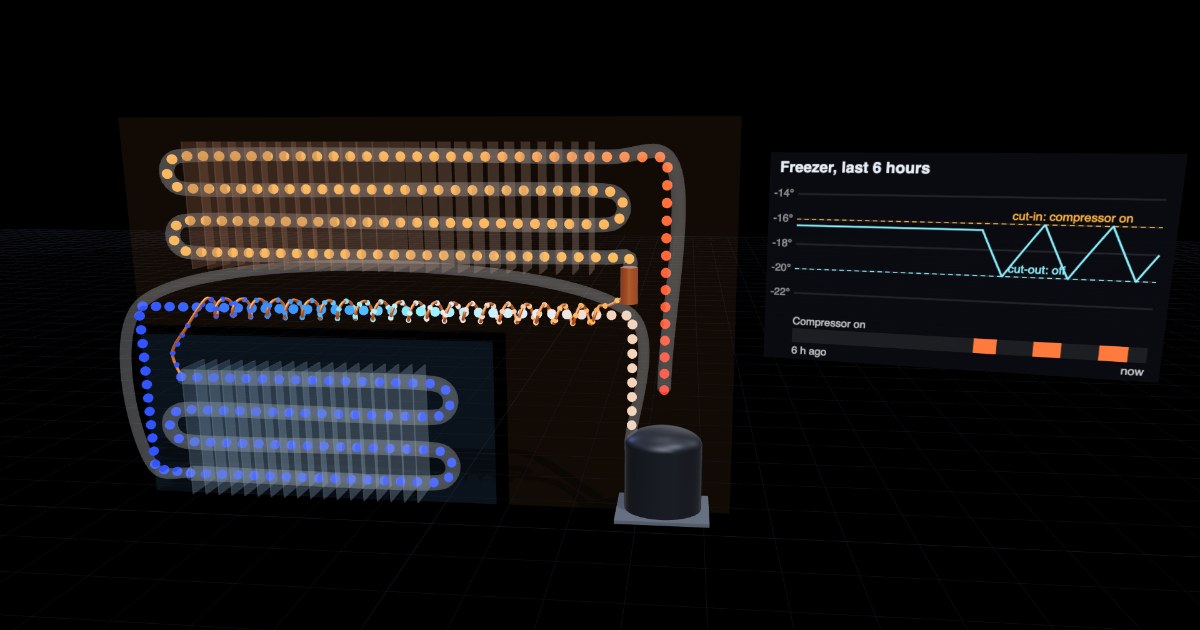
The refrigerant goes round the same loop again and again, changing between gas and liquid. Follow one drop:
1. Compressor. Cool gas gets squeezed hard, to about 30 times the pressure of the air. Squeezing a gas heats it up, so it leaves at around 95 °C: hotter than the hottest summer day.
2. Condenser. Because it is hotter than the outside air, it gives its heat away as a fan blows air over the coil. It cools down and condenses into a warm liquid, just as steam turns to water on a cold window.
3. Expansion valve. The liquid squirts through a tiny opening. On the other side the pressure is much lower, part of it flashes into vapour, and it drops to about 7 °C.
4. Evaporator. Now it is colder than your room. It boils as room air blows over the coil, soaking up heat, and leaves as cool gas, ready to be squeezed again.
Lower the pressure and a liquid boils cold, soaking up heat as it goes.
Water boils at 100 °C, right? Only at sea level. The boiling point depends on the pressure pushing down on the liquid. High on a mountain, where the air is thinner, water boils at about 70 °C. In a strong enough vacuum it boils at room temperature.
Boiling needs heat. Turning a liquid into a gas takes a lot of energy, called latent heat, without making it any hotter. So a boiling liquid keeps pulling heat from whatever is around it. That's why sweat cools you down.
An AC's refrigerant is picked because it boils very cold. R-32 boils at about −52 °C at normal air pressure. The AC keeps it at around 10 bar in the indoor coil, so it boils at a comfortable 7 °C, cold enough to chill air, but not so cold the coil freezes.
An AC moves three or four times more heat than the electricity it uses.
A heater turns 1 unit of electricity into 1 unit of heat. An AC does something cleverer: it uses electricity to move heat, and it can move 3 to 4 times as much heat as the electricity it uses. That ratio is the COP (coefficient of performance).
AC sizes are given in tons: one ton of cooling is 3.517 kW, the heat needed to melt a ton of ice in a day. A typical 1.5-ton split pulls about 5.3 kW of heat out of a room using about 1.5 kW of electricity. Out of the back comes the sum of both: about 6.8 kW of heat.
Moving heat "uphill", from a cool room to a hotter outdoors, gets harder the bigger the gap. So on a scorching day the AC works harder for less, and every degree cooler you set it costs a little more. Labels like EER, SEER and India's ISEER star ratings measure this efficiency.
A coil colder than the dew point pulls water out of the air.
Air always carries some invisible water vapour. How much it can hold depends on its temperature: warm air holds lots, cold air very little. Relative humidity says how full the air is, compared with the most it could hold.
Cool air down and at some point it is full: 100% humidity. That temperature is the dew point. Go any colder and the extra water has to come out as liquid. It's why a cold glass of juice "sweats" on a hot day.
An AC's evaporator coil is usually around 10 °C, well below the dew point of a humid room. Water condenses on the fins, drips into a tray and runs out of the drain pipe. On a sticky day a 1.5-ton AC can pull out a few litres an hour, and drier air feels cooler, because your sweat evaporates more easily.
Slow down instead of switching off, and run the loop backwards to heat.
An old fixed-speed AC has one setting: full blast. A thermostat switches it on when the room gets a degree too warm and off when it is a degree too cool. The room swings up and down, and every start wastes energy while the coils get cold again.
An inverter AC changes the speed of its compressor motor. It runs flat out to cool the room down, then slows to just the speed that matches the heat leaking in. The room stays steady, and a slower compressor works more efficiently, so it uses less electricity: often 30% or more less.
One more trick: a reversing valve can send the refrigerant round the loop the other way. Now the indoor coil is the hot condenser and the outdoor coil is the cold evaporator, pulling heat in from the winter air. That's a heat pump, and it heats a room using a third of the electricity of a heater.
Moves heat from inside to outside. It pumps heat out of the room. The cold coil is just where the heat gets picked up.
Where is the compressor in a split AC?
In the outdoor unit. The noisy, hot parts, the compressor and condenser, live outside.
Why does an AC have a drain pipe?
Water from the air condenses on the cold coil and must go somewhere. The evaporator is colder than the dew point, so water drips off it into a tray and out.
Where does the refrigerant give its heat away?
In the condenser, outdoors. The condenser is hotter than the outside air, so heat flows out of it.
Why does the compressor make the gas so hot?
Squeezing a gas heats it up. Squashing a gas packs its energy into less space, so its temperature rises.
What happens just after the expansion valve?
Pressure drops and the refrigerant gets very cold. At low pressure the liquid starts to boil at a low temperature, so it becomes cold.
What happens to water’s boiling point when you lower the pressure?
It falls. Less pressure pushing down means molecules escape more easily, so it boils at a lower temperature.
Why does evaporating liquid cool things down?
Turning liquid into gas takes heat from the surroundings. The latent heat needed to boil is drawn from whatever the liquid touches.
Why is R-32 kept at about 10 bar in the indoor coil?
So it boils at about 7 °C, not −52 °C. Pressure sets the boiling point. At 10 bar R-32 boils at a useful 7 °C.
A 1.5-ton AC removes 5.3 kW of heat using 1.5 kW. How much heat comes out of the outdoor unit?
About 6.8 kW. Energy is never lost: the heat from the room plus the electricity both end up outside.
What happens to an AC’s efficiency on a hotter day?
It goes down. The bigger the temperature gap it pumps across, the more work each unit of heat needs.
How much cooling is 1 ton of refrigeration?
3.517 kW. It is the heat to melt a (short) ton of ice in 24 hours: 12,000 BTU per hour, or 3.517 kW.
What is the dew point?
The temperature where air is saturated and water starts to condense. Below the dew point the air can’t hold all its vapour, so liquid water forms.
Why does water drip from an AC?
Vapour in room air condenses on the cold coil. The coil is colder than the dew point, so vapour turns to liquid on its fins.
What happens if the coil is warmer than the dew point?
No water condenses. Air only gives up water when it is cooled below its dew point.
How does an inverter AC keep a room cool?
It slows its compressor to match the heat coming in. Running slower and steady avoids on-off swings and wasted starts.
Why does an inverter usually save energy?
A compressor running slower works more efficiently and avoids start-up losses. Part-load running raises the COP, and no energy is wasted re-cooling the coils after each start.
What does a reversing valve do?
Sends refrigerant the other way so the AC heats instead. Swapping the flow swaps which coil is hot and which is cold.
Words worth knowing
Refrigerant
The fluid that circulates in an AC, boiling indoors to absorb heat and condensing outdoors to release it. Many new ACs use R-32.
Compressor
The pump that squeezes refrigerant gas, raising its pressure and temperature and driving it round the loop.
Evaporator
The cold indoor coil, where the refrigerant boils and takes heat from the room air.
Condenser
The hot outdoor coil, where the refrigerant condenses back to liquid and gives its heat to the outside air.
Expansion valve
A narrow opening that drops the refrigerant's pressure, so it becomes cold enough to absorb heat.
Latent heat
The energy a liquid takes in as it turns to gas, without getting any hotter.
COP
Coefficient of performance: heat moved divided by electricity used. About 3.5 for a good AC on a hot day.
Dew point
The temperature at which air is saturated with water vapour. Cool it further and water condenses out.
Fork it. Teach with it.
This box is plain HTML, CSS and JavaScript, with no build step and no accounts. Run it yourself and it sends nothing anywhere. The code is MIT. The words, images and videos are CC BY 4.0, so you can reuse them anywhere if you credit “Glassbox, glassbox.how/e/acclear”.