What are density and buoyancy?

Density and buoyancy: F = ρ × V × g. Density is how much mass is packed into each bit of space. A fluid pushes up on anything in it with the weight of the fluid it pushes aside, so things less dense than the fluid float and denser things sink.

Why does a 100,000-tonne steel ship float while a nail sinks? Lower blocks of cork, ice, iron and gold into a brim-full can, load a cargo ship to its Plimsoll line, test Archimedes' crown, fly a hot-air balloon, dive a submarine and float in the Dead Sea.

Density and buoyancyOpened 27 Sept 202612 min to playFree · no sign-up

In 60 seconds

  1. Density and the upward push

    Density is mass ÷ volume: water is 1 g/cm³, cork 0.24, iron 7.87, gold 19.3. A fluid pushes up with the weight of the fluid pushed aside, F = ρ × V × g. Less dense than the fluid, it floats with ρ_object ÷ ρ_fluid under the surface: 92% for ice.

  2. Ships, clay and a crown

    A steel ship floats because its hollow hull averages less than 1 g/cm³. Load lines show how deep it may sit, a little deeper in fresh water than salt. A clay lump sinks but a clay bowl floats, and silver mixed into a gold crown makes it bigger, so water pushes it up harder.

  3. Floating on air

    Air at 100 °C is 20% lighter than at 20 °C, so a balloon of it lifts hundreds of kilograms. Hot water floats to the top of a geyser, and cold AC air sinks, which is why the AC goes high on the wall.

  4. Swimmers, fish and submarines

    A big breath makes most people float. Fish tune their density with a gas-filled swim bladder, submarines with ballast tanks. Salt makes water denser until a fresh egg floats, and liquids stack by density.

  5. Surprises and myths

    Water is densest at 4 °C, so lakes freeze from the top down. The Dead Sea, 1.24 g/cm³, holds a fifth of you out of the water. Astronauts train neutrally buoyant in a 12 m pool. Heavy logs float and small nails sink, and deep water doesn't float a boat any better.

Where you'll meet it

F = ρ × V × g

buoyant force = fluid density × volume under the surface × g: the weight of the fluid pushed aside. Density is mass ÷ volume (ρ = m ÷ V). Anything less dense than the fluid floats, with ρ_object ÷ ρ_fluid of it under the surface; anything denser sinks.

The history

From a king's crown in Syracuse to stitched ships, balloons, bathyscaphes and submarines.

Read the full history
  1. 250 BCEArchimedes writes On Floating Bodies
  2. 1612Why ice floats: Galileo's floating bodies
  3. 1876The Plimsoll line becomes law
  4. 1960The bathyscaphe Trieste reaches the deepest sea

The full explanation

Density and buoyancy, chapter by chapter

Chapter 1

Density decides what floats

Same size, very different mass. The water pushes up with the weight of what you push aside.

Pick up a cork and an iron block of the same size. The iron is about 33 times heavier. That difference is density: how much mass is packed into each bit of space.

ρ = m ÷ V

ρ (the Greek letter rho) is density, m is mass and V is volume. The SI unit is kg/m³; in the kitchen we use g/cm³. Water is 1 g/cm³, which is 1,000 kg/m³: one litre has a mass of one kilogram. To measure a density, weigh the object, find its volume (with a ruler, or by how much water it pushes aside) and divide.

Now lower a block into water. The water it pushes aside wants its place back, so it pushes up. Archimedes worked out how hard, over 2,200 years ago: the buoyant force equals the weight of the fluid pushed aside.

F = ρfluid × Vsubmerged × g

The upward push comes from pressure: water pushes harder on the bottom of the block, which is deeper, than on its top (see PressureClear). So:

If the object is less dense than the fluid, it sinks only until it has pushed aside its own weight of fluid, then it floats. The fraction under the surface is ρobject ÷ ρfluid. Ice is 0.917 g/cm³, so about 92% of an ice cube, or of an iceberg in fresh water, hides below the surface.

If it is denser, even a fully sunk block can't push aside enough, so it sinks. It still feels lighter: the spring balance reads less underwater. Weight itself is gravity's pull (see GravityClear), and Newton's laws say the block settles where the forces balance (NewtonClear).
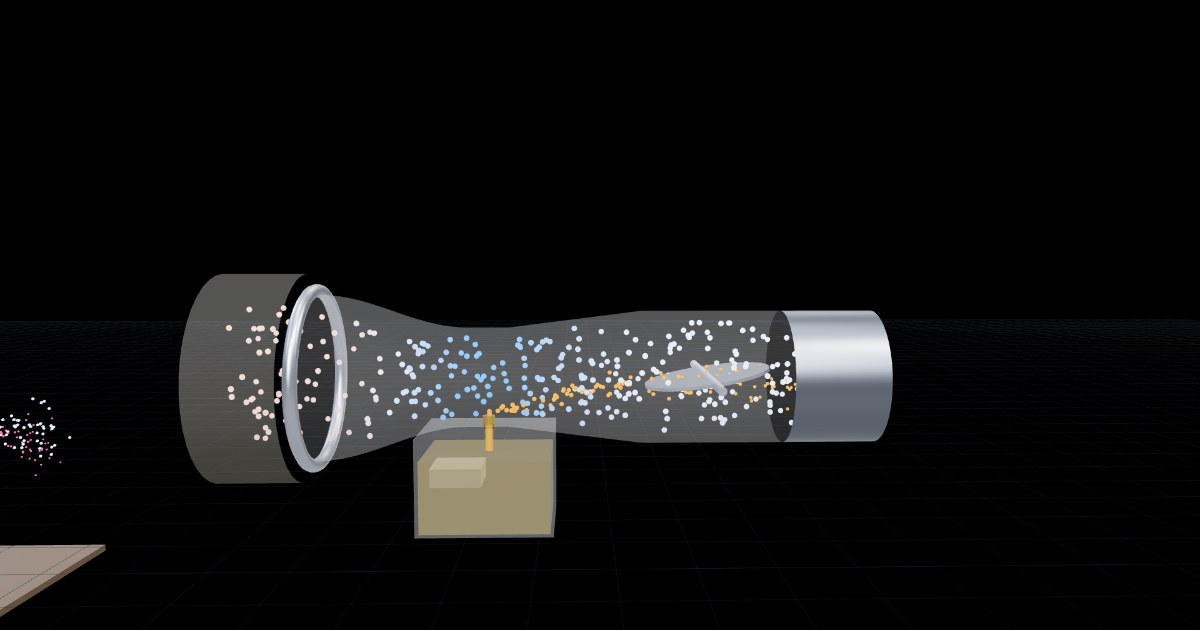
Try “Density and floating” in the interactive model →

Chapter 2

Why a steel ship floats

Shape it right and even steel or clay floats. Load it wrong and it sinks.

Steel is almost 8 times as dense as water, so a steel bolt sinks. A steel ship floats because of its shape. The hull is a huge hollow bowl: it pushes aside a lot of water while the steel itself takes up very little space. What matters is the average density of the whole ship, steel plus the air inside, and that is well below 1 g/cm³.

As you load cargo, the ship sinks deeper until the water it pushes aside weighs as much as ship plus cargo. That is its displacement. How deep the bottom sits is the draft. Load too much and there is too little hull left above the water, the freeboard, to ride out waves.

In 1876 a British MP, Samuel Plimsoll, got a law passed that made every ship carry a load line mark: a circle with a line through it. Next to it, short lines show how deep it may go in tropical, summer and winter seas, and in fresh water. Sea water (about 1.025 g/cm³) holds a ship up a little more than fresh water (1.000), so the same ship floats about 2.5% deeper in a river port like Kolkata than out at sea.

You can try it with clay. A 50 g lump sinks. Press the same clay into a bowl and it floats, and can even carry coins. A folded lotus leaf works even better: it is light, and its waxy skin keeps water out.

Archimedes is said to have used the same idea to test a king's crown. Gold is 19.3 g/cm³; silver is 10.5. A crown with silver mixed in is bigger than the same mass of pure gold, so it pushes aside more water.

Try “Ships and boats” in the interactive model →

Chapter 3

Floating on air: balloons, geysers and AC

Warm air and warm water are a little lighter, so they rise. Cold sinks.

Air is a fluid too, so Archimedes works in air. Everything around you is pushed up by the weight of the air it displaces. For you that is only about 0.08 kg worth, so you don't notice. For a balloon it is everything.

Heat air and its molecules spread out, so the same volume holds fewer of them. Air at 100 °C is about 20% lighter than air at 20 °C. Fill a 2,800 m³ envelope with it and the lighter air inside floats on the heavier air outside, lifting 600 kg or more. That is how the Montgolfier brothers flew in 1783. Pilots like to fly in cool early mornings: the colder the air outside, the bigger the difference, the more lift.

Helium is lighter still, 0.17 kg/m³ against air's 1.2, so a party balloon floats even when cold.

Water does the same. Water at 60 °C is 1.5% lighter than at 20 °C, so in a geyser the hot water rises and collects at the top, right where the outlet pipe draws from (see WaterHeaterClear). The cold inlet comes in at the bottom.

And the air in your room: cold air sinks. A split AC is mounted high on the wall so its cold air falls through the whole room and stirs it (see ACClear). Mount it low and the cold air pools on the floor while warm air stays floating under the ceiling. Heaters work best low for the same reason. This rising of warm fluid is convection (HeatClear). Sunshine warms the ground, warm moist air rises in bubbles called thermals, cools as it climbs and makes puffy clouds. Kites and eagles ride those thermals.

Try “Air and heat” in the interactive model →

Chapter 4

Swimmers, fish, submarines and eggs

A breath of air, a bag of gas, a tank of sea water or a spoon of salt tips the balance.

Your body is very close to the density of water. Fat is about 0.90 g/cm³, muscle and bone together about 1.10, so most people average 0.98 to 1.05 g/cm³. The big switch is your lungs (see LungsClear). Breathe all the way in and you add about 6 litres of air: almost everyone floats. Breathe out and you sink slowly. That is why swimming teachers say "take a big breath and lie back".

Fish have a built-in balloon, the swim bladder. Fish flesh is about 1.07 g/cm³, so a bladder of about 7% of the body lets a river fish hover without swimming; sea fish need only about 5% because sea water is denser. Submarines copy the trick with ballast tanks. An Indian Navy Kalvari-class submarine floats at 1,615 tonnes. Let about 160 tonnes of sea water into its tanks and it weighs exactly as much as the sea it displaces, so it can hover. Blow the tanks with compressed air and it rises.

Try the egg test in your kitchen. A fresh egg sinks in plain water. Stir in salt and the water gets denser, until the egg floats. Old eggs lose water through the shell and grow a bigger air pocket, so they stand on end, then float even in plain water.

Density also separates mixtures. Oil floats on water, honey sinks under both, and cream (malai) rises to the top of boiled milk because milk fat is lighter than the rest. Grit settles to the bottom of a water tank. In an RO purifier's storage tank a float switch rides up on the water and turns the pump off when the tank is full (see ROClear).

Try “Around us” in the interactive model →

Chapter 5

Ice on top, salty seas, space pools and myths

Water is weird at 4 °C, salt lets you lie on the sea, and heavy things can float.

Almost everything gets denser as it cools. Water does too, until 4 °C. Below that it starts to expand again, and when it freezes it expands by about 9%: ice is only 0.917 g/cm³. So a lake cooling in winter first mixes until it is 4 °C all through. After that, the colder water stays on top, ice forms at the surface and floats, and the bottom stays at about 4 °C. Fish survive the winter under the lid of ice. If ice sank, lakes would freeze solid from the bottom up.

The Dead Sea, between Jordan and Israel, is so salty that its water is about 1.24 g/cm³. People float with a fifth of their body out of the water and read a newspaper lying on their back. You can't dive in it; you bob back up.

Astronauts practise spacewalks underwater. NASA's Neutral Buoyancy Laboratory in Houston is a pool 62 m long and 12 m deep. Divers add small lead weights and foam to each suited astronaut until they neither rise nor sink. It feels like floating in space, but it isn't quite: water drags on every move, and inside the suit you still feel your weight pressing on the shoulders.

Myth: heavy things sink. No: dense things sink. A 390 kg pine log floats while a 5 g nail sinks, because the log is 0.5 g/cm³ and the iron is 7.9. Buoyancy compares densities, not weights.

Myth: a boat floats better in deep water. No: the push depends on how much water the hull pushes aside, not on how much water is underneath. The same boat sits at the same depth in a 2 m canal and in the open ocean, as long as its bottom doesn't touch.

Try “Surprises and myths” in the interactive model →

Test yourself

Frequently asked

A 2 kg stone has a volume of 800 cm³. What is its density?

2.5 g/cm³. ρ = m ÷ V = 2,000 g ÷ 800 cm³ = 2.5 g/cm³. It is denser than water, so it sinks.

A block that weighs 30 N in air reads 20 N on a spring balance when fully under water. What is the buoyant force?

10 N. The balance reads weight minus buoyant force: 30 − F = 20, so F = 10 N. That is also the weight of the water the block pushed aside (about 1 litre).

Ice has a density of 0.92 g/cm³. Floating in fresh water, how much of an ice cube is under the surface?

92%. A floating object sinks until it pushes aside its own weight of water. The fraction under is ρ_ice ÷ ρ_water = 0.92, so 92% is hidden.

Why does a steel ship float when a steel bolt sinks?

The hollow hull pushes aside its own weight of water, so its average density is less than water’s. The hull encloses a big volume of air. Averaged over that volume, the ship is less dense than water, so it floats once it has pushed aside its own weight.

A loaded ship sails from the sea into a freshwater river. What happens?

It sinks a little deeper. Fresh water (1.000) is less dense than sea water (1.025). To push aside the same mass of water, the ship must sink about 2.5% deeper, which is why load lines have a separate fresh-water mark.

A 1 kg crown secretly contains silver. Balanced against 1 kg of pure gold and lowered into water, which side rises?

The crown side. Silver is less dense, so the crown has a bigger volume, pushes aside more water and is pushed up harder. Its side of the balance rises.

Why does a hot-air balloon rise?

The hot air inside is less dense than the cooler air it displaces. The envelope displaces its own volume of outside air. The warm air inside weighs less than that, so the difference is an upward force.

Why do balloon pilots prefer to fly early on cool mornings?

Cooler outside air is denser, so the same hot air inside gives more lift. Lift depends on the difference in density between outside and inside. Cold outside air makes that difference bigger.

Why is a split AC usually mounted high on the wall?

Cold air is denser and sinks, so from high up it falls through and mixes the whole room. Cold air falls. From near the ceiling it tumbles down through the room. Mounted low, the cold air would just pool on the floor.

Why do you float more easily after a big breath in?

The extra air raises your volume but hardly your mass, so your average density drops. Six litres of air weigh about 7 g but add 6 litres of volume. Your average density falls below the water’s, so you float.

How does a submarine dive?

It lets sea water into its ballast tanks until it is as dense as, or denser than, the sea. Flooding the ballast tanks adds mass without changing the hull’s volume, so its average density rises to match or beat the sea’s.

A fresh egg sinks in tap water. What makes it float?

Adding sugar or salt to make the water denser. Dissolved salt makes the water denser. Once the water is denser than the egg (about 1.08 g/cm³), the egg floats.

Why do lakes freeze from the top down?

Water below 4 °C, and ice, are lighter than 4 °C water, so the coldest water stays on top. Water is densest at about 4 °C. Colder water and ice float on top of it, so the ice forms on the surface and the bottom stays near 4 °C.

A 400 kg log floats and a 5 g nail sinks. Why?

Floating depends on density, not weight: wood is less dense than water and iron is denser. Buoyancy compares the object’s density with the water’s. Pine is about 0.5 g/cm³, iron 7.9, water 1.0.

A boat floats in 10 m of water. It moves into a 3 m deep canal (its draft is 1.2 m). What happens to its draft?

It stays the same. The buoyant force depends only on the volume of water the hull displaces, not on the water below it. Only if the water is shallower than the draft does it touch bottom.

Words worth knowing

Density (ρ)
Mass divided by volume, in kg/m³ or g/cm³. Water is 1,000 kg/m³.
Buoyant force
The upward push of a fluid, equal to the weight of the fluid displaced.
Archimedes' principle
F = ρ_fluid × V_submerged × g: a body in a fluid is pushed up by the weight of the fluid it pushes aside.
Displacement
The fluid an object pushes aside; for a ship, the mass of water equal to the ship's own mass.
Average density
Total mass over the total volume enclosed, air spaces included. It decides whether a ship floats.
Neutral buoyancy
Exactly as dense as the surrounding fluid, so it neither rises nor sinks.
Convection
Warm, lighter fluid rising and cool, denser fluid sinking, carrying heat with it.
Load line
The Plimsoll mark on a ship's side showing the deepest it may legally float.

Fork it. Teach with it.

This box is plain HTML, CSS and JavaScript, with no build step and no accounts. Run it yourself and it sends nothing anywhere. The code is MIT. The words, images and videos are CC BY 4.0, so you can reuse them anywhere if you credit “Glassbox, glassbox.how/e/buoyancyclear”.

git clone https://github.com/bdeeps/buoyancyclear.git

Built with three.js (MIT), Geist, Instrument Serif (SIL OFL 1.1).

←→ previous / next box · / search

Would you like to see the full page, with the interactive model?