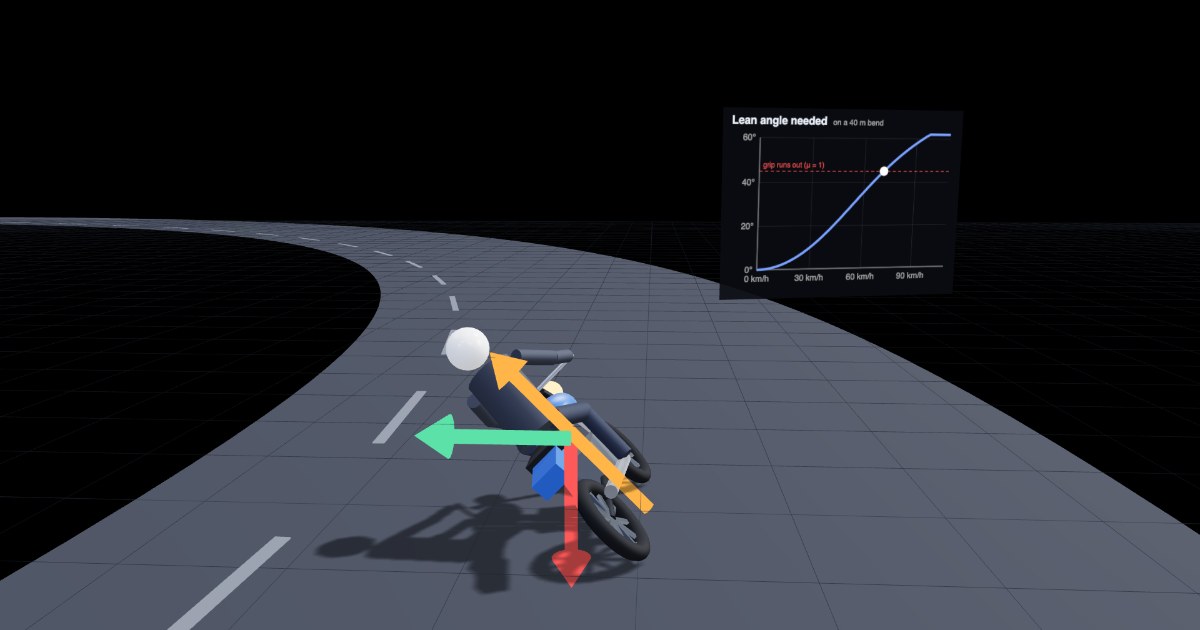
What are electric current and voltage?

Electric current and voltage: I = Q ÷ t. Current is how much electric charge flows past a point each second; voltage is how much energy each bit of charge carries, the push that drives it. A torch cell gives a push of 1.5 volts; a torch bulb lets through about 0.3 amps.

Current is a flow of charge, voltage is the push behind it. Build a torch and count the electrons, light fairy lights in series and in parallel, switch on a geyser and an AC in an Indian home, drain a phone and an electric car, and find out why a bird on a wire is safe but wet hands are not.

Electric current and voltageOpened 27 Sept 202612 min to playFree · no sign-up

In 60 seconds

  1. Flow and push

    Current is charge flowing past a point each second, I = Q ÷ t, in amperes. Voltage is the energy each coulomb carries, in volts. In a torch, electrons crawl at about 0.1 mm/s, but the push races round the loop near light speed, so the bulb lights at once. Diagrams show current from + to −; electrons go the other way.

  2. Series and parallel

    Bulbs in series share the voltage and all go out if one breaks, like old fairy lights. In parallel each gets the full voltage and their currents add up, like the sockets in a house. A fuse melts when the current gets too big, such as in a short circuit.

  3. Home electricity

    Indian mains is 230 V AC at 50 Hz; the US uses 120 V at 60 Hz. Live, neutral and earth wires run to every socket. A fan takes 0.3 A, an AC about 7 A and a geyser 8.7 A, so the geyser needs a 16 A socket. MCBs trip on overload; an RCCB trips when 30 mA leaks to earth.

  4. Batteries and power

    A cell turns chemical energy into electrical energy: 1.5 V for an AA, 3.7 V for lithium-ion, 12 V for six lead-acid cells, nearly 400 V for an EV pack. Energy stored is volts × amp-hours, in watt-hours; power is P = V × I.

  5. Safety and myths

    Current, not voltage alone, harms you: about 1 mA is felt, 10 mA can stop you letting go, 100 mA can kill. Wet skin lets far more through. A bird on one wire is safe. A battery stores chemical energy, not electrons, and higher voltage does not always mean more current.

Where you'll meet it

I = Q ÷ t

current = charge ÷ time, in amperes (1 A = 1 coulomb per second). Voltage is energy per charge, V = E ÷ Q, in volts (1 V = 1 joule per coulomb). Together they give the power: P = V × I

The history

From amber that pulls on feathers to the ampere defined by counting electrons: how people learned what flows in a wire and what pushes it.

Read the full history
  1. 600 BCEAmber that pulls feathers
  2. 1747Plus and minus
  3. 1800The Volta pile: the first battery
  4. 1879Electric light in Calcutta
  5. 1897India's first hydroelectric station
  6. 2018Every village electrified

The full explanation

Electric current and voltage, chapter by chapter

Chapter 1

Current is a flow, voltage is a push

Build a torch: count the charge flowing each second, and the energy each coulomb carries.

Everything is made of atoms, and atoms hold tiny particles with electric charge: positive protons and negative electrons. In a metal wire some electrons are free to wander. Charge is measured in coulombs (C). One coulomb is the charge of about 6.24 billion billion electrons.

Current is how much charge flows past a point each second: I = Q ÷ t. Its unit is the ampere (A), one coulomb per second. An ammeter measures it, placed in the loop so the flow passes through it. A torch bulb takes about 0.3 A.

Voltage is the push: the energy each coulomb carries from the battery to the bulb. Its unit is the volt (V), one joule per coulomb. A voltmeter measures it across a part, one lead on each side. Each AA cell gives 1.5 V; put two in a row and each coulomb picks up 3 joules. How much current that push drives depends on the resistance, which is Ohm’s law (see OhmsLawClear).

Two surprises. The electrons crawl: about 0.1 mm per second in a torch wire, slower than a snail. But the wire is already full of them, and the push races round the loop at nearly the speed of light, so the bulb lights at once. And the arrows on circuit diagrams point the “wrong” way. Conventional current flows from + to −, a choice Benjamin Franklin made in the 1740s, long before anyone knew electrons exist. Electrons, being negative, really drift from − to +.

Think of water in a pipe: the battery is a pump, voltage is the pressure, current is the flow. It helps, but it breaks down. Cut a pipe and water pours out; cut a wire and nothing leaks, the current just stops. And the pipe does not need to be a loop, but a circuit does.
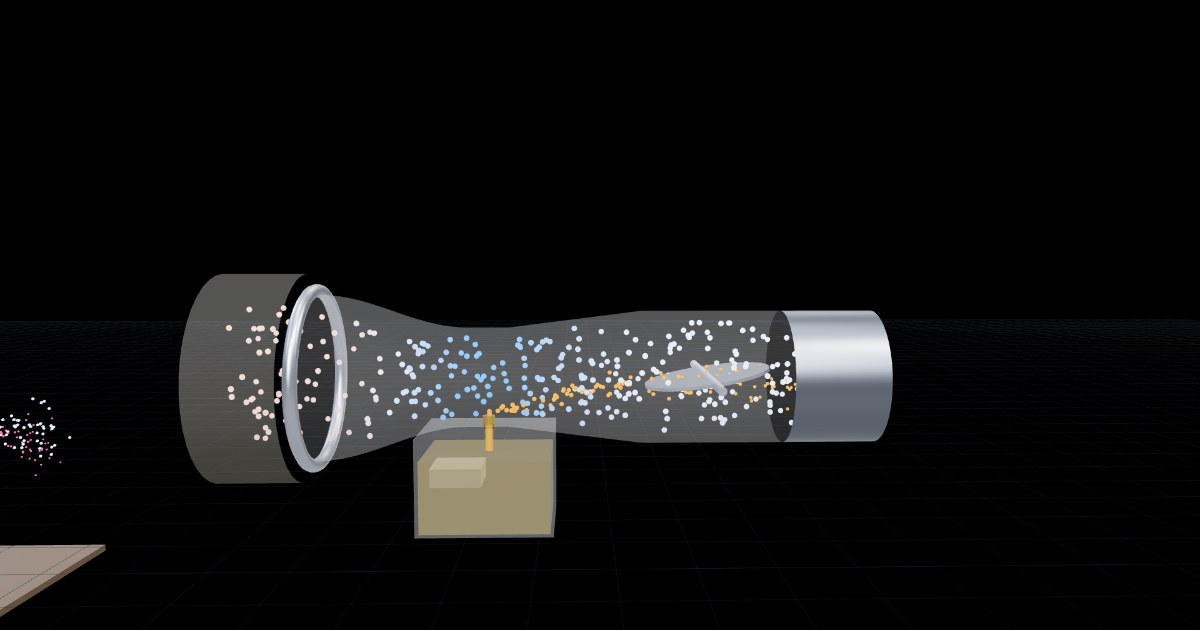
Try “Flow and push” in the interactive model →

Chapter 2

One path or many

Fairy lights and house wiring: how current splits, why bulbs dim, and what a fuse is for.

There are two ways to connect several things to one battery. In series they sit one after another in a single loop, like beads on a string. In parallel each one gets its own path between the battery’s two ends, like the rungs of a ladder.

Series: the same current flows through every bulb, but they share the battery’s voltage. Two bulbs get half each, three get a third, so each glows far dimmer. Worse, if one bulb breaks, the loop is broken and all go dark. Old fairy lights were wired like this: about 50 little bulbs sharing 230 V, and one dead bulb meant hunting along the whole string.

Parallel: every bulb gets the full voltage and shines at full brightness, and one broken bulb does not affect the others. The currents add up: four bulbs take four times the current from the battery. Your house is wired in parallel, so every socket gets the full 230 V and each switch controls only its own branch.

That adding-up is why we need fuses. A fuse is a thin wire in the main line that melts if the current gets too big, breaking the loop before the wiring overheats. A short circuit, a thick wire straight across the battery with no bulb in the way, drives a huge current. Chapter 3 shows the MCBs that do this job in a home.

Try “Series & parallel” in the interactive model →

Chapter 3

The electricity in your walls

230 volts that swap direction 50 times a second: live, neutral and earth, MCBs and RCCBs.

The sockets in an Indian home supply 230 V of alternating current (AC) at 50 hertz: the push flips direction 50 times a second, so the electrons in the wires just jiggle back and forth. In the USA it is 120 V at 60 Hz. A battery gives direct current (DC), a steady push one way. An inverter turns a battery’s DC into AC for your home during power cuts (see UPSClear). AC won because a transformer can easily step its voltage up for long-distance lines and back down for homes (see FaradayClear).

Three wires come to each socket. Live (brown, or red in older Indian homes) carries the push. Neutral (blue, or black) is the return path. Earth (green, or green and yellow) is a safety wire bolted to metal cases and to a rod in the ground. Everything is wired in parallel (chapter 2), so every appliance gets the full 230 V.

Each appliance draws I = P ÷ V. A ceiling fan takes about 0.3 A, an AC about 7 A and a 2 kW geyser 8.7 A. That’s why a geyser needs a big 16 A socket: its current would overheat a small 6 A one. The same 2 kW in the USA takes 17 A, so big American heaters run on 240 V instead.

In the distribution board, each circuit has an MCB (miniature circuit breaker): a switch that trips when too much current flows, like a fuse you can reset. The RCCB watches for current leaking to earth. If live and neutral differ by just 30 mA, current is going somewhere it shouldn’t, maybe through a person, and it cuts the power in a few hundredths of a second. What you pay for is energy: one unit on the bill is one kilowatt-hour (see WorkClear).

Try “Home electricity” in the interactive model →

Chapter 4

Chemical energy on tap

From an AA cell to an electric car: volts, amp-hours, watt-hours and P = V × I.

A cell turns chemical energy into electrical energy. It has two different materials, the electrodes, in a chemical called the electrolyte. Their reaction pushes electrons out of the negative electrode, round the circuit and into the positive one. Inside the cell the loop is closed by ions, charged atoms drifting through the electrolyte. A battery is several cells joined together.

The chemistry sets the voltage: 1.5 V for an alkaline AA cell, about 3.7 V for a lithium-ion cell, 2.1 V for each lead-acid cell. Join cells in series and the voltages add: six lead-acid cells make a 12 V car battery, and about 96 lithium cells make an electric car’s pack of nearly 400 V (see CarClear).

How long it lasts depends on its capacity. A phone battery might say 5,000 mAh: it could give 5 A for one hour, or 0.5 A for ten. Multiply by the voltage and you get the energy it stores in watt-hours: 3.7 V × 5 Ah = 18.5 Wh. An electric car stores about 30,000 Wh, the same as 1,600 phones.

The rate of using energy is power: P = V × I, in watts (see WorkClear). Divide the energy by the power and you get the running time. Your body runs on electricity too: nerve cells fire tiny voltage pulses of about a tenth of a volt (see NervousClear).

Try “Batteries & power” in the interactive model →

Chapter 5

What really hurts, and two myths

Birds on wires, wet hands, lightning, and why volts alone don’t tell you the current.

A bird on a power line is safe. Both its feet are on the same wire, so there is almost no voltage between them: about a thousandth of a volt. With no difference in push, almost no current flows through the bird. If a big bird’s wing touches the wire and the earthed pole at the same time, it bridges thousands of volts and is killed. This really happens to vultures and eagles on Indian power poles.

What harms you is the current through your body, and that depends on the voltage and your resistance: I = V ÷ R. Dry skin resists strongly. Wet skin resists about a hundred times less, so the same 230 V drives a hundred times the current. About 1 mA can be felt, about 10 mA makes your muscles clench so you can’t let go, and about 100 mA across the chest can stop the heart. That’s why RCCBs trip at 30 mA, and why you never touch switches with wet hands.

Lightning is the extreme: about 30,000 A and hundreds of millions of volts, for a few millionths of a second. A lightning rod gives it a thick metal path to the ground. In India lightning kills nearly 3,000 people a year: in a storm, go indoors, and stay away from lone trees and open fields.

Myth: “a battery stores electrons.” It doesn’t. It stores chemical energy. Every electron that leaves the − end comes back in at the + end, so a flat battery has just as many electrons as a full one (chapter 4).

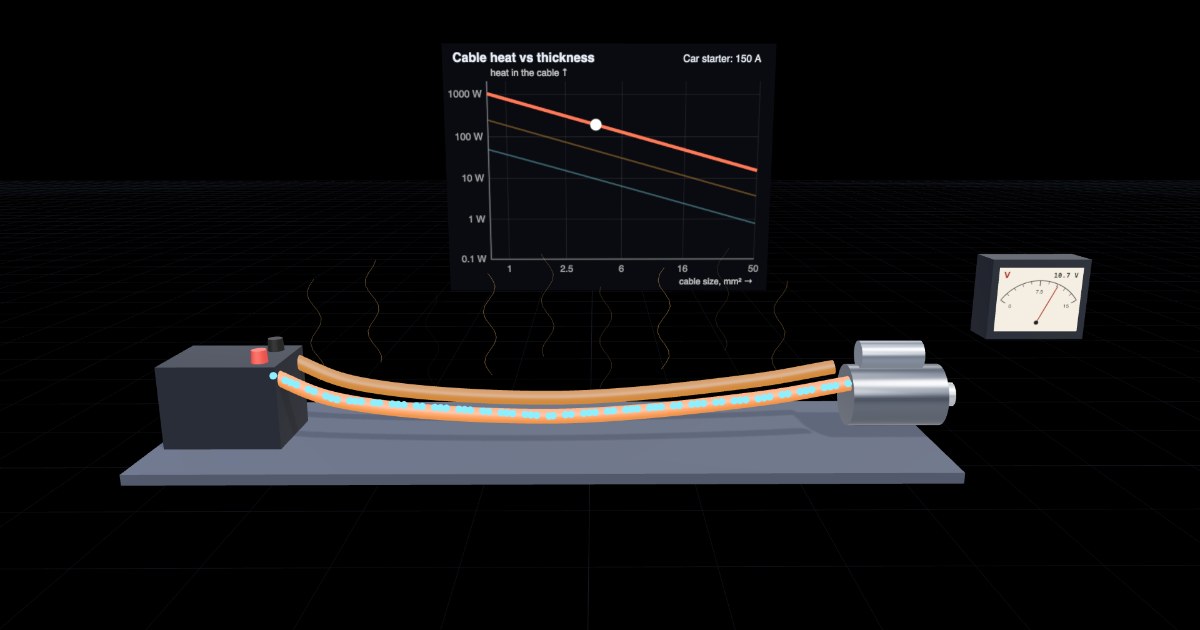
Myth: “higher voltage always means more current.” A 230 V geyser takes 8.7 A, but a car’s 12 V starter motor takes about 150 A. Current depends on the resistance too (see OhmsLawClear).

Stay safe: never touch mains wiring or open sockets, never poke anything into a socket, and never go near a fallen power line. For any electrical fault, switch off at the board and call a qualified electrician.

Try “Safety & myths” in the interactive model →

Test yourself

Frequently asked

3 coulombs of charge flow through a bulb in 10 seconds. What is the current?

0.3 A. I = Q ÷ t = 3 C ÷ 10 s = 0.3 A.

What does “a 1.5 V cell” tell you?

Each coulomb it pushes round gets 1.5 joules of energy. A volt is a joule per coulomb. The current depends on what you connect.

Electrons drift at about 0.1 mm/s. Why does the bulb light the instant you switch on?

The wire is full of electrons, and the push reaches them all almost at light speed. Like water in a full hose, the electrons near the bulb start moving as soon as the push arrives, which takes a few billionths of a second.

Three identical bulbs are in series on a 6 V battery. Roughly what voltage does each get?

2 V. In series the bulbs share the voltage: 6 V ÷ 3 = 2 V each, so they glow dimly.

Why is a house wired in parallel?

Every socket gets the full voltage, and each appliance works on its own. In parallel, each branch sits across the full 230 V and one appliance failing does not break the others.

What does a fuse do?

Melts and breaks the circuit when the current is too big. Its thin wire overheats first, cutting the current before the wiring can catch fire.

A 2,000 W geyser runs on 230 V. About how much current does it take?

8.7 A. I = P ÷ V = 2,000 ÷ 230 ≈ 8.7 A, more than a 6 A socket is built for.

What does an RCCB detect?

Current leaking to earth, when live and neutral currents differ. Normally everything that goes out on live comes back on neutral. A difference of 30 mA means current is escaping, perhaps through a person.

India’s mains is “230 V AC at 50 Hz”. What does 50 Hz mean?

The current reverses direction 50 times each second. Alternating current swings back and forth. 50 hertz means 50 complete cycles every second.

A phone battery is 3.7 V and 5,000 mAh. How much energy does it store?

18.5 Wh. Energy = volts × amp-hours = 3.7 V × 5 Ah = 18.5 watt-hours.

How do six 2.1 V lead-acid cells make a 12.6 V car battery?

They are in series, so their voltages add. Cells in series add their voltages: 6 × 2.1 V = 12.6 V.

A car’s 12 V starter motor takes 150 A. What power is that?

1,800 W. P = V × I = 12 V × 150 A = 1,800 W, about as much as a split AC.

Why can a bird sit safely on a single high-voltage wire?

Both feet are at almost the same voltage, so almost no current flows through it. Current needs a difference in voltage. Between two feet 5 cm apart on one wire it is about a thousandth of a volt.

Why is touching a live wire with wet hands so much more dangerous?

Wet skin has much lower resistance, so far more current flows. I = V ÷ R. Wet skin can resist about a hundred times less than dry skin, letting through a deadly current from the same 230 V.

Is it true that a higher voltage always means a bigger current?

No: the current also depends on the resistance. A 12 V starter motor takes about 150 A; a 230 V geyser takes 8.7 A. I = V ÷ R.

Words worth knowing

Electric current
The rate at which charge flows past a point, I = Q ÷ t, measured in amperes (A).
Voltage
The energy each coulomb of charge carries, the push that drives current, measured in volts (V = J/C).
Coulomb
The unit of charge: about 6.24 × 10¹⁸ electrons. One amp is one coulomb per second.
Conventional current
Current drawn flowing from + to −. Electrons, being negative, drift from − to +.
Series and parallel
One path shared by every part, or a separate path for each part across the supply.
AC and DC
Alternating current reverses direction many times a second; direct current flows one way.
Watt-hour
Energy: volts × amp-hours. 1,000 Wh is 1 kWh, one unit on an electricity bill.
RCCB
A breaker that cuts the power when 30 mA or more leaks to earth, for example through a person.

Fork it. Teach with it.

This box is plain HTML, CSS and JavaScript, with no build step and no accounts. Run it yourself and it sends nothing anywhere. The code is MIT. The words, images and videos are CC BY 4.0, so you can reuse them anywhere if you credit “Glassbox, glassbox.how/e/currentclear”.

git clone https://github.com/bdeeps/currentclear.git

Built with three.js (MIT), Geist, Instrument Serif (SIL OFL 1.1).

←→ previous / next box · / search

Would you like to see the full page, with the interactive model?