Chapter 1
Going round in a circle needs a pull to the centre
Double the speed and you need four times the pull.
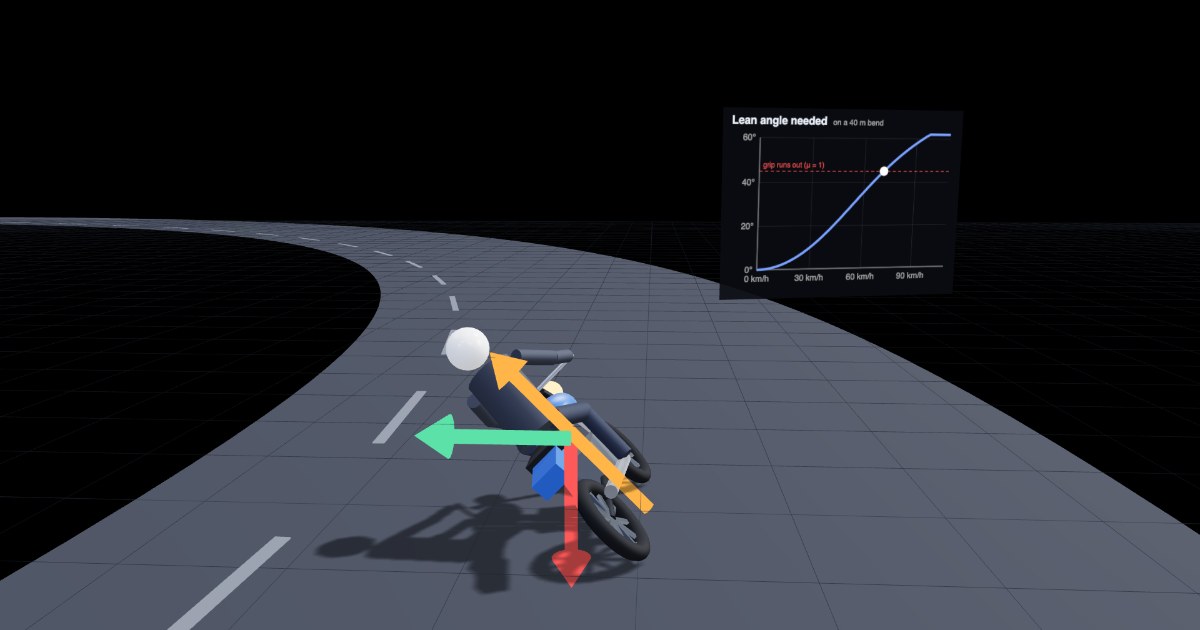
Whirl a ball on a string. Its speed can stay the same, but its direction changes all the time. A change of direction is a change of velocity, so the ball is accelerating, and by Newton's second law (see NewtonClear) something must push or pull it. That something is the string, pulling towards the centre. We call a pull like this a centripetal force: "centre-seeking".
How big must it be? For mass m going at speed v round a circle of radius r:
F = m v² ÷ r, and the acceleration is a = v² ÷ r.
Force is in newtons, acceleration in m/s². The speed is squared, so double the speed and the pull goes up four times. A tighter circle, smaller r, also needs a bigger pull. You can measure it by putting a spring balance in the string, as here.
Spinning things are often described by how fast they turn instead: the angular speed ω in radians per second, or rpm, turns per minute. Every point on a spinning thing turns at the same ω, but points further out move faster: v = ω r. Watch the bead halfway along the string: it goes round with the ball but at half the speed.
Now cut the string. The ball does not fly outwards. It goes straight on, along the line touching the circle, the tangent. Nothing was pushing it out; the string was only bending its path in.