What are speed, velocity and acceleration?

Speed, velocity and acceleration: a = Δv ÷ Δt. Speed is how far you go each second. Velocity is speed with a direction, and acceleration is how quickly the velocity changes: speeding up, slowing down or turning. Speed is distance ÷ time, in m/s (1 m/s = 3.6 km/h).

Speed tells you how fast. Velocity adds which way. Acceleration says how quickly that changes. Drive a car past distance posts with a stopwatch, race an EV against a bicycle, stop in time for a child near a school, spin a washing machine drum at 400 g, and find out why nothing catches light.

Speed, velocity and accelerationOpened 27 Sept 202612 min to playFree · no sign-up

In 60 seconds

  1. How fast, which way, how quickly it changes

    Speed is distance ÷ time, in m/s (1 m/s = 3.6 km/h). Velocity is speed with a direction. Acceleration is the change in velocity per second, in m/s². With steady acceleration, v = u + a t and s = u t + ½ a t², and the area under a velocity–time graph is the distance.

  2. Speeding up

    0–100 km/h is an acceleration test: about 10 s (2.8 m/s²) for a hatchback, about 3 s for a sports EV. Grip limits the start, then power does, because the push fades as P ÷ v while drag grows with v².

  3. Stopping and falling

    Stopping distance is thinking distance (speed × reaction time) plus braking distance (v² ÷ 2a): about 18 m from 30 km/h and 36 m from 50 km/h. Dropped things gain 9.81 m/s every second, and in a lift the scales read m (g + a).

  4. Going round, and the needle

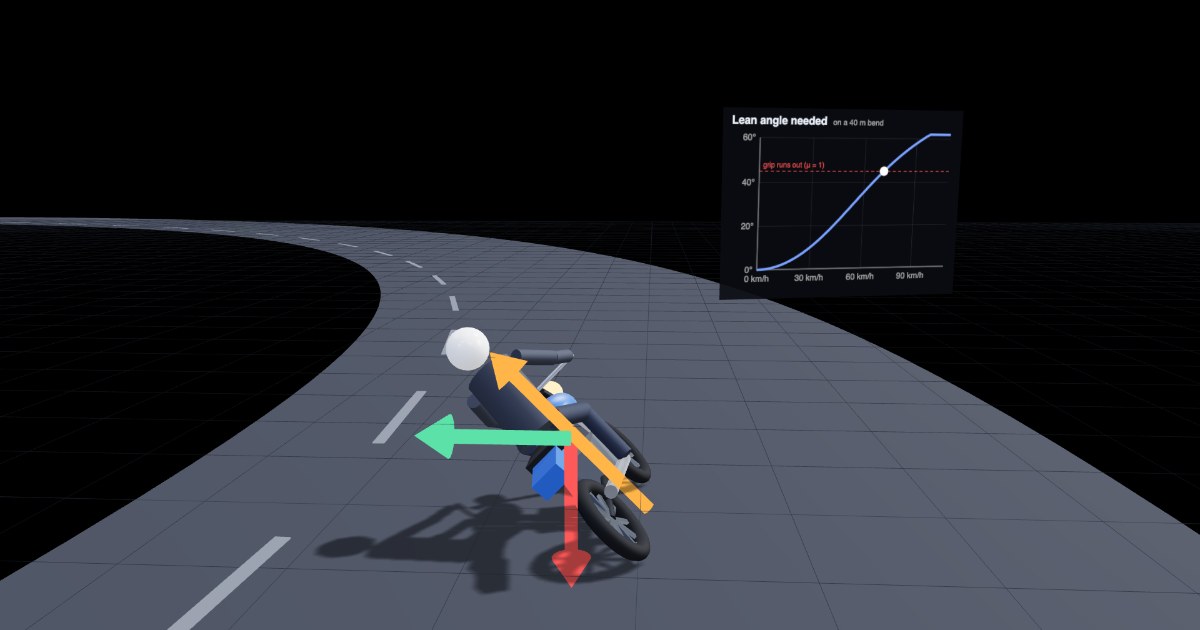
    At steady speed in a circle the velocity still turns, so there is an acceleration v² ÷ r towards the centre: 3,700 m/s² at a fan blade tip, about 400 g in a spinning washer drum. A speedometer shows instantaneous speed; the trip computer, the average.

  5. Myths and limits

    A lap of a 400 m track has zero displacement and zero average velocity. Heavy and light balls fall together; only air slows the feather. Velocities depend on your frame of reference, and near light speed they no longer simply add: nothing with mass reaches c.

Where you'll meet it

a = Δv ÷ Δt

acceleration = change in velocity ÷ time taken; with steady acceleration, v = u + a t and s = u t + ½ a t²

The history

From Aristotle's falling stones to satellites that clock your bike ride: 2,300 years of learning what 'how fast' means.

Read the full history
  1. 350 BCEHeavier things fall faster, says Aristotle
  2. 1350Motion drawn as a graph
  3. 1638Uniform acceleration is defined
  4. 1902The eddy-current speedometer
  5. 1905Nothing catches light
  6. 1995Speed from satellites

The full explanation

Speed, velocity and acceleration, chapter by chapter

Chapter 1

How fast, which way, and how quickly it changes

Speed, velocity and acceleration, on a straight road with a stopwatch.

Speed is how far you go each second: speed = distance ÷ time. Its SI unit is the metre per second (m/s). A car that covers 100 m in 10 s is doing 10 m/s. There are 3,600 seconds in an hour and 1,000 metres in a kilometre, so 1 m/s = 3.6 km/h: multiply by 3.6 to get km/h, divide by 3.6 to get back.

Velocity is speed with a direction: 10 m/s forwards is not the same velocity as 10 m/s backwards, even though the speed is the same. On a straight road we use a sign: + for forwards, − for backwards.

Acceleration is how quickly the velocity changes: a = Δv ÷ Δt, in metres per second per second (m/s²). An acceleration of 2 m/s² adds 2 m/s to your velocity every second. Braking is acceleration too, just pointing backwards.

With a steady acceleration, two short rules tell you everything: v = u + a t (your velocity now, from the starting velocity u) and s = u t + ½ a t² (how far from the start you are). On the velocity–time graph, the slope is the acceleration and the area under the line is the distance. Measure distance with the posts, time with the stopwatch, and you have measured all three. Newton's laws (NewtonClear) then tell you what force it takes.
Try “How fast, which way” in the interactive model →

Chapter 2

Nought to a hundred

A drag race: how quickly a car, an EV, a motorbike and a bicycle gain speed.

Car makers boast about one number above all: the time from a standstill to 100 km/h. It is really a measure of acceleration. 100 km/h is 27.8 m/s, so a car that takes 10 s gains on average a = Δv ÷ Δt = 27.8 ÷ 10 ≈ 2.8 m/s².

A family hatchback like the one in CarClear takes about 10 s. A high-performance electric car can do it in about 3 s: over 9 m/s², close to 1 g, the acceleration of a falling stone. Electric motors give full pull from standstill, and with all four wheels driven the tyres' grip is the only limit.

Watch the curves on the board: nobody accelerates steadily. At first grip sets the limit, then power does: the push a motor can give is P ÷ v, so it fades as speed grows, while air drag grows with v². That is why the lines bend over. A 150 cc motorcycle (MotorcycleClear) starts as briskly as the hatchback but runs out of power, and a strong cyclist (CycleClear) tops out around 40 km/h.

Acceleration is often quoted in g: divide by 9.81 m/s². The hatchback's 2.8 m/s² is about 0.3 g, a gentle push into the seat.

Try “Speeding up” in the interactive model →

Chapter 3

Slowing down, stopping and falling

Stopping distances, school zones, a dropped ball and the g-force in a lift.

Braking is acceleration backwards. A car on a dry road can slow at about 6.5 m/s², losing 6.5 m/s of speed every second. But before the brakes even start, the driver has to notice and react. That takes about 1.5 s for most people, longer if they are looking at a phone.

So a stop comes in two parts. The thinking distance is speed × reaction time: at 50 km/h (13.9 m/s) that is about 21 m, before the car slows at all. The braking distance is v² ÷ 2a, and that square matters: double the speed and it takes four times as far. Together: about 18 m from 30 km/h, 36 m from 50 km/h and 71 m from 80 km/h on a dry road. On the speed–time graph the two parts are the two shaded areas.

That is why many cities set 30 km/h near schools. A child who runs out 25 m ahead is safe from a car at 30 km/h. At 50 km/h the car is still doing about 40 km/h when it gets there. The WHO notes that a pedestrian's risk of dying rises about 4.5 times between being hit at 50 km/h and at 65 km/h, and it recommends 30 km/h where people walk, cycle and play.

Falling is the purest acceleration there is. Near the Earth, anything dropped gains 9.81 m/s every second: g = 9.81 m/s². After 1 s it falls at 35 km/h, after 2 s at 71 km/h. The strobe copies of the ball get further apart each 0.2 s, just like the dots in chapter 1.

In a lift, scales measure how hard the floor pushes you: m (g + a). Speeding up on the way up, you feel heavier; on a drop-tower ride in free fall the scales read zero, and you feel weightless. "g-force" is this push compared with your normal weight. See NewtonClear for the forces behind it.

Try “Stopping and falling” in the interactive model →

Chapter 4

Going round, and what the needle shows

Steady speed can still be acceleration. And average speed is not the speed right now.

A fan runs at a steady speed. Is anything accelerating? Yes: the tip of every blade. Its speed never changes, but its direction does, all the time, so its velocity changes. A change in velocity is acceleration, and for something going round a circle it points to the centre: a = v² ÷ r.

The tip of a 400 mm desk fan (FanClear) at 1,300 rpm goes round a 0.2 m circle 22 times a second: v = 2π r n ÷ 60 ≈ 27 m/s, nearly 100 km/h. Its acceleration towards the hub is about 3,700 m/s², around 380 g. The blade has to pull that hard on its tip to keep it going round.

In a washing machine (WasherClear) the drum tumbles slowly, about 50 rpm, so the clothes are lifted and then fall: the acceleration needed, 0.7 g, is less than gravity. At 1,200 rpm the drum wall pushes on the clothes with about 400 g, but the water can't follow the curve: it flies straight on through the holes. The same maths turns a car or bike round a bend (see NewtonClear).

A car's speedometer shows the instantaneous speed: how fast you are going right now. The trip computer shows the average speed: total distance ÷ total time, red lights and all. Take the average over a shorter and shorter time and it gets closer and closer to the needle. That idea, the rate over a vanishingly small time, is where calculus began.

Try “Round and round” in the interactive model →

Chapter 5

Speed is not velocity, and other surprises

A lap that goes nowhere, a myth about falling, and why nothing catches light.

Speed is not the same as velocity. Run one lap of a 400 m track at 5 m/s and you have covered 400 m in 80 s: an average speed of 5 m/s. But you finish where you started, so your displacement is zero and your average velocity is zero too. On the bends your speed stays the same while your velocity turns, so you are accelerating even at a steady pace.

Myth: heavier things fall faster. Aristotle taught it, and a feather seems to prove it. But drop a bowling ball and a tennis ball together from 20 m and they land within a blink of each other. Gravity gives every object the same acceleration, 9.81 m/s². Only air resistance makes the difference, and it matters most for light, fluffy things. On the Moon in 1971, astronaut David Scott dropped a hammer and a feather, and they landed together.

Velocity depends on who is watching. Walk forwards at 5 km/h on a train doing 100 km/h: to your friend on the train you do 5 km/h, to someone on the platform 105 km/h. Every velocity is measured relative to something, its frame of reference. Even the platform is spinning with the Earth at about 1,670 km/h at the equator.

For everyday speeds you just add. But near the speed of light, c = 299,792,458 m/s, adding stops working. Einstein showed in 1905 that velocities combine as (u + v) ÷ (1 + u v ÷ c²). Fire a probe at 0.8 c from a ship doing 0.8 c and it goes 0.98 c, not 1.6 c. Nothing with mass can reach c.

Try “Myths and limits” in the interactive model →

Test yourself

Frequently asked

A scooter does 54 km/h. How many metres does it cover each second?

15 m. Divide by 3.6: 54 ÷ 3.6 = 15 m/s, so 15 metres every second.

A car starts at 5 m/s and accelerates at 2 m/s² for 4 s. How fast is it going?

13 m/s. v = u + a t = 5 + 2 × 4 = 13 m/s, about 47 km/h.

You walk 200 m to a shop and 200 m back home. What is your displacement?

Zero. Displacement is how far you end up from where you started, with a direction. You are back home, so it is zero, even though you travelled 400 m.

A car reaches 100 km/h (27.8 m/s) from rest in 10 s. Its average acceleration is about…

2.8 m/s². a = Δv ÷ Δt = 27.8 ÷ 10 ≈ 2.8 m/s², about 0.28 g.

An electric car does 0–100 km/h in 3 s. Compared with a 10 s hatchback, its average acceleration is…

about 3.3 times bigger. Same change in velocity in less time: 27.8 ÷ 3 ≈ 9.3 m/s² against 2.8 m/s², about 3.3 times as much.

Why do the speed–time curves bend over instead of staying straight?

The pushing force fades as P ÷ v while air drag grows. With a fixed power, the drive force is about P ÷ v, and drag grows with v². Less net force means less acceleration.

You double your speed. Your braking distance becomes…

four times as long. Braking distance is v² ÷ 2a. Double v and v² goes up four times.

At 50 km/h (13.9 m/s) with a 1.5 s reaction time, how far do you go before the brakes even start?

About 21 m. Thinking distance = speed × reaction time = 13.9 × 1.5 ≈ 21 m.

On a drop-tower ride in free fall, what would bathroom scales under your feet read?

Zero. You and the scales fall together at g, so the scales don’t need to push on you at all: m (g + a) = m (g − g) = 0.

A ceiling fan turns at a steady 300 rpm. Is the tip of a blade accelerating?

Yes, because its direction keeps changing. Velocity includes direction. Going round, the direction changes all the time, so the tip accelerates towards the centre.

Doubling a drum’s rpm makes the acceleration of its wall…

four times as big. Rim speed doubles, and a = v² ÷ r, so the acceleration grows four times.

You drive 30 km in 45 minutes, sometimes stuck in traffic. Your average speed is…

40 km/h. Average speed = distance ÷ time = 30 km ÷ 0.75 h = 40 km/h, even if the needle often read more or less.

A runner finishes one 400 m lap in 80 s. What is their average velocity for the lap?

Zero. They end where they started, so the displacement is zero, and average velocity = displacement ÷ time = 0. Their average speed was 5 m/s.

A bowling ball and a tennis ball are dropped together from a balcony. What happens?

They land at almost the same time. Gravity accelerates both at 9.81 m/s². Air resistance slows the light tennis ball only a little over a short drop.

A spaceship at 0.8 c fires a probe forwards at 0.8 c. How fast does the probe go, seen from Earth?

About 0.98 c. Einstein’s rule: (0.8 + 0.8) ÷ (1 + 0.64) ≈ 0.976 c. Nothing with mass reaches c.

Words worth knowing

Speed
How far something travels per second: distance ÷ time, in metres per second.
Velocity
Speed in a stated direction. It changes when either the speed or the direction changes.
Acceleration
The rate of change of velocity: a = Δv ÷ Δt, in metres per second per second (m/s²).
Displacement
How far, and in which direction, you are from where you started.
Equations of motion
For steady acceleration: v = u + a t and s = u t + ½ a t².
Free fall
Motion under gravity alone. Near the Earth everything accelerates at g = 9.81 m/s².
Centripetal acceleration
The acceleration towards the centre needed to move in a circle: a = v² ÷ r.
Frame of reference
The point of view velocities are measured from, such as the platform or the moving train.

Fork it. Teach with it.

This box is plain HTML, CSS and JavaScript, with no build step and no accounts. Run it yourself and it sends nothing anywhere. The code is MIT. The words, images and videos are CC BY 4.0, so you can reuse them anywhere if you credit “Glassbox, glassbox.how/e/motionclear”.

git clone https://github.com/bdeeps/motionclear.git

Built with three.js (MIT), Geist, Instrument Serif (SIL OFL 1.1).

←→ previous / next box · / search

Would you like to see the full page, with the interactive model?