Momentum: p = m × v. Momentum is how much 'oomph' a moving thing carries: its mass times its velocity. When things collide or push apart, momentum passes from one to the other, but the total never changes. Momentum is mass times velocity, p = m v, in kg·m/s, and it has a direction.
Why does a lorry shove a car backwards in a crash, why does a helmet have foam, and why does a Newton's cradle send out exactly two balls when you drop two? Crash carts, cars and carrom strikers, fire a cannon and a rocket, catch a cricket ball, and sail on sunlight.
MomentumOpened 27 Sept 202612 min to playFree · no sign-up
In 60 seconds
Mass on the move
Momentum is mass times velocity, p = m v, in kg·m/s, and it has a direction. Measure m on a scale and v with light gates, and multiply. When two carts collide or spring apart, whatever one loses the other gains, so the total is the same before and after: bouncy, sticky or explosive. Kinetic energy is only kept in the bouncy case.
Crashes and catches
After a head-on crash the wreck moves with the total momentum, so a lorry barely slows while a car's Δv is huge. Stopping anything needs an impulse, F × Δt = Δp. Crumple zones, belts, airbags, helmet foam and soft hands all stretch Δt so the peak force, in g, falls.
Push-offs
Start at zero momentum and push apart: skaters, a boat and its jumper, a cannon and its ball end with equal and opposite momentum. A rocket keeps throwing exhaust back, Δv = v_e ln(full ÷ empty), and a ceiling fan's thrust is the air's momentum per second, about 13 N.
Games
Newton's cradle sends out as many balls as you drop, because only that keeps both momentum and energy; clay balls crawl off together. On a carrom board momentum adds as arrows, and equal pool balls split at 90°. A cricket bat reverses the ball's momentum in about a millisecond.
Myths and limits
In a crash both vehicles feel the same force; the heavier one just changes speed less, and the wreck goes the way of more momentum. Momentum isn't energy: same p, a lighter, faster ball digs a far deeper dent. Spin has its own conserved momentum, L = I ω, and even light pushes: IKAROS, 2010.
Where you'll meet it
p = m × v
momentum = mass × velocity, in kg·m/s. In any collision or explosion with no outside push, the total momentum before equals the total after.
Crumple zones and airbags
A crash takes away all of a car's momentum. Crumple zones, belts and airbags stretch the stop from milliseconds to about a tenth of a second, cutting the force on the people inside many times.
Locked together after a head-on crash, the wreck moves with the total momentum. A 16 t lorry barely slows; a 1.2 t car's speed changes by more than its own crash speed.
A rider's head must lose its momentum whatever happens. A helmet's 3 cm foam liner stretches that stop about five times longer than bare skull, keeping the peak under the 275 g test limit.
A 90 kg bike and rider at 20 km/h carry 500 kg·m/s. Brakes remove it gently over seconds; a kerb does it in a few hundredths of a second, which is why you go over the bars.
Throwing exhaust back at 3 km/s gives the rocket the same momentum forwards, no air needed. Tsiolkovsky's 1903 equation turns that into the rocket's final speed.
Newton's cradle
Lift two balls and two come out. One ball at double speed would keep momentum but double the energy, so hard steel balls choose the only answer that keeps both.
Giving with the hands
A fielder who draws her hands back 40 cm makes a catch last 40 times longer than stiff hands, so the same momentum arrives with a fortieth of the force.
Sailing on sunlight
Light carries momentum. In 2010 JAXA's IKAROS spread a 14 m sail and measured a push of about 1.1 millinewtons from sunlight alone.
The history
From impetus to solar sails: 1,500 years of learning what a moving thing carries.
Crash two carts together, stick them, or spring them apart. The total momentum never changes.
A rolling cart is hard to stop for two reasons: it is heavy, or it is fast. Momentum puts both into one number: p = m × v, mass times velocity. Its SI unit is the kilogram metre per second (kg·m/s), and it has a direction: here, rightwards is plus and leftwards is minus.
To measure it, weigh the cart on a scale for m, time it between two light gates for v, and multiply. A 2 kg cart at 1.5 m/s has 3 kg·m/s. So does a 1 kg cart at 3 m/s.
Now the magic. When two things collide, whatever momentum one loses, the other gains, because they push on each other equally hard for exactly the same time (Newton's third law, see NewtonClear). So the total momentum is conserved: the same before and after, every time.
Energy is different. Bouncy magnets keep the kinetic energy (elastic). Velcro grabs, and some of it turns into heat and sound (inelastic). A spring adds energy from nothing moving at all. Momentum is kept in all three.
Momentum sets who moves where after a crash. Stretching the stop sets how much it hurts.
When a car meets a lorry head-on, they lock together and move off with the total momentum they had before. A 16 t lorry at 40 km/h has thirteen times the momentum of a 1.2 t car at 40 km/h, so the wreck keeps going the lorry's way. The car's change in velocity, Δv, is huge; the lorry's is tiny. Δv is what hurts the people inside (see CarClear, MotorcycleClear and CycleClear).
To stop anything you must take away all its momentum. The push needed is the impulse: force × time = change in momentum, F × Δt = Δp. The Δp is fixed by the speed. The only thing you can choose is Δt. Stretch the stop over ten times longer and the force drops ten times.
That is the whole idea behind a crumple zone (the car's nose folds up slowly), a seat belt that stretches, an airbag, and the thick foam in a helmet. It is also why a fielder gives with the hands when catching a cricket ball: pulling the hands back 40 cm instead of 2 cm makes the stop 20 times longer.
Push two things apart and their momenta cancel. Keep throwing mass back and you get thrust.
Two skaters stand still on ice: total momentum zero. They push apart. Now one has momentum to the left and the other the same amount to the right, so the total is still zero. The lighter skater goes faster: m₁ v₁ = m₂ v₂.
The same rule explains recoil. A cannonball leaves at 450 m/s, so the heavy cannon must roll back with the same momentum, about 2 m/s. A rifle kicks the same way, which is why you hold it firmly against your shoulder: then the rifle and you share the recoil. Jump off a small boat and the boat shoots backwards, stealing part of your jump. In a light kayak you may land in the water.
A rocket does this non-stop. It throws hot gas backwards at 2 to 4.4 km/s, and every kilogram thrown back gives the rocket that much momentum forwards. Thrust = momentum thrown away per second, ṁ × v. It needs no air to push on, which is why rockets work in space. Tsiolkovsky's equation says the final speed depends on the exhaust speed and how much of the rocket is fuel (see ForceClear and NewtonClear for the forces).
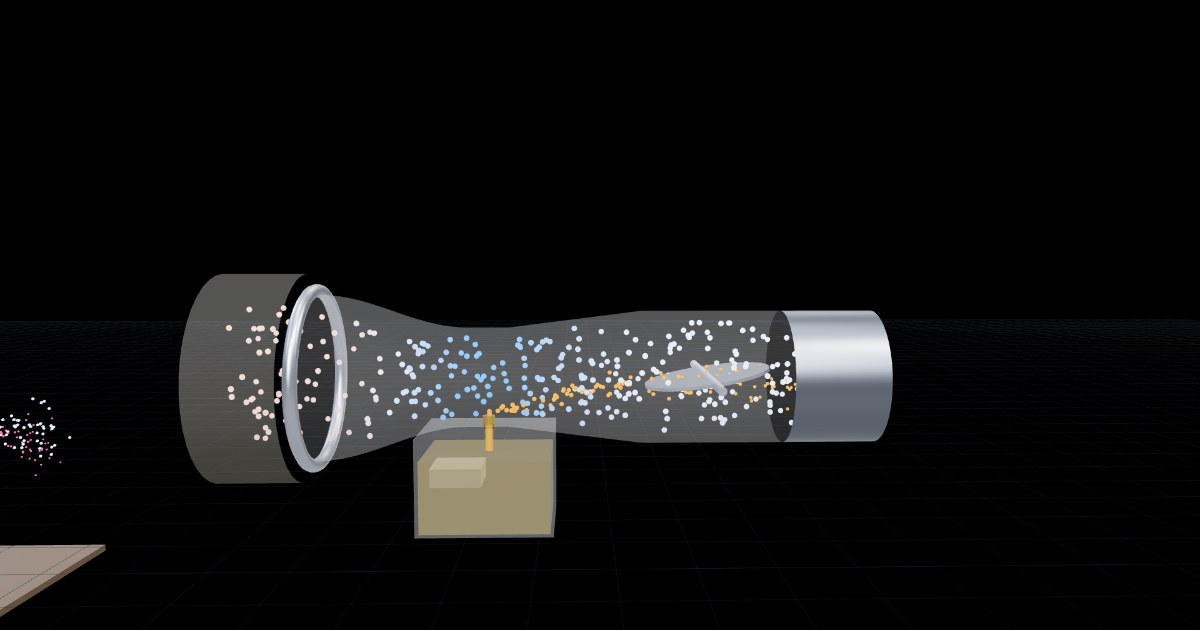
A ceiling fan is a gentle rocket. It pushes about 4 kg of air down every second at 3 m/s, so the air pushes the fan up with about 13 N (FanClear).
Momentum passes down a row of steel balls, splits at an angle on a carrom board, and flies off a bat.
Newton's cradle is momentum in a row. Lift one ball and let go: one ball flies out the far side. Lift two, and two come out. Why not one ball at twice the speed? That would carry the same momentum, but twice the kinetic energy. Hard steel balls must keep both, and only "same number, same speed" does. Make the balls of clay and they stick: all five crawl off together: momentum kept, much of the energy gone.
On a carrom board or a pool table, momentum is conserved as an arrow. Add the striker's arrow after the hit to the coin's arrow and you get exactly the striker's arrow before. Two equal pool balls always split at about 90°. A carrom striker is almost three times heavier than a coin, so it follows through.
In cricket, the bat reverses a 0.16 kg ball in about a millisecond. The ball's momentum changes by more than it had to begin with, because it goes back the other way. That change needs a force of several thousand newtons. The heavier and faster the bat, the more momentum it can hand over.
Who really “wins” a crash, why momentum isn’t energy, spinning momentum, and sunlight that pushes.
Myth: “the heavier vehicle always wins.” In a crash the car pushes the lorry exactly as hard as the lorry pushes the car, at every instant (Newton's third law, see NewtonClear). The forces are equal. What differs is the change in velocity: the same force for the same time changes a light car's speed far more. And the wreck goes whichever way had more momentum, not more mass: a car at 90 km/h can shove a lorry crawling at 5 km/h backwards.
Myth: “momentum and energy are the same thing.” Both depend on mass and speed, but differently: p = m v, and energy = ½ m v² = p² ÷ 2m. Two balls with the same momentum push a block off at the same speed, but a light, fast one carries far more energy and digs a much deeper dent. Momentum decides the shove; energy decides the damage. Leibniz and the Cartesians argued about this for fifty years (see the history).
Spinning things have their own momentum, angular momentum, L = I ω, and it is conserved too. Tip a spinning bicycle wheel over while sitting on a swivel stool and the stool starts to turn, to keep the total the same. A skater pulling in her arms is the same law (InertiaClear).
Light has no mass, yet it carries momentum, p = E ÷ c. Sunlight pushes about 9 micronewtons on every square metre of mirror. Tiny, but it never stops: in 2010 Japan's IKAROS sailed between the planets on sunlight alone.
Which has more momentum: a 2 kg cart at 3 m/s or a 3 kg cart at 2 m/s?
They are equal. p = m v: 2 × 3 = 6 kg·m/s and 3 × 2 = 6 kg·m/s. Same momentum, different mixes of mass and speed.
A 1 kg cart at 4 m/s hits a 3 kg cart at rest and they stick. How fast do they move off?
1 m/s. Momentum before is 1 × 4 = 4 kg·m/s. Afterwards 4 kg carry it, so v = 4 ÷ 4 = 1 m/s.
In the sticky collision above, what happens to the kinetic energy?
Some turns into heat and sound. Before: ½ × 1 × 4² = 8 J. After: ½ × 4 × 1² = 2 J. Momentum is kept; 6 J of energy went into heat, sound and squashed Velcro.
A car and a heavy lorry crash head-on at the same speed. Which one’s occupants get the bigger Δv?
The car’s. The pair moves off with the lorry’s much bigger momentum. The lorry barely slows; the car is flung backwards, so its Δv is far larger.
An airbag doesn’t change how much momentum your head loses in a crash. What does it change?
The time taken to stop, so the force is lower. Impulse F × Δt = Δp. With Δp fixed, a longer Δt means a smaller force.
A fielder lets her hands travel back 40 cm instead of 2 cm while catching. Roughly how much smaller is the average force?
20 times. For a steady stop, Δt = 2d ÷ v. Twenty times the distance gives twenty times the time, so a twentieth of the force.
A 50 kg skater and an 80 kg skater push apart. The 50 kg skater moves off at 1.6 m/s. How fast does the other go?
1.0 m/s. The momenta must cancel: 50 × 1.6 = 80 kg·m/s, so the 80 kg skater moves at 80 ÷ 80 = 1.0 m/s the other way.
Why can a rocket accelerate in empty space, with no air to push against?
It throws exhaust backwards, and gains the same momentum forwards. The rocket and its exhaust start with the same total momentum. Throwing gas back gives the rocket equal momentum forwards. No air needed.
A ceiling fan pushes 4 kg of air downwards each second at 3 m/s. What upward push does the air give the fan?
12 N. Thrust is momentum per second: 4 kg/s × 3 m/s = 12 N, about the weight of 1.2 kg.
You lift two balls of a Newton’s cradle and let go. Why don’t you get one ball out at twice the speed?
It would carry twice the kinetic energy, and energy must be kept too. One ball at 2v has the same momentum as two at v, but ½ m (2v)² is twice ½ (2m) v². Hard steel keeps both, so two balls come out.
A pool ball hits an equal ball at rest off-centre. About what angle do their paths make afterwards?
90°. Equal masses in a nearly elastic collision split at right angles. Their momentum arrows still add up to the first ball’s arrow.
A 0.16 kg ball arrives at 30 m/s and leaves the bat at 40 m/s the other way. What is its change in momentum?
11.2 kg·m/s. Direction matters: from −30 to +40 m/s is a change of 70 m/s. 0.16 × 70 = 11.2 kg·m/s.
A car and a lorry crash head-on. Which one feels the bigger force?
Both feel the same force. They push on each other: a third-law pair, equal and opposite. The car suffers more because the same force changes its smaller mass’s velocity more.
Ball A (1 kg, 2 m/s) and ball B (0.1 kg, 20 m/s) have the same momentum. Which has more kinetic energy?
B, ten times more. A: ½ × 1 × 2² = 2 J. B: ½ × 0.1 × 20² = 20 J. Same momentum, ten times the energy, so B makes a much deeper dent.
How can light, which has no mass, push a solar sail?
Light carries momentum, p = E ÷ c, and hands it to the sail. Every photon carries momentum. A mirror reverses it, getting twice the push. IKAROS measured about 1.1 millinewtons from sunlight in 2010.
Words worth knowing
Momentum
Mass times velocity, p = m v, in kg·m/s. It has a size and a direction.
Conservation of momentum
With no outside push, the total momentum of colliding or exploding objects stays the same.
Impulse
Force × time, F Δt, in N·s. It equals the change of momentum, so a longer stop means a smaller force.
Elastic and inelastic
Elastic collisions keep kinetic energy too; inelastic ones turn some of it into heat, sound and dents.
Δv
The change of velocity in a collision, the best single measure of how much a crash hurts.
Thrust
The push from throwing mass away: mass per second × speed. Rockets and fans both work this way.
Rocket equation
Δv = v_e ln(m_full ÷ m_empty), Tsiolkovsky, 1903.
Angular momentum
The momentum of spinning, L = I ω, also conserved. Light carries momentum too: p = E ÷ c.
Fork it. Teach with it.
This box is plain HTML, CSS and JavaScript, with no build step and no accounts. Run it yourself and it sends nothing anywhere. The code is MIT. The words, images and videos are CC BY 4.0, so you can reuse them anywhere if you credit “Glassbox, glassbox.how/e/momentumclear”.