How does the skin work?

Your skin is your largest organ: about 2 square metres that keeps water in, germs out and your core at 37 °C. Cut open a block of it, follow a cell from birth to flake, sweat through a humid heatwave, feel with five kinds of sensor, and see why skin comes in every shade.

SkinClearOpened 14 Aug 202615 min to playFree · no sign-up

In 60 seconds

  1. Three layers, one big organ

    Skin covers about 1.5 to 2 m² and weighs about 3.5 to 4 kg. On top is the thin epidermis, about 0.1 mm on most of the body. Below is the tough dermis with blood vessels, nerves, hair follicles and sweat glands, and under that a layer of fat.

  2. A wall that rebuilds itself

    New cells are born in the basal layer and pushed up. They fill with keratin, die and flatten into bricks glued with fatty mortar, then flake off, about 4 weeks after birth. This barrier keeps water in and germs out.

  3. Your built-in air conditioner

    Vessels widen to dump heat or narrow to save it, and each gram of sweat that evaporates carries away about 2,400 J. In humid heat sweat can't dry: near a wet-bulb temperature of 35 °C, or lower, even resting in shade can't cool you.

  4. Five kinds of touch sensor

    Merkel cells feel pressure, Meissner corpuscles light touch, Pacinian corpuscles vibration near 250 Hz, Ruffini endings stretch, and free nerve endings pain and temperature. A fingertip tells two points apart at 2 to 3 mm; the back needs about 40 mm.

  5. Melanin, the skin's own sunshade

    Everyone has about the same number of melanocytes; skin tone depends on how much and which melanin they make. Melanin absorbs UV. UV-B burns but also makes vitamin D. Indian summers often reach UV index 11+, and SPF 30 used thickly blocks about 97% of sunburning UV.

  6. Healing and what goes wrong

    A cut heals through clotting, inflammation, new tissue and months of remodelling into a scar at most 80% as strong. Burns are graded by depth. Acne, eczema and moles each have a simple cause. For your own skin, see a doctor or dermatologist.

Laws at work here

The history

2,500 years from a new nose cut from the cheek in ancient India to lab-grown skin, touch sensors and a fairer scale for every skin tone.

Read the full history
  1. 600 BCEA new nose from the cheek
  2. 1794A letter from Pune
  3. 1869Pinches of skin that grow
  4. 1934The science of sweat
  5. 1975Growing skin in a dish
  6. 2000Why skin comes in many colours

The full explanation

SkinClear, chapter by chapter

Chapter 1

The body’s largest organ

Three layers, about 2 m² and 4 kg, packed with hair, glands, nerves and blood.

Your skin is an organ, and the biggest one you have: about 1.5 to 2 m², the size of a single bed sheet, and about 3.5 to 4 kg. It keeps water in and germs out, holds your temperature at 37 °C, feels the world, and even makes vitamin D.

This is a tiny block of it, magnified about 20 times, cut open like a model. On top is the epidermis, only about 0.1 mm thick on most of the body (thicker on your soles, thinner on your eyelids; we drew it thicker so you can see it). Its outer skin, the stratum corneum, is made of dead, flattened cells. At its base, the basal layer makes new cells, and melanocytes there make the pigment melanin.

Under it is the dermis, about 1 to 4 mm of tough, stretchy tissue made of collagen and elastin fibres. It holds the blood vessels, nerves and touch receptors, the hair follicles with their sebaceous (oil) glands and tiny arrector pili muscles, and the coiled sweat glands. Its bumpy top, the dermal papillae, locks into the epidermis like a zip so the layers don’t slide apart. Deepest is the hypodermis, a cushion of fat that stores energy and keeps heat in.
Try “Inside your skin” in the interactive model →

Chapter 2

A wall that rebuilds itself

New cells rise, flatten and die into bricks and mortar, then flake away, about every 4 weeks.

The outer skin you touch is dead. It is made in the basal layer at the bottom of the epidermis, where cells called keratinocytes divide. Each new cell is pushed upwards by the ones born under it.

As it rises, it changes. In the spinous layer it fills with tough keratin fibres. In the granular layer it makes waxy fats and loses its nucleus. By the top it has died and flattened into a corneocyte, a thin plate of keratin. Thousands of these plates stack like bricks, glued by fatty mortar: the stratum corneum. After about 4 weeks from birth (longer as we age) a cell flakes off.

This brick wall is the barrier. It stops you drying out: only about 300 to 400 mL of water a day seeps through healthy skin. Lose it, as after a big burn, and water loss can rise about tenfold. It also keeps most germs out. Water moving across layers like this is osmosis and diffusion, the subject of a future OsmosisClear box.

You shed roughly 500 million skin cells a day. They are part of house dust, but the popular claim that dust is mostly skin is exaggerated: much of it is soil, fibres and other bits.

Try “A skin that renews” in the interactive model →

Chapter 3

Your built-in air conditioner

Sweat, blood flow and goosebumps hold your core near 37 °C, until the air is too hot and humid.

Your body makes heat all the time, about 100 watts at rest, like a bright old light bulb, and several times more when you run. To stay near 37 °C inside, it has to lose exactly as much heat as it makes, and the skin is where it does it.

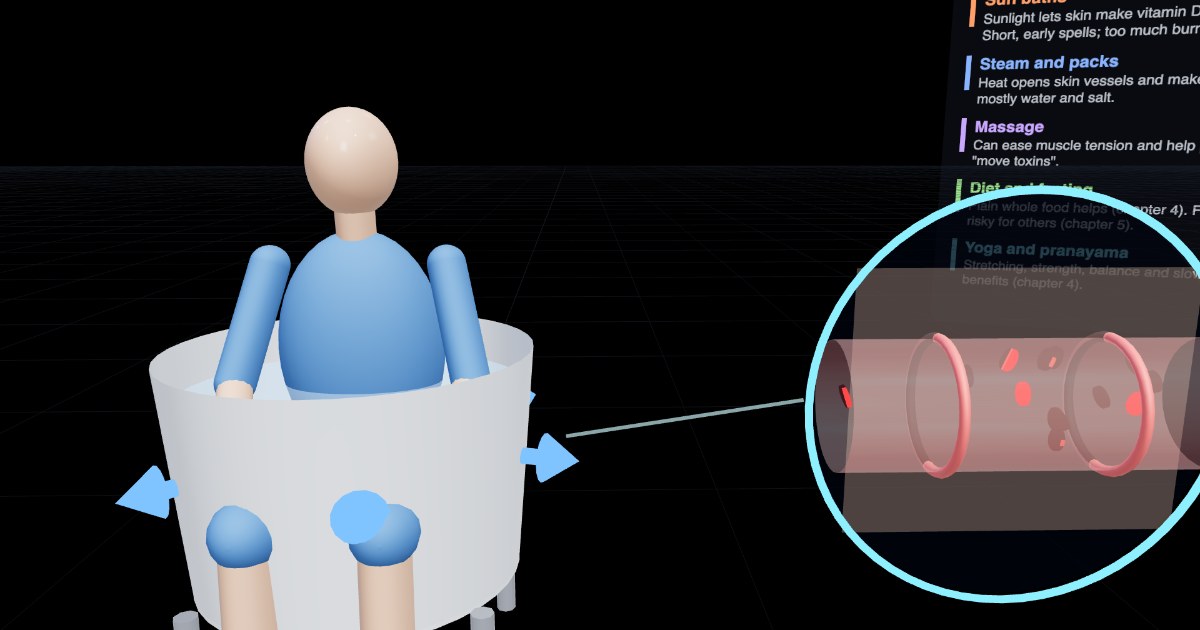
Blood vessels are the first dial. When you are warm, vessels in the dermis widen and send warm blood to the surface to lose heat: you look flushed. In the cold they narrow and keep blood deep: fingers go pale and cold. Skin blood flow can go from almost nothing to about 7 litres a minute.

Sweat is the big one. Turning 1 gram of sweat into vapour takes about 2,400 joules of heat, pulled from your skin. You can sweat 1 to 2 litres an hour. But sweat only cools when it evaporates. In humid air it can’t dry, drips off and cools you very little. A breeze helps by carrying damp air away: see the cooling chapter of FanClear. Heat always flows from hot to cold, as ThermoClear shows (a future HeatClear box will dig into heat transfer).

Scientists combine heat and humidity into the wet-bulb temperature. Above about 35 °C wet-bulb, even a healthy person resting in the shade can’t cool down, and lab tests suggest the real limit is lower, about 31 °C. Humid heat waves in India make this very real, so rest, shade and water matter. Goosebumps are the arrector pili standing hairs up: in furry animals that traps warm air; in us it is a leftover.

Try “Keeping 37 °C” in the interactive model →

Chapter 4

Five kinds of touch sensor

Pressure, flutter, vibration, stretch and pain, each felt by its own receptor.

Your skin feels with receptors: nerve endings, some wrapped in special capsules, each tuned to a different kind of touch. This is fingertip skin: no hair, friction ridges (your fingerprint) and some of the most crowded receptors in the body.

Merkel cells sit at the base of the epidermis and report steady pressure, edges and shapes; they keep firing while you press. Meissner corpuscles, tucked into the dermal papillae, feel light touch and slipping, and fire as a touch starts and stops, best at a flutter of about 30 Hz. Deep down, onion-like Pacinian corpuscles feel vibration, most sharply at about 250 Hz, like a phone buzzing. Ruffini endings feel the skin stretch. Bare free nerve endings reach right into the epidermis and report pain, heat, cold and itch.

How finely you can feel depends on how close together the receptors and their patches of skin are. In the two-point test a doctor touches you with two points: on a fingertip you can tell them apart at about 2 to 3 mm; on your back they must be about 40 mm apart. The brain gives sensitive parts more space in its touch map, the famous “homunculus” you can explore in BrainClear.

Try “The sense of touch” in the interactive model →

Chapter 5

Melanin, the skin’s own sunshade

Why skin comes in every shade, how UV burns and tans, and what SPF really means.

Every person has about the same number of melanocytes. Skin colour comes from how much melanin they make and which kind: brown-black eumelanin or red-yellow pheomelanin. Melanocytes pack it into tiny grains and pass them to nearby skin cells, where it sits over the nucleus like a little umbrella.

Melanin absorbs ultraviolet (UV) light, which is just beyond violet on the spectrum: more energetic than visible light, far less than the X-rays in XrayClear. UV-B mostly stops in the epidermis, causes sunburn and damages DNA. UV-A goes deeper into the dermis and ages skin. Light skin lets roughly five times more UV-B into the dermis than deeply pigmented skin. Sun exposure makes melanocytes produce more melanin: a tan, which protects only a little. UV-B is also useful: it makes vitamin D in the epidermis.

The UV index tells you how strong the sunburning UV is. Around summer noon, Indian cities often reach 10 to 12 or more, “very high” to “extreme”. SPF 30 sunscreen, used thickly as in the lab, blocks about 97% of sunburning UV (1 in 30 gets through). Everyone can burn, and every skin tone can get skin cancer, so for your own skin, ask a doctor or dermatologist.

Why so many shades? Our ancestors lived under Africa’s strong sun, where dark skin protects folate, a vitamin vital for healthy babies. As people moved to places with weaker sun, lighter skin let enough UV-B in to make vitamin D (Nina Jablonski and George Chaplin, 2000). India, with its sunny south, high mountains and long history of people mixing, has nearly the whole range. Skin colour is an adaptation to sunlight. It says nothing about anyone’s worth. Doctors also use the Fitzpatrick scale (1975), which sorts skin by how it reacts to sun, not by colour.

Try “Colour and sun” in the interactive model →

Chapter 6

How skin heals, and what goes wrong

Cuts, scars, burns, acne, eczema and moles: general facts, not medical advice.

Skin gets hurt more than any other organ, and it is very good at mending. This chapter shares general facts only: for anything about your own skin, see a doctor or dermatologist.

A cut heals in overlapping stages. Within minutes, platelets and a fibrin mesh form a clot. For a few days white blood cells clean the wound, so the edges look red. Then pink granulation tissue fills the gap and new skin cells crawl across under the scab. For months after, collagen is rebuilt. The result is a scar: it has no hair, sweat glands or ridges, and at best about 80% of the original strength.

Burns are graded by depth. First degree reaches only the epidermis (like mild sunburn). Second degree reaches the dermis and blisters. Third degree destroys the whole skin, even its nerve endings, and usually needs skin grafts. The WHO counts over a million serious burns a year in India, many from kitchen fires and hot liquids; first-aid guides say to cool a burn under clean, cool running water and to get medical help for anything more than a small burn.

Acne starts when sebum and dead cells plug a follicle; bacteria grow and the body reacts with a red spot. Most teenagers get some. Eczema is partly a leaky barrier: water escapes and irritants get in, so skin turns dry and itchy. Moles are clusters of melanocytes. Most are harmless, but the ABCDEs help spot ones to show a dermatologist. In darker skin, melanoma is rarer but more often appears on palms, soles or under nails.

Try “Healing and problems” in the interactive model →

Test yourself

Frequently asked

Which is the skin’s outermost layer?

The epidermis. The epidermis is on top. Its outer part, the stratum corneum, is made of dead, flattened cells.

Where are the skin’s blood vessels, nerves and sweat glands?

Mostly in the dermis. The epidermis has no blood vessels. The dermis holds the vessels, nerves, glands and hair roots.

About how big is an adult’s skin?

About 1.5 to 2 m², like a bed sheet. Spread flat, adult skin covers about 1.5 to 2 m² and weighs about 3.5 to 4 kg.

Where are new skin cells made?

In the basal layer at the bottom of the epidermis. Cells divide in the basal layer, then are pushed up as newer cells form beneath them.

What is the stratum corneum mostly made of?

Flat dead cells of keratin glued with fats. Dead corneocytes are the bricks and fats are the mortar. Together they form the barrier.

About how long does a cell take to go from birth to flaking off?

About 4 weeks. Roughly 2 weeks through the living layers and 2 through the stratum corneum, and longer as we age.

Why does sweat cool you?

Evaporating it takes heat from your skin. Sweat comes out warm. Each gram that evaporates carries away about 2,400 J of heat.

Why is humid heat more dangerous than dry heat at the same temperature?

Sweat can’t evaporate well, so it doesn’t cool you. When the air is already full of water vapour, sweat drips off instead of evaporating, so little heat leaves.

What happens to skin blood vessels in the cold?

They narrow to keep warm blood deep inside. Vasoconstriction keeps warm blood in the core, which is why fingers go pale and cold.

Which receptor is best at feeling a phone buzzing (fast vibration)?

Pacinian corpuscles. Onion-like Pacinian corpuscles are most sensitive to vibration around 250 Hz.

Where can you tell two touching points apart when they are closest together?

On your fingertip. Fingertips have densely packed receptors with small receptive fields, so about 2 to 3 mm is enough; the back needs about 40 mm.

What do free nerve endings mostly sense?

Pain, heat, cold and itch. They are bare nerve endings reaching into the epidermis, and report pain, temperature and itch.

Why do people have different skin colours?

Melanocytes make different amounts and kinds of melanin. Everyone has similar numbers of melanocytes. The amount and type of melanin they make sets the tone.

About how much sunburning UV does SPF 30 block when applied as in the lab?

About 97%. About 1/30 of sunburning UV gets through, so about 97% is blocked. Most people apply less than the lab amount.

What does UV-B do in the skin that is useful?

Makes vitamin D. UV-B turns a cholesterol-like molecule in the epidermis into previtamin D3.

What fills a healing wound before the scar forms?

Pink granulation tissue. Granulation tissue, full of tiny new blood vessels, fills the gap. It is later remodelled into scar collagen.

Why can a third-degree burn feel numb in the middle?

The nerve endings in the skin are destroyed. A full-thickness burn destroys the dermis, including its nerve endings. It is very serious and needs medical care.

What does the “E” in the ABCDEs of moles stand for?

Evolving: changing in size, shape or colour. A mole that changes is a reason to see a dermatologist.

Words worth knowing

Epidermis
The thin outer layer of skin, renewed from its basal layer about every 4 weeks.
Dermis
The tough middle layer of collagen and elastin, holding vessels, nerves, glands and hair roots.
Stratum corneum
The outermost skin: flat dead cells of keratin glued by fats, the main barrier.
Melanin
The pigment made by melanocytes that colours skin and absorbs ultraviolet light.
Eccrine gland
The common sweat gland, a coiled tube opening straight onto the skin.
Latent heat
The heat that turning a liquid into vapour takes: about 2,400 J per gram of sweat.
Wet-bulb temperature
A single temperature that combines heat and humidity; it sets the limit for cooling by sweat.
Pacinian corpuscle
An onion-like touch receptor deep in the skin, most sensitive to vibration near 250 Hz.
SPF
Sun protection factor: with SPF 30 applied as in the lab, about 1/30 of sunburning UV gets through.

Fork it. Teach with it.

This box is plain HTML, CSS and JavaScript, with no build step and no accounts. Run it yourself and it sends nothing anywhere. The code is MIT. The words, images and videos are CC BY 4.0, so you can reuse them anywhere if you credit “Glassbox, glassbox.how/e/skinclear”.

git clone https://github.com/bdeeps/skinclear.git

Built with three.js (MIT), Geist, Instrument Serif (SIL OFL 1.1), Monk Skin Tone Scale (Ellis Monk, Google) (CC BY 4.0).

←→ previous / next box · / search

Would you like to see the full page, with the interactive model?