How does the circulatory system work?

Five litres of blood go round your body about once a minute, through a network that reaches almost every cell. Arteries carry blood away from the heart, veins bring it back, and about 10 billion capillaries join them in every organ.

Five litres of blood go round your body about once a minute, through a network that reaches almost every cell. Follow one red blood cell to the lungs and back, squeeze an arteriole and watch the flow collapse, see what leaks out of a capillary, and plug a cut.

CirculationClearOpened 15 Aug 202615 min to playFree · no sign-up

In 60 seconds

  1. A network in every part of you

    Arteries carry blood away from the heart, veins bring it back, and about 10 billion capillaries join them in every organ. The portal vein sends gut blood to the liver first, and faint lymph vessels return fluid that leaks out.

  2. Two loops, one lap a minute

    Right heart to the lungs and back, then left heart to the body and back: a double circulation. About 5 L of blood pumped at about 5 L a minute means a lap takes about a minute, 98% full of oxygen out and about 75% back. In a sprint the heart pumps four or five times more, and most of it floods the muscles.

  3. From 120 over 80 to almost nothing

    Pressure falls from about 120/80 in the aorta to about 35 then 15 mmHg across the capillaries. The biggest drop is in the muscular arterioles, and by Poiseuille's law halving their radius cuts flow sixteen-fold. Baroreceptors and the kidneys keep the pressure steady.

  4. Swap at the capillaries

    Oxygen and glucose diffuse out, carbon dioxide diffuses in. Blood pressure pushes fluid out, plasma proteins pull it back, and the lymph takes the extra. Veins have one-way valves, and the calf muscle pump drops ankle vein pressure from about 90 to about 20 mmHg when you walk.

  5. What blood is

    About 55% plasma and 40–45% red cells, with white cells and platelets in a thin layer. A cut makes the vessel narrow, platelets plug it, and a cascade of clotting proteins ends in fibrin threads that make a firm clot.

  6. Keeping it healthy

    High blood pressure affects about 1 in 4 adults in India and usually has no symptoms. Plaque narrows arteries; a clot on it causes a heart attack or stroke (call 112 or 108). Varicose veins, anaemia and giving blood too. For your own health, see a doctor.

The history

From Galen's one-way blood to blood banks, cuffs and clot science: 1,800 years of finding the loop.

Read the full history
  1. 1242Blood goes through the lungs
  2. 1661The missing link: capillaries
  3. 1840Narrow tubes and the fourth power
  4. 1901Blood comes in groups
  5. 1964Clotting is a cascade
  6. 2023The silent epidemic, counted

The full explanation

CirculationClear, chapter by chapter

Chapter 1

A network in every part of you

One pump, two kinds of pipes out and back, and a mesh of tiny tubes in between.

Your circulatory system is a delivery network. A pump, the heart, pushes about 5 litres of blood round your body every minute, bringing oxygen and food to every cell and carrying waste away. We are facing the person, so their right side is on your left.

Arteries carry blood away from the heart. The biggest, the aorta, is about as wide as your thumb. It arches over the heart, sends branches up to the head and arms, and runs down in front of the spine to the gut, kidneys and legs.

Veins bring blood back. They join into two huge veins: the superior vena cava from the head and arms and the inferior vena cava from everything below. One odd vein, the portal vein, takes blood from your gut to the liver first, so food is checked before it reaches the rest of you.

Between them, in every organ, is a mesh of capillaries, tubes so thin that red blood cells go through in single file. You have about 10 billion of them. Laid end to end, your capillaries alone would stretch thousands of kilometres. (The famous figure of 100,000 km comes from a rough 1922 guess and is too big: newer estimates are about 9,000 to 19,000 km.)

The thin green threads are the lymph vessels. They collect fluid that leaks out of capillaries and return it to the veins near your neck, passing through bean-shaped lymph nodes on the way. The heart itself has its own box: see HeartClear. Click it on the model.
Try “The whole network” in the interactive model →

Chapter 2

Two loops, one lap a minute

Follow one red blood cell to the lungs, back to the heart, out to an organ and home.

Your blood goes round two loops, and passes through the heart once for each. That is why it is called a double circulation.

In the pulmonary loop, the right side of the heart pumps oxygen-poor blood through the pulmonary artery to the lungs. In the lung capillaries, next to the air sacs, it gives up carbon dioxide and fills up with oxygen in less than a second. It returns to the left side of the heart about 98% full. (How the lungs do it is in LungsClear.)

In the systemic loop, the left side pumps it through the aorta to an organ. In the organ's capillaries it hands over oxygen and picks up waste, then the veins carry it back. At rest, blood returning to the heart is still about 75% full: a reserve for when you need it. Blood from the brain comes back about 67% full, blood from the kidneys about 91%, because they take very different amounts.

You have about 5 litres of blood and at rest the heart pumps about 5 litres a minute, so an average lap takes about a minute. Most of that time is spent slowly drifting back through the veins, which hold about two thirds of your blood.

When you run, the heart can pump four or five times as much. Small arteries in the working muscles open wide while those to the gut and kidneys narrow, so muscles go from about a sixth of the flow to over three quarters.

Try “Two loops” in the interactive model →

Chapter 3

From 120 over 80 to almost nothing

Why pressure falls along the way, why tiny tubes matter most, and what the walls are like.

Blood flows because of a difference in pressure, from high to low. In the aorta it swings between about 120 and 80 mmHg with each beat, a mean of about 93. By the far end of the capillaries it is about 15, and it arrives back at the heart with almost none left.

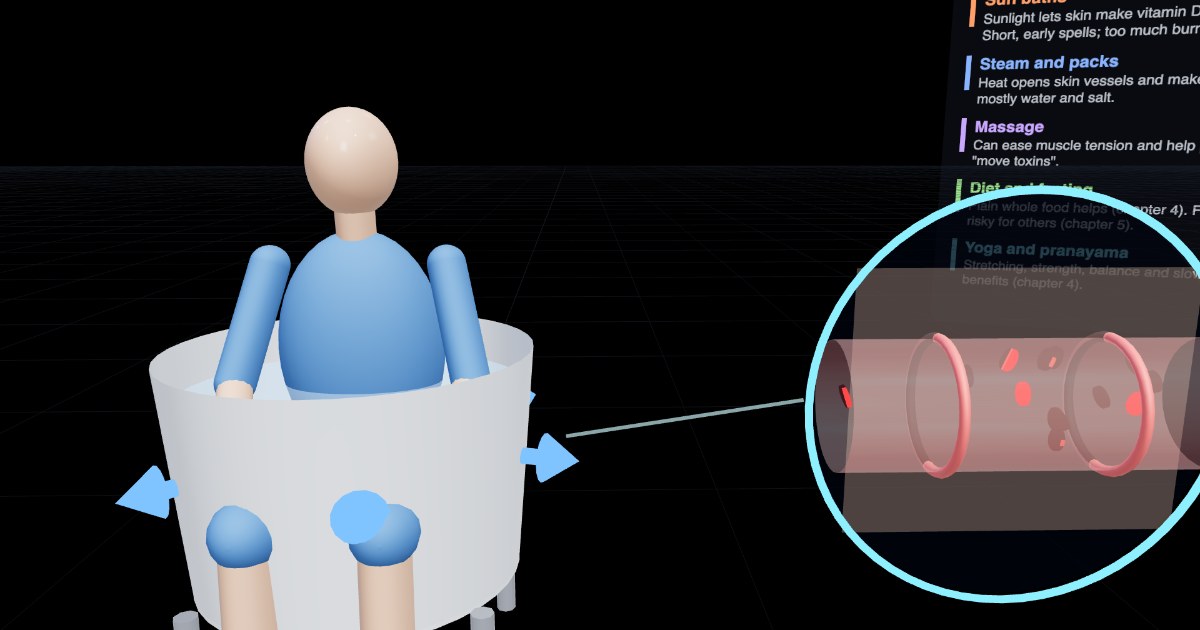
The biggest drop is in the arterioles, the smallest arteries. They have thick rings of smooth muscle, so they act as taps. Poiseuille's law says the resistance of a tube goes up with the fourth power of how much narrower it gets: squeeze an arteriole to half its width and it lets through only one sixteenth as much. By opening some taps and closing others, your body sends blood where it is needed.

Blood also changes speed. The aorta is one tube of about 2.5 cm², but the capillaries together are about 1,000 times wider, so blood slows from about 33 cm a second to about 0.3 mm a second, giving time to swap oxygen and food.

The walls match the job. Arteries have thick, stretchy walls to take the pounding. Capillaries are one cell thick so things can pass through. Veins have thin, floppy walls and hold most of your blood at low pressure.

Your body watches the pressure too. Stretch sensors called baroreceptors in the neck and aorta report to the brainstem (see BrainClear). If you stand up fast and pressure dips, within seconds your heart speeds up and arterioles tighten. Over hours and days the kidneys adjust it with a hormone called renin (see KidneyClear).

A doctor's cuff reads the top and bottom of the swing in your arm's artery: 120/80 is the classic normal. HeartClear lets you work a cuff yourself.

Try “Pressure and flow” in the interactive model →

Chapter 4

Swap at the capillaries, squeeze back home

Where blood finally does its job, and how it climbs back up your legs.

Everything the heart does is for this moment. In a capillary, only one cell thick and just wide enough for one red blood cell at a time, blood slows to about 0.3 mm a second and swaps things with the cells around it.

Oxygen and glucose are more crowded in the blood than in the cells, so they diffuse out. Carbon dioxide is more crowded in the cells, so it diffuses in. Nothing pumps them: they just spread from crowded to less crowded.

Water moves too, pushed and pulled by Starling forces. Blood pressure pushes fluid out, about 35 mmHg at the start of the capillary. Proteins in the plasma, mainly albumin, pull water back in by osmosis, about 28 mmHg (see OsmosisClear). At the start the push wins and fluid leaks out; by the end the pressure has dropped to about 15 and some is drawn back. What is left over, about 2–3 litres a day, is collected by lymph vessels.

If too much leaks, tissues swell: oedema. It happens when capillary pressure rises (as in heart failure) or when blood has too little protein (as in severe malnutrition or liver disease).

Then blood has to get home. In your legs that means climbing more than a metre with very little pressure left. Veins have one-way valves, and every time your calf muscles squeeze, they milk blood upwards: the muscle pump. Stand still for long and blood pools in your feet; walk, and ankle vein pressure falls from about 90 to about 20 mmHg.

Try “At the capillaries” in the interactive model →

Chapter 5

What blood is, and how it plugs a leak

Red cells, white cells, platelets and plasma, and the chain reaction that makes a clot.

Spin a tube of blood fast and it separates. About 55% is plasma, a straw-coloured liquid that is mostly water, carrying salts, sugar, hormones and proteins such as albumin. Just under half is red blood cells. The share of red cells is the haematocrit, about 40–45%: a bit higher in men, lower in women, higher again in people living high in the mountains.

A drop the size of a pinhead (one microlitre) holds about 5 million red cells, which carry oxygen on haemoglobin; about 5,000–10,000 white cells, which fight germs; and about 150,000–450,000 platelets, tiny cell pieces that help plug leaks. Red cells live about 120 days, so your bone marrow makes about 2–3 million every second. When oxygen is low, the kidneys send a hormone, EPO, to speed it up (see KidneyClear).

Cut a small vessel and three things happen. The vessel narrows. Platelets stick to the torn edge and to each other, making a soft plug. Then the clotting cascade runs: a chain of proteins in the plasma, each switching on many copies of the next, until thrombin turns soluble fibrinogen into sticky fibrin threads that knit the plug into a firm clot. Because each step multiplies the last, a tiny trigger quickly makes a big clot.

People with haemophilia lack one of the proteins, usually factor VIII, so their blood clots slowly.

Try “What blood is” in the interactive model →

Chapter 6

When the pipes and the blood go wrong

High blood pressure, clogged arteries, heart attack and stroke, varicose veins, anaemia, and giving blood.

Most problems with the circulation build up quietly over years, so regular check-ups matter. This chapter explains them; it cannot tell you what is going on in your own body. For that, see a doctor.

High blood pressure (hypertension) means a reading that stays at 140/90 mmHg or more. It usually causes no symptoms, yet it strains the heart, kidneys, brain and eyes. About 1 in 3 adults worldwide has it, and nearly half don't know. In India, the NFHS-5 survey found raised blood pressure in about 1 in 4 adults. A simple cuff check at a clinic is the only way to find out.

Atherosclerosis is fatty plaque building up inside artery walls, helped by high blood pressure, smoking, diabetes and high cholesterol. Because of Poiseuille's r⁴ rule a narrowing matters a lot, though small arteries downstream can open up and hide it until it is severe.

If a plaque cracks, a clot can form on it and block the artery. In a coronary artery that is a heart attack: chest pain or pressure that may spread to the arm, jaw or back, with sweating or breathlessness. In the brain it is a stroke: think FAST, face drooping, arm weakness, speech trouble, time to call. Either way, call an ambulance at once (in India 112 or 108): every minute counts.

Varicose veins are swollen, twisted veins, usually in the legs, where valves have stopped working. Anaemia means too little haemoglobin, so you feel tired and breathless; NFHS-5 found it in about 57% of Indian women and 67% of young children. Iron-rich food helps, and a doctor can test for it and find the cause.

You can help others too. A healthy adult can give blood: in India, aged 18–65 and at least 45 kg. One donation of 350–450 mL is less than a tenth of your blood; the plasma is replaced in about a day and the red cells in a few weeks.

Try “Keeping it healthy” in the interactive model →

Test yourself

Frequently asked

What makes a vessel an artery?

It carries blood away from the heart. Direction decides. The pulmonary artery carries oxygen-poor blood, but away from the heart, so it is an artery.

Where does blood from your gut go first?

To the liver, through the portal vein. The portal vein takes it to the liver, which stores and checks what you absorbed before it reaches the rest of the body.

What do lymph vessels do?

Return fluid that leaked out of capillaries to the blood. A little fluid leaks out of capillaries all the time. Lymph vessels collect it and empty it into veins near the neck.

Why is it called a double circulation?

Blood passes through the heart twice per lap: once for the lungs, once for the body. Right heart to the lungs and back to the left heart, then left heart to the body and back to the right heart.

At rest, blood coming back to the heart is about how full of oxygen?

About 75%. The body takes only about a quarter of the oxygen at rest. The rest is a reserve for exercise.

When you run hard, blood flow to your gut…

Drops, as blood is sent to the muscles. Small arteries to the gut and kidneys narrow while those in the muscles open wide.

Where does blood pressure drop the most?

Across the arterioles. Arterioles are narrow and muscular, so they hold back the most. That is what lets them control flow.

An arteriole narrows to half its radius. Its resistance becomes about…

16 times bigger. Poiseuille’s law: resistance goes with 1/r⁴, and 2⁴ = 16.

Why does blood move slowest in the capillaries?

Together they are about 1,000 times wider than the aorta. The same flow spread over a much bigger total cross-section means a much slower speed: good for exchange.

What moves oxygen from the blood into your cells?

Diffusion: from more crowded to less crowded. There is more oxygen in the blood than in the cells, so it spreads out across the thin capillary wall by itself.

What pulls water back into a capillary?

Proteins in the plasma, by osmosis. Plasma proteins such as albumin cannot leave, so they draw water back in: about 28 mmHg of pull.

Why does walking lower the pressure in your ankle veins?

Calf muscles squeeze the veins and the valves stop blood falling back. Each squeeze pushes blood up; the valves stop it sliding back. Standing still, ankle vein pressure is about 90 mmHg; walking, about 20.

About what share of your blood is red cells?

About 40–45%. That is the haematocrit. Plasma makes up most of the rest, about 55%.

Which part of blood starts plugging a cut?

Platelets. Platelets stick to the torn wall and to each other within seconds, making a soft plug.

Why is clotting called a cascade?

Each activated protein switches on many of the next, so the signal grows fast. Like a waterfall that gets bigger as it falls, each step multiplies the one before, ending in fibrin threads.

What is the usual sign of high blood pressure?

Usually none: you only find out by measuring. It is often called a silent condition. Nearly half of the people who have it don’t know, so get it checked.

Someone’s face droops on one side and their speech is slurred. What should you do?

Call an ambulance straight away. These are FAST signs of a stroke. Treatment works best in the first hours, so call for help immediately.

Halving an artery’s radius cuts the flow through that narrowed piece to about…

One sixteenth. Poiseuille’s law: flow goes with r⁴, and (1/2)⁴ = 1/16.

Words worth knowing

Double circulation
Blood passes through the heart twice per lap: once for the lungs, once for the body.
Artery and vein
Arteries carry blood away from the heart; veins carry it back. Direction, not colour, decides.
Capillary
The tiniest vessel, about one red cell wide, where oxygen, food and waste are swapped.
Arteriole
The smallest artery, with a muscle ring that acts like a tap on the blood supply.
Poiseuille's law
Flow through a narrow tube depends on its radius to the fourth power.
Starling forces
Blood pressure pushing fluid out of capillaries and plasma proteins pulling it back in.
Baroreceptor
A stretch sensor in the neck and aorta that helps the brain keep blood pressure steady.
Haematocrit
The share of blood made of red cells, about 40–45%.
Clotting cascade
A chain of blood proteins, each switching on many of the next, that ends in fibrin threads.

Fork it. Teach with it.

This box is plain HTML, CSS and JavaScript, with no build step and no accounts. Run it yourself and it sends nothing anywhere. The code is MIT. The words, images and videos are CC BY 4.0, so you can reuse them anywhere if you credit “Glassbox, glassbox.how/e/circulationclear”.

git clone https://github.com/bdeeps/circulationclear.git

Built with three.js (MIT), Geist, Instrument Serif (SIL OFL 1.1).

←→ previous / next box · / search

Would you like to see the full page, with the interactive model?