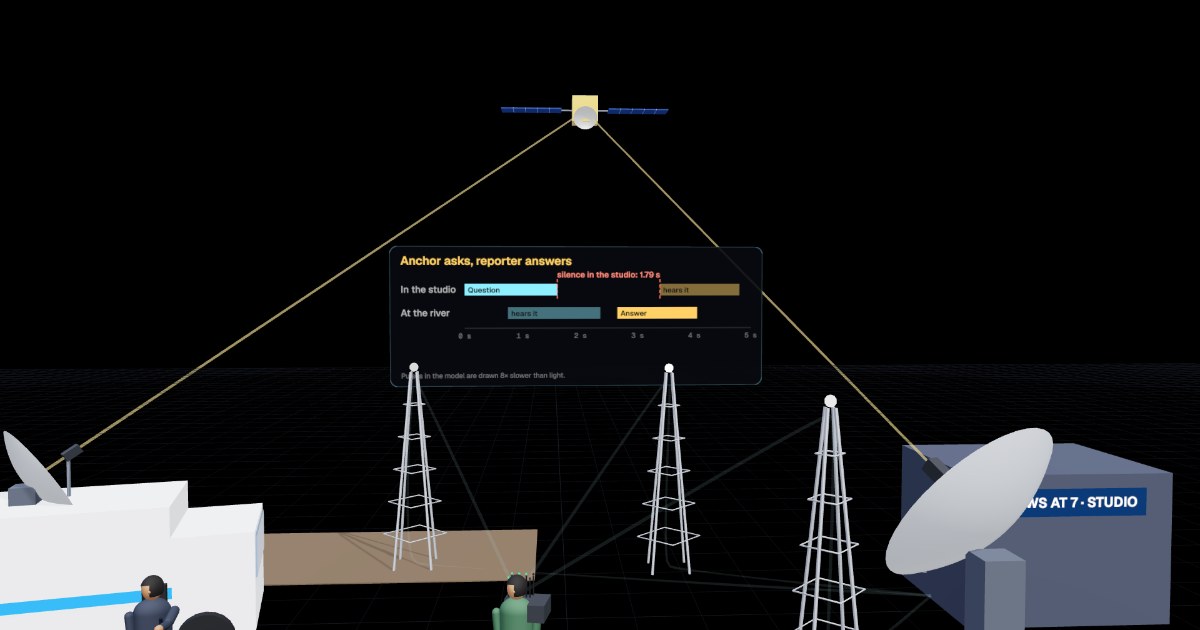
A radio pulls one voice out of an invisible sea of waves, using a coil, a capacitor and a diode. A classic transistor radio is a ferrite rod antenna, a gang tuning capacitor, IF transformer cans, six or seven transistors, a detector diode, a speaker and four D cells (6 V).
A radio pulls one voice out of an invisible sea of waves, using a coil, a capacitor and a diode. Open up a 1970s transistor set, shake charges into radio waves, play with AM and FM, tune a circuit into resonance and follow a signal through a superhet.
RadioClearOpened 26 Sept 202615 min to playFree · no sign-up
In 60 seconds
A few parts, no computer
A classic transistor radio is a ferrite rod antenna, a gang tuning capacitor, IF transformer cans, six or seven transistors, a detector diode, a speaker and four D cells (6 V). A modern radio can be one DSP chip that does the same jobs with arithmetic.
Waves of electric and magnetic field
Charges surging up and down an antenna send out linked electric and magnetic ripples at 300,000 km/s. Wavelength is c / f: AIR's medium-wave band, 531 to 1,602 kHz in 9 kHz steps, has waves 190 to 560 m long. By day the ionosphere's D layer soaks up medium waves; at night they bounce off the E layer a thousand kilometres away.
A voice rides a carrier
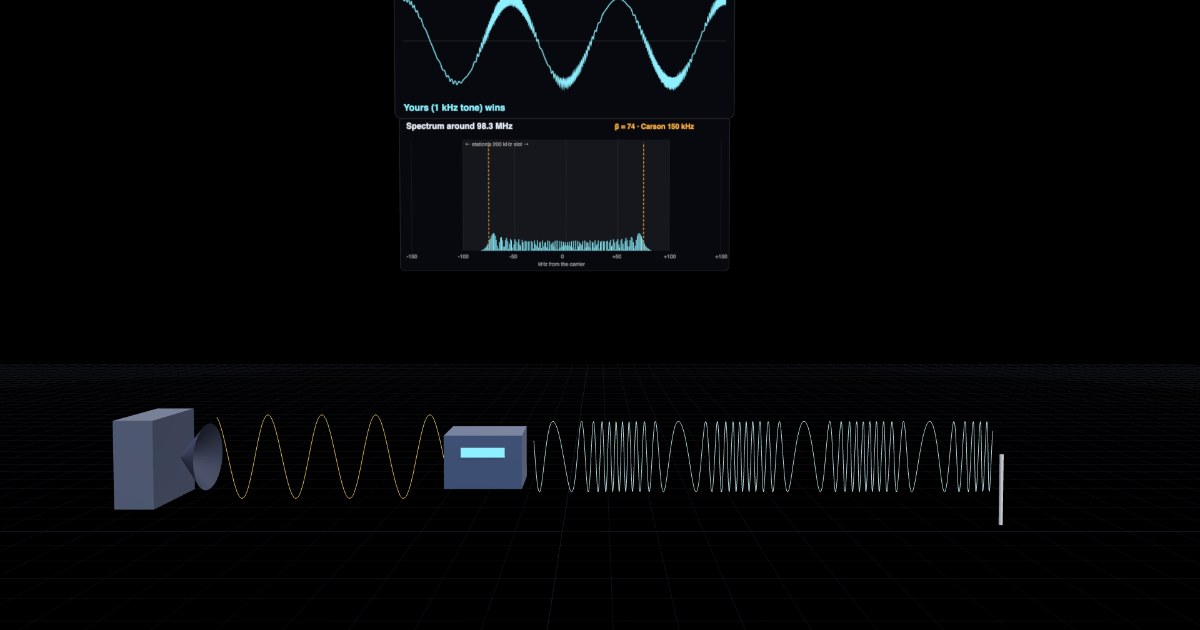
AM changes the carrier's size, so its envelope traces the sound and it fits in a 9 kHz channel. FM swings the frequency by up to ±75 kHz and needs about 180 kHz, but its receiver ignores the size of the wave, so most static vanishes.
Tuning is resonance
A coil and a capacitor ring at f = 1 / (2π√LC). With a 230 µH coil, 40 to 400 pF tunes the whole medium-wave band. The peak is about f / Q wide, and one tuned circuit alone lets a neighbouring station leak in.
The superheterodyne
A local oscillator runs 455 kHz above the station (10.7 MHz for FM). The mixer's difference frequency is always the same, so sharp fixed filters and most of the gain work identically on every station. A diode and capacitor then follow the envelope to recover the sound. A crystal set does it with no battery at all.
Radio in India
Akashvani reaches about 99% of Indians in 23 languages. Medium wave carries IMD cyclone bulletins far out to sea, ham operators kept the Andamans in touch after the 2004 tsunami, and hundreds of 100-watt community stations serve villages about 12 km around.
The history
From a set of equations in 1865 to a voice from the sky in almost every Indian home.
A ferrite rod, a tuning capacitor, a few transistors, a speaker and four big batteries.
For many Indian families in the 1970s and 80s, the transistor radio was the first electronic thing in the house. It sat on a shelf in a wooden or leatherette case, ran on four big D cells, and was always on for the news, film songs and the cricket.
Open one up and there are surprisingly few parts. At the top lies a black ferrite rod wrapped in copper wire: that is the antenna. The tuning knob turns a gang capacitor, a stack of metal plates that slide between each other. Together, the coil and the capacitor pick one station out of dozens. Small metal cans called IF transformers filter the signal, six or seven transistors amplify it, a tiny diode pulls the sound out of the radio wave, and the speaker turns it back into air pressure.
A radio today can be a single DSP chip a few millimetres across. It turns the radio wave into numbers and does the tuning and filtering with maths. The ideas inside are the same ones you will see in the old set.
Shake a charge and ripples of electric and magnetic field race away at the speed of light.
Push electrons up and down a metal rod, fast. Each moving charge drags its electric field with it, and moving charge makes a magnetic field. The changes cannot spread instantly, so they ripple outwards at the speed of light, about 300,000 km every second. That ripple of electric and magnetic field, always at right angles to each other, is a radio wave. It is the same stuff as light, just with much longer waves (see WaveClear).
The frequency is how many times the charges swing each second. The wavelength is how far the wave travels in one swing: λ = c / f. AIR's medium-wave stations sit between 531 and 1,602 kHz, spaced 9 kHz apart in India, with waves 190 to 560 metres long. FM (88 to 108 MHz) has waves about 3 metres long. Phones use waves a few centimetres long (see MobileClear).
Wavelength decides how a wave travels. Long medium waves hug the ground as a ground wave for hundreds of kilometres. By day a low layer of the ionosphere, the D layer, soaks up any medium wave that heads for the sky. At night the D layer fades, and the higher E layer bounces medium waves back down, a thousand kilometres away or more. That is why a radio picks up far-off AIR stations after dark. Shortwaves bounce off the even higher F layer, hop after hop, round the world. FM goes straight through the ionosphere into space, so it only reaches as far as the horizon.
A voice cannot fly on its own. It hitches a ride on a fast carrier wave, by changing its size or its frequency.
Your voice is a slow wobble, a few hundred to a few thousand times a second. Waves that slow would need an antenna kilometres long, and every station would talk over every other. So a radio station makes a fast, steady carrier wave on its own frequency, say 819 kHz, and makes the voice change it. This is modulation.
In AM (amplitude modulation) the voice changes the carrier's size. Trace the tops of the peaks and you see the voice: this outline is the envelope. In FM (frequency modulation) the size stays fixed and the voice nudges the frequency up and down, by up to 75 kHz for FM broadcasts. The waves bunch up and spread out in time with the sound.
Modulation spreads a station's signal into sidebands either side of the carrier. An AM station needs only 9 kHz of room, so there is space for many of them. An FM station takes about 200 kHz but sounds better. Lightning, motors and switches make bursts of static that change the size of the wave. An AM set hears every burst as a crackle. An FM set ignores the size and listens only to the timing, so most of the static vanishes. How FM stations share the band is the story of FMClear.
A coil and a capacitor pass one frequency and turn the rest away.
Every station in range is hitting your antenna at the same time, each on its own frequency. How does a radio pick just one? With resonance, the same effect that lets you pump a swing higher by pushing in time with it (see WaveClear).
A coil (inductor, L) and a capacitor (C) wired together make a tuned circuit. Charge sloshes back and forth between them, from electric field in the capacitor to magnetic field in the coil and back, at one natural frequency: f = 1 / (2π√LC). Signals at that frequency build up big. Signals at other frequencies do not.
Turning the tuning knob swings the gang capacitor's plates in or out. More overlap means more capacitance and a lower frequency. With a 230 µH coil, 40 to 400 pF tunes the whole medium-wave band.
How sharp the peak is depends on the circuit's Q (quality factor): the peak is about f / Q wide. A sharp peak gives good selectivity: it can split two stations only 18 kHz apart. But one tuned circuit is never quite sharp enough on its own, as you will see. That is why real radios add the trick in the next chapter.
Shift every station to one fixed frequency, then filter and amplify it there.
Almost every radio since the 1930s is a superheterodyne, or "superhet", an idea Edwin Armstrong worked out in 1918. Follow the signal from left to right.
The antenna picks up every station at once. A tuned RF amplifier favours the one you want. Then comes the clever part. A local oscillator inside the radio makes its own wave, always 455 kHz above the station you tune (for AM). The mixer multiplies the two together, which makes their sum and their difference. The difference is always 455 kHz, whatever station you picked. This fixed intermediate frequency (IF) goes through sharp, fixed filters (the IF transformer cans) and most of the amplification. So the radio gets the same sharpness on every station.
The detector then recovers the sound. For AM it is a diode and a capacitor, which follow the envelope. An FM set uses 10.7 MHz as its IF and a detector that turns frequency changes into voltage. An audio amplifier drives the speaker.
The simplest radio of all, the crystal set, has no battery. An antenna, a coil, a capacitor, a crystal diode and earphones are enough, powered only by the radio wave itself. Build one and hear why the diode matters.
From Akashvani in every home to cyclone warnings at sea, ham operators and village stations.
In India, radio reaches places nothing else does. All India Radio, called Akashvani ("voice from the sky"), is heard by about 99% of the population across some 92% of the country, in 23 languages. Generations grew up on Vividh Bharati's film songs, the news at fixed hours, and cricket commentary that made you see every ball. Since 2014 the Prime Minister's monthly Mann Ki Baat has gone out on the same network.
Radio also saves lives. When a cyclone forms over the Bay of Bengal or the Arabian Sea, the India Meteorological Department issues bulletins every three hours and AIR broadcasts them. Medium wave travels hundreds of kilometres over the sea, far beyond FM, and a battery radio keeps working when power lines and phone towers are down. After the 2004 tsunami, amateur ham radio operators visiting Port Blair kept the Andaman Islands in touch with the mainland. Shortwave bounced off the sky, so they needed no towers at all.
Community radio stations, run by colleges, NGOs and farm universities, broadcast with just 100 watts to villages about 12 km around. And DRM (Digital Radio Mondiale) puts digital, near-FM sound into AIR's old medium-wave channels. For FM stations and how they share the band, see FMClear. For television, see TVStationClear and TVClear.
What is the black rod wrapped in copper wire at the top of a transistor radio?
The antenna. It is a ferrite rod antenna. The magnetic part of the radio wave passes through the rod and makes a tiny voltage in the coil.
What changes when you turn the tuning knob?
How much the plates of the gang capacitor overlap. More overlap means more capacitance, and that tunes the circuit to a lower frequency.
How does a modern radio chip do the tuning and filtering?
With arithmetic on the signal turned into numbers. A DSP radio chip digitises the signal and filters it with maths, so one tiny chip replaces the coils and cans.
What is the wavelength of AIR's 1,000 kHz medium-wave signal? (c = 300,000 km/s)
300 m. λ = c / f = 300,000,000 ÷ 1,000,000 = 300 metres.
Why can you hear distant medium-wave stations at night but not by day?
The D layer that absorbs medium waves by day fades after sunset, so waves bounce off the E layer. Sunlight builds the D layer, which soaks up medium waves. At night it fades and the E layer bounces them far away.
Why does an FM station only reach about as far as the horizon?
Its short waves go straight through the ionosphere instead of bouncing back. At around 100 MHz the ionosphere does not bend the wave back, so FM travels in straight lines.
In AM, what does the voice change?
The carrier's size (amplitude). Amplitude modulation makes the carrier bigger and smaller in the shape of the sound.
Why does FM sound cleaner than AM in a thunderstorm?
Static mostly changes a wave's size, and an FM set ignores size. An FM receiver clips the wave to a fixed size and listens only to its frequency, so bursts of static mostly disappear.
An AM station sends a 3 kHz whistle on an 819 kHz carrier. Where are its sidebands?
At 816 kHz and 822 kHz. The sidebands sit at the carrier plus and minus the sound frequency: 819 − 3 and 819 + 3 kHz.
You turn the knob so the gang capacitor's plates overlap more. What happens?
The radio tunes to a lower frequency. More overlap means more capacitance, and f = 1 / (2π√LC) gets smaller.
What does a higher Q do?
Makes the resonance peak narrower, so neighbouring stations are kept out. The peak is about f / Q wide, so a higher Q means a sharper peak and better selectivity.
A tuned circuit has L = 230 µH and C = 100 pF. Roughly what does it tune to?
1,050 kHz. f = 1 / (2π√(230×10⁻⁶ × 100×10⁻¹²)) ≈ 1.05 million hertz, in the medium-wave band.
An AM superhet is tuned to 702 kHz. What is its local oscillator's frequency?
1,157 kHz. The oscillator runs 455 kHz above the station: 702 + 455 = 1,157 kHz. Their difference is the 455 kHz IF.
Why convert every station to one intermediate frequency?
So the sharp filters and most of the gain can be fixed, and work the same for every station. Filters tuned once at the factory to 455 kHz give the same selectivity wherever the dial is.
In a crystal set with no diode, why do the earphones stay silent?
The radio wave pushes the earphone equally both ways, so it averages to nothing. The diode lets through only one half of each wave, so what is left follows the envelope, the sound.
Why is medium-wave AIR so useful for cyclone warnings at sea?
Its ground wave travels hundreds of kilometres over sea water, far beyond FM's horizon. Medium waves hug the Earth, and sea water conducts well, so they reach boats far offshore.
How did ham operators link the Andaman Islands to the mainland after the 2004 tsunami?
With shortwave radio bounced off the ionosphere. Shortwave reflects off the F layer, so two small stations 1,200 km apart can talk with no towers in between.
About how far does a typical Indian community radio station reach?
12 km. The policy allows 100 watts from a mast about 30 m high, which covers roughly 12 km around.
Words worth knowing
Radio wave
Linked electric and magnetic ripples moving at the speed of light, with wavelengths from millimetres to kilometres.
Wavelength
The length of one wave, λ = c / f: 366 m at 819 kHz, about 3 m for FM.
Carrier
The steady high-frequency wave a station sends, which the sound then modulates.
AM and FM
Amplitude modulation changes the carrier's size; frequency modulation changes its frequency.
Sideband
The extra frequencies either side of the carrier that the modulation creates.
Resonance
A tuned circuit's big response at its own frequency, f = 1 / (2π√LC).
Q factor
How sharp a resonance is; the peak is about f / Q wide.
Intermediate frequency
The fixed frequency a superhet shifts every station to: 455 kHz for AM, 10.7 MHz for FM.
Ionosphere
Charged layers of the upper air, 60 to 500 km up, that absorb or reflect radio waves.
Fork it. Teach with it.
This box is plain HTML, CSS and JavaScript, with no build step and no accounts. Run it yourself and it sends nothing anywhere. The code is MIT. The words, images and videos are CC BY 4.0, so you can reuse them anywhere if you credit “Glassbox, glassbox.how/e/radioclear”.