Every electric heater turns 100% of its electricity into heat, yet a halogen warms your face in a second while an oil radiator needs many minutes to get going. Radiant heaters (rod, quartz, halogen, carbon) make something glow, and their infrared warms whatever it shines on, in seconds.
Every electric heater turns 100% of its electricity into heat, yet a halogen warms your face in a second while an oil radiator needs many minutes to get going. Take nine heaters apart in 3D, heat a Delhi bedroom through a January night, and see why an angithi in a closed room can kill.
RoomHeaterClearOpened 25 Sept 202614 min to playFree · no sign-up
In 60 seconds
Every heater is 100% efficient
A heater pushes current through a wire with resistance, and all of that electricity becomes heat: a 2,000 W heater on 230 V mains is about 26 Ω and makes 2 kWh of heat an hour. Heaters differ only in how the heat reaches you.
Glow or flow
Radiant heaters (rod, quartz, halogen, carbon) make something glow, and their infrared warms whatever it shines on, in seconds. Convection heaters (fan, PTC, convector, oil radiator) warm the air, which carries heat round the whole room, more slowly.
Oil, bimetal and clever stones
An oil-filled radiator stores over 10 kJ per degree in its oil and steel, so it warms slowly and stays warm. A bimetal strip bends to switch it off, a tip-over switch cuts it if it falls, and PTC ceramic stones raise their own resistance above about 220 °C so they can't overheat.
A room is a leaky box
A typical Indian bedroom leaks about 100 watts for every degree it is held above the outside air. On a 7.5 °C Delhi January night, a 2 kW fan heater warms the air in about an hour, but the brick walls take many hours, and eight hours flat out costs 16 units: over ₹100.
Dry air and a silent gas
Warming air adds no water, so humidity falls: foggy 85% outside becomes about 32% indoors at 22 °C. Burning charcoal, coal or wood in a closed room is far worse: odourless carbon monoxide builds up and can kill sleepers in two or three hours.
Use it safely
Keep a metre clear of curtains and beds, plug a 2 kW heater (8.7 A) into a 16 A wall socket rather than a thin extension board, switch off at bedtime, and buy one with the ISI mark. Never sleep beside an angithi.
The history
A million years from a fire in a cave to glowing halogen tubes, oil radiators, self-limiting ceramics and heat pumps, and the angithi that still kills in closed rooms.
Nine ways to warm a winter room: glowing tubes, hot oil, blowing air and a pot of charcoal.
Every electric heater does the same simple thing: it pushes current through a wire with resistance, and the wire gets hot. A 2,000 W heater on 230 V mains has about 26 Ω of wire, from P = V² ÷ R (see OhmsLawClear). All of the electricity becomes heat, so every electric heater is 100% efficient, exactly like the element in a geyser (WaterHeaterClear). What differs is how the heat reaches you.
Radiant heaters (the rod, quartz, halogen and carbon types) make something glow. Their infrared shines straight onto you, like sunshine, and a shiny reflector aims it forward. They feel warm in seconds, but only where they point.
Convection heaters warm the air. A fan heater blows air past a hot coil, just like a big HairDryerClear; a PTC ceramic heater uses clever stones that can't overheat; a convector lets warm air rise out of its top. The oil-filled radiator (OFR) heats oil sealed inside steel fins: slow to start, gentle, and still warm for a while after you switch it off.
The angithi, a pot of burning charcoal, is the old way. It gives real heat, but it also fills a closed room with invisible carbon monoxide. More on that in chapter 5.
Radiation warms you. Convection warms the air. Conduction lets it leak out through the walls.
Heat moves in three ways (all three are in HeatClear). A heater uses the first two.
Radiation is heat carried by light, mostly infrared that you can't see but can feel. Everything warm glows; hot things glow far more, because the power follows the Stefan–Boltzmann law: P = εσAT⁴, with T in kelvin. Double the temperature and the glow is 16 times stronger. Infrared is the same kind of electromagnetic wave as the radio signals in RadioClear, FMClear and TVStationClear, only with wavelengths a million times shorter. Above about 525 °C some of the glow becomes visible: dull red, then orange, then yellow-white. A halogen filament at 2,200 °C is bright; an oil radiator at 75 °C glows only in infrared.
Infrared crosses the air without warming it and lands on you, the floor and the walls. So a radiant heater warms whatever it points at, fast. Step out of its beam and you feel cold again.
Convection is heat carried by moving air. Air touching something hot warms, gets lighter and rises; cooler air flows in below. A fan simply pushes harder. Convection heaters warm the room air, so the whole room slowly gets comfortable, not just one side of you.
Conduction is heat passed on by touch. In a room it works against you: heat seeps out through walls, windows and the roof to the cold outside.
Oil that stores heat, a strip of two metals that switches it, and a stone that can’t overheat.
An oil-filled radiator has no oil to burn. The oil is sealed in for good. An element at the bottom heats it; hot oil rises inside each fin, gives its heat to the steel and sinks again: convection inside. The fins then warm the room air: convection outside.
About 3.5 kg of oil and 9 kg of steel make a big thermal mass: over 10,000 joules for each degree. So an OFR takes many minutes to warm up where a fan heater takes seconds, runs at a gentle 70 to 80 °C, and keeps giving heat for 15 to 20 minutes after you switch it off.
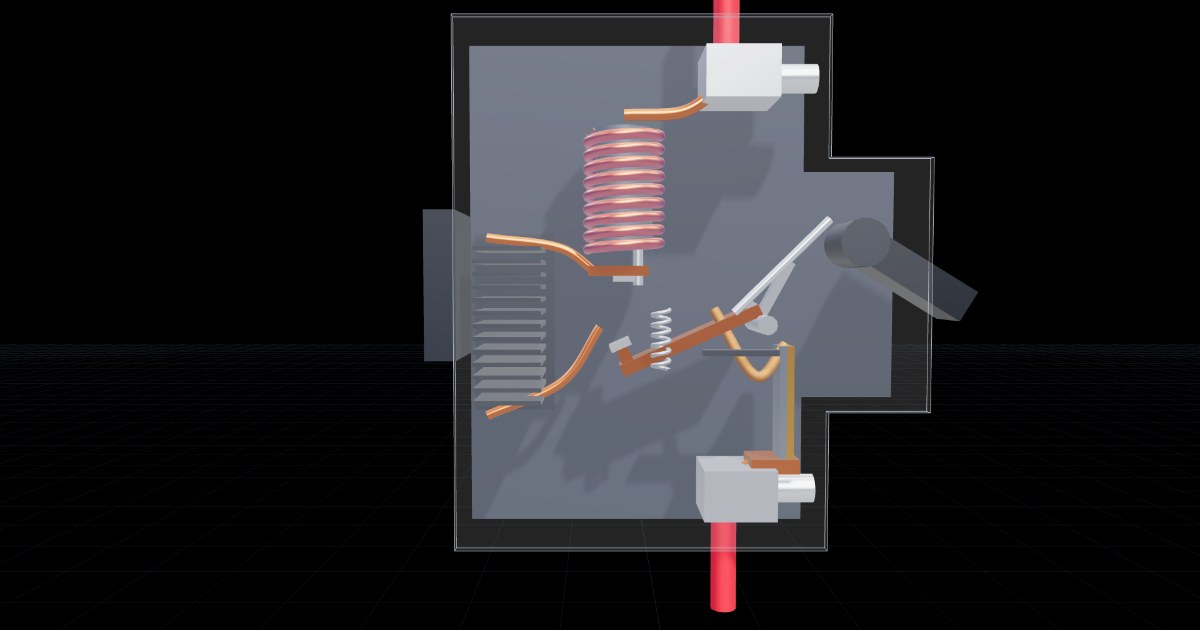
Its thermostat is a bimetal strip: brass and steel bonded together. Brass expands more when warm, so the strip bends and flicks a contact open. Turning the knob moves the contact. A tip-over switch in the base cuts the power if the heater falls, and a thermal fuse is the last line of defence.
A PTC ceramic heater uses stones of doped barium titanate. Below about 220 °C they conduct well; just above it, their resistance shoots up ten times every 12 °C. So they draw full power when cool and throttle themselves when hot. Block the airflow and the power simply falls. A plain nichrome coil would keep getting hotter until a cut-out saved it.
How long it takes, how warm it gets, and what the night costs.
A room is a leaky box. Heat escapes through the walls, the window, the roof and every draught. The rate is roughly U × A × ΔT: how leaky each surface is, how big, and how much warmer inside is than outside. Add it all up and a typical Indian bedroom loses about 100 watts for every degree you hold it above the outside air.
So a heater can only warm a room until the leaks match its power. That is the steady temperature. A 2 kW heater in a leaky room might never reach 20 °C; the same heater in a small, sealed room can make it too hot.
The walls matter too. Brick and concrete soak up heat for hours before they warm, which is why a heater warms the air quickly but the room still feels chilly near the walls. Heaters with a thermostat switch off when the air is warm enough, which saves money; plain radiant heaters just run flat out.
An AC in heat mode is a heat pump: it moves heat in from outdoors and gives about 3 units of heat for 1 unit of electricity (see ACClear). Every other heater here gives exactly 1. The energy itself follows EnergyClear: every joule you pay for ends up leaking outside.
Why heated rooms feel dry, and why a fire in a closed room can kill while you sleep.
Dry air. Warm air can hold much more water vapour than cold air: about twice as much for every 11 °C. Heating a room adds warmth but no water, so the relative humidity (RH) falls. Foggy Delhi night air at 7 °C and 85% RH, warmed to 22 °C, drops to about 32%. Below about 30 to 40%, many people get dry eyes, dry skin and a scratchy throat. Radiant heaters feel worst because they also dry the skin they shine on. A bowl of water helps a little; opening a window now and then helps more.
Carbon monoxide (CO) is the real danger. Charcoal, coal and wood in an angithi or sigri never burn completely (why, see CombustionClear); a glowing charcoal bed makes a lot of CO. It has no colour and no smell. It grabs haemoglobin in your blood more than 200 times as tightly as oxygen, forming COHb, so your blood carries less and less oxygen.
Asleep, you feel nothing. At 10 to 20% COHb comes a headache; at 30% you are too confused and weak to get up; above 50 to 60% it is often fatal. In a closed room this can happen in two or three hours. Every winter, families across North India are found dead this way. Delhi Fire Service counted 15 angithi deaths in Delhi in January 2024 alone. A study of autopsies at AIIMS New Delhi found about 80% of CO deaths happen in winter, nearly all in closed rooms. Official NCRB figures list only about ten CO deaths a year for all of India, so most are probably recorded under other causes. The true toll is not known, but it is far higher.
Distance from fabric, the right socket, fresh air, and a heater that switches itself off.
Most heater accidents are fires, burns and poisoning, and each has a simple rule.
Keep 1 metre clear. Curtains, quilts, sofas, clothes drying on a chair: infrared heats them just as it heats you, and they can't move away. Never dry clothes on a heater or cover it.
Plug it straight into a wall power socket. A 2 kW heater draws 8.7 amps for hours. A 6 A socket or a cheap extension board with a thin cord gets hot at the pins and in the wire, and that heat is where many house fires start. Heaters belong on a 16 A power socket on a 16 A MCB (see MCBClear). Don't run a heater and a geyser on one circuit.
Switch it off when you sleep, or use one with a thermostat and a timer. Never sleep in a closed room with a fire: an angithi, coal or wood needs a window open, and even then it is safer to put it out and take it outside before bed. A CO alarm costs less than a heater.
Children and pets touch things. Choose heaters with a guard, a tip-over switch and a cool-touch body, and keep them out of reach. Buy one with the ISI mark: in India, room heaters must meet IS 302 (Part 2/Sec 30) and be certified by BIS.
A 2,000 W fan heater and a 2,000 W oil-filled radiator run for an hour. Which turns more electricity into heat?
Both make exactly the same heat. Every electric heater turns all its electricity into heat. 2 kW for an hour is 2 kWh of heat either way. They only differ in where the heat goes first.
Why does a halogen heater feel warm the moment you switch it on?
Its infrared shines straight onto your skin, like sunlight. Its thin filament reaches over 2,000 °C in about a second and radiates infrared, which crosses the room at the speed of light and warms you directly.
What does the shiny curved metal behind a radiant heater’s tubes do?
Reflects the infrared forward, towards you. Polished metal reflects infrared well. The curved reflector aims the glow forward instead of into the wall behind.
You sit in front of a halogen heater. Why does your face warm up long before the room air does?
Its infrared crosses the air and is absorbed by your skin. Air lets infrared pass almost untouched. Your skin absorbs it, so you warm first; the air only warms later, from the surfaces the light has heated.
A coil goes from 500 K to 1,000 K. How much more does it radiate?
Sixteen times. Radiated power goes as T⁴. Doubling the kelvin temperature multiplies it by 2⁴ = 16.
Which heater is best for warming a whole bedroom evenly for the evening?
A convection heater like an oil radiator or convector. Convection heaters warm the air, which carries heat all round the room. Radiant heaters are best for warming one person quickly.
Why does an oil-filled radiator keep warming the room after you switch it off?
The hot oil and steel store a lot of heat and release it slowly. Thermal mass: over 10 kJ for each degree. At 75 °C it holds more than half a megajoule, which it gives out over the next 15 to 20 minutes.
How does a bimetal strip switch a heater off?
Its two metals expand by different amounts, so it bends and opens a contact. Brass expands more than steel for each degree. Bonded together, they curl as they warm, and the moving end opens the contact.
A cloth falls over a PTC heater and blocks the air. What happens?
Their resistance shoots up, so the power drops and they stay near 230 °C. Above their switching temperature the stones’ resistance climbs steeply, so V²/R falls and they limit themselves. Still: never cover any heater.
Your 2 kW heater never gets a leaky room above 17 °C. What is happening?
Heat leaks out as fast as the heater makes it. At the steady temperature, the loss (heat loss coefficient × ΔT) equals the heater’s 2 kW. Only less leakage or more power can raise it.
A 2 kW fan heater runs flat out for 8 hours. How many units (kWh) does it use?
16. 2 kW × 8 h = 16 kWh. At ₹7 a unit that is about ₹112 for the night.
Why does an AC in heat mode cost about a third as much to run for the same warmth?
It moves heat from the outdoor air into the room, using electricity only to pump it. A heat pump is a fridge run the other way round. It moves about 3 units of heat for each unit of electricity at 7 °C outside.
Why does a heated room feel dry, even though no water was removed?
Warm air can hold more water, so the same water is a smaller share of the most it could hold. Relative humidity is vapour ÷ the maximum at that temperature. Warming raises the maximum, so RH drops.
Why is carbon monoxide from an angithi so dangerous at night?
It has no colour or smell, and sleeping people don’t notice the symptoms. CO is invisible and odourless. Asleep, you miss the headache and dizziness until you are too weak to move.
Which is safest for warming a bedroom overnight?
An electric heater with a thermostat, away from fabric, with some fresh air. Electric heaters burn nothing, so they make no CO. Never burn charcoal, coal or wood in a closed room.
How far should a heater be from curtains, beds and sofas?
About 1 metre. At a metre, the infrared and hot air reaching fabric are gentle. Close up, a curtain can pass 200 °C and char or catch fire.
A 2 kW heater is plugged into a cheap extension board with a thin 0.5 mm² cord. What is the problem?
The cord is rated for about 3 A but the heater draws 8.7 A, so it overheats. Heat in a wire grows as I²R. Nearly three times its rated current makes the cord and plug pins hot for hours: a common cause of fires.
Why is it dangerous to sleep with an angithi burning in a closed room?
It fills the room with odourless carbon monoxide. Burning charcoal makes CO, which builds up in a closed room and poisons sleepers without waking them.
Words worth knowing
Resistance heating
Current through a resistance turns electrical energy into heat: P = V²/R. All of it becomes heat.
Infrared
Light with wavelengths longer than red. Warm things give it off and we feel it as warmth.
Stefan–Boltzmann law
A surface radiates εσT⁴ watts per square metre with T in kelvin, so doubling the temperature gives 16 times the glow.
Convection
Heat carried by moving air or liquid: warm fluid rises, cool fluid sinks, and a fan pushes it harder.
Thermal mass
How much heat an object must take in to warm by one degree; big thermal mass means slow to heat and slow to cool.
Bimetal thermostat
A strip of two metals that bends as it warms and opens a contact at the set temperature.
PTC ceramic
A ceramic whose resistance rises steeply above a switching temperature, so it limits its own power.
Relative humidity
How much water vapour the air holds compared with the most it could hold at that temperature.
Carbon monoxide
A colourless, odourless gas from incomplete burning that stops the blood carrying oxygen.
Fork it. Teach with it.
This box is plain HTML, CSS and JavaScript, with no build step and no accounts. Run it yourself and it sends nothing anywhere. The code is MIT. The words, images and videos are CC BY 4.0, so you can reuse them anywhere if you credit “Glassbox, glassbox.how/e/roomheaterclear”.