Before mobiles, a beep on your belt meant someone needed you. A pager is a pocket receiver with a loop antenna, a crystal-tuned receiver, a decoder chip, a small LCD, a buzz motor and one AA battery. It can't transmit, so it can't reply: it just waits for messages with its own address.
Before mobiles, a beep on your belt meant someone needed you. Open a 1990s pager in 3D, type a message into a real POCSAG encoder, add radio noise and watch ten check bits repair it.
PagerClearOpened 15 Sept 202612 min to playFree · no sign-up
In 60 seconds
A radio that only listens
A pager is a pocket receiver with a loop antenna, a crystal-tuned receiver, a decoder chip, a small LCD, a buzz motor and one AA battery. It can't transmit, so it can't reply: it just waits for messages with its own address.
One call, a whole city
You phoned a paging centre and an operator typed your words, or the centre read your keypad tones. The message was queued, coded and sent from several tall towers at the same instant (simulcast). Every pager hears every page; only the one with the matching address beeps.
Words become codewords
In the POCSAG code each character is a 7-bit number, and bits are packed into 32-bit codewords: a flag, 20 message bits, 10 BCH check bits and a parity bit. After a 576-bit preamble come batches of a sync word and 8 frames, sent at 512, 1,200 or 2,400 bit/s by shifting the carrier 4.5 kHz up for 0 and down for 1.
Ten bits that fix mistakes
Noise flips bits on the way. The pager re-computes the check bits, and the mismatch points to the wrong bits. POCSAG's BCH(31,21) code plus parity corrects up to 2 errors in each codeword and notices when there are more.
Why pagers lasted
A pager listens only for the sync word and its own frame, so its radio is off about 80% of the time, and it never transmits. That stretches one AA cell to weeks or months. Strong VHF signals reach deep into buildings, which is why many hospitals and emergency crews still carry them.
India's short pager boom
India auctioned paging licences for 27 cities in 1992 and services began in 1995. Pagers, over 95% alphanumeric, beat early mobiles that charged about ₹16.80 a minute even to receive. Subscribers peaked at around 8 lakh in 1998 by one count, then faded as mobiles and SMS got cheap.
The history
70 years from a doctor's radio bleep to India's pager boom, and the hospitals that still carry one.
A pocket radio that only listens. It waits for its own address, then beeps, buzzes and shows a message.
In the 1990s, before most people had mobile phones, doctors, business people and college students clipped a pager to their belts. It is a small radio receiver with a screen. It can't make calls and it can't reply. It just listens, all day, for messages meant for it.
Look inside. The copper loop antenna runs round the edge of the case and catches the radio signal. The receiver chip tunes to one channel, and a quartz crystal keeps that tuning exact. The decoder chip turns the signal into ones and zeros and checks each message's address. If the address is this pager's, it saves the message in memory, shows it on the LCD and sets off the beeper or the vibration motor: a tiny motor with an off-centre weight that shakes the whole pager.
All of this runs on one AA battery for weeks or months. How? The pager sleeps most of the time and wakes only when its own messages might arrive (see the POCSAG chapter). A 1990s mobile phone lasted days at best.
You phone a paging centre. Tall towers across the city shout your message, and only one pager listens.
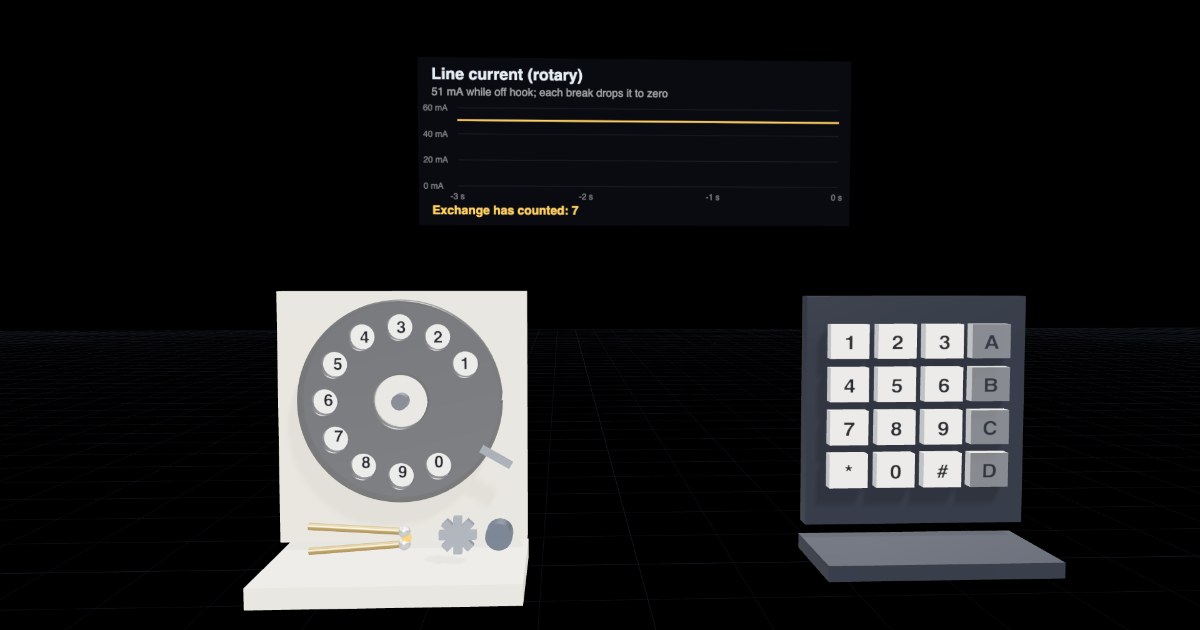
To page someone in the 1990s, you picked up an ordinary phone and dialled the paging centre. There were two ways to leave a message. You could speak to an operator, who typed your words into a computer. Or, on a numeric service, you tapped your phone number on the keypad, and the centre read the DTMF tones, the beeps each key makes (see TelephoneClear).
The paging terminal put the message in a queue with everyone else's, turned it into a digital code, and sent it to a set of tall transmitter towers. Every tower broadcasts the same signal at the same instant. This is called simulcast. Where two towers overlap, their signals arrive in step, so they add up instead of fighting.
Every pager in the city hears every message. Each one checks the address at the start, and ignores anything that isn't its own. Only the right pager beeps.
A pager is one-way. It never transmits, so the network doesn't know where you are. That's why the whole city gets every message. A mobile phone keeps telling the network where it is, so calls go only to the nearest tower (see MobileClear). Radio waves themselves are covered in WaveClear.
A page travels as a strict digital code called POCSAG: 32-bit codewords, in frames, sent as two tones.
Most pagers of the 1990s spoke a code called POCSAG, worked out by a group at the British Post Office from 1976 and made a world standard in 1981. It is still used today.
Your message is split into characters. Each one becomes a 7-bit number (A is 1000001), sent smallest bit first. The bits are packed into codewords of 32 bits: 1 flag bit, 20 message bits, 10 check bits for fixing errors, and 1 parity bit. The very first codeword is the address: which pager the message is for.
Before any message, the tower sends a preamble of at least 576 bits, 1010…, like clearing its throat. Then come batches: a special sync codeword, then 8 frames of 2 codewords each. Every pager belongs to one frame, set by the last 3 bits of its address. It wakes up for the sync word and its own frame, and sleeps through the other seven. That's the secret of the long battery life.
The bits go out at 512, 1,200 or 2,400 bits per second by frequency shift keying (FSK): the carrier moves up 4.5 kHz for a 0 and down 4.5 kHz for a 1.
Radio noise flips some bits. Ten check bits in every codeword let the pager find and fix them.
Radio is noisy. Lightning, motors, other transmitters and weak signal deep inside a building all add noise. Now and then noise makes the pager read a 1 as a 0, or a 0 as a 1. One wrong bit can turn a C into an A, or 2233 into 2213. In a hospital, that matters.
So every codeword carries 10 check bits, calculated from its 21 information bits using a BCH code (named after Bose, Chaudhuri and Hocquenghem). The pager re-does the calculation. If the answer doesn't match, the mismatch, called the syndrome, points to exactly which bits are wrong. POCSAG's BCH(31,21) code, plus a parity bit, can fix up to 2 wrong bits in each codeword and notice when there are more.
If a codeword has 3 or more errors, the pager can't fix it, but it knows. Real pagers show a warning mark instead of silently showing the wrong message. Burst noise, such as a crackle of static, is the enemy: it can smash many bits in one codeword.
A pager sleeps most of the time, never transmits, and hears signals deep inside buildings.
A 1990s mobile phone needed charging every few days. A pager ran for weeks or months on one AA battery. Three reasons:
1. It sleeps. In POCSAG, a pager only needs the sync word and its own frame: 3 codewords out of every 17. So its radio is off about 80% of the time. The clock and screen sip almost nothing. (For how a battery stores energy, see CurrentClear.)
2. It never talks back. Sending radio takes far more power than listening. A phone must keep telling towers where it is. A one-way pager never transmits at all.
3. Strong, low-frequency signals. Paging uses powerful transmitters on tall towers, often around 150 MHz, and every tower sends every page (simulcast). Lower frequencies get through walls and floors better, and a pager only needs to hear, not be heard. So pagers often work in basements and lift lobbies where phones struggle.
That's why many hospitals and fire and emergency crews still use them. In 2017 the NHS in England was reported to use about 130,000 pagers, and a US survey found most hospital doctors were still given one. England told hospitals to phase them out by 2021, but kept some for emergencies such as a Wi-Fi failure.
For a few years in the late 1990s, a beeping belt pager was how India's cities stayed in touch on the move.
India's government auctioned paging licences for 27 cities in 1992, and after years of disputes the first licensed service began in 1995. It took off fast. By May 1996 there were reported to be about 2 lakh subscribers, and one 1996 report called India arguably the fastest-growing pager market in the world.
Why? In the 1990s a home landline could take months to get. Mobile phones arrived in 1995 too, but calls cost about ₹16.80 a minute, and you paid even to receive a call. A pager cost a few thousand rupees and a flat monthly rent that the government capped at under $5, about ₹175 then.
Unlike the US and Japan, where people sent numeric codes (143 for "I love you" in the US, 14106 for "aishiteru", I love you, in Japan), India overwhelmingly bought alphanumeric pagers: more than 95% by one 1996 report. You rang an operator, dictated a short message, and read it on the screen. People learned to write short and telegraphic: "PLS CALL", "URGENT", "REACHING 9PM". Then you found the nearest STD/PCO booth to call back.
The boom was short. Subscribers peaked at around 8 lakh in 1998 by one count (some reports say more), and fell as mobile calls got cheaper and SMS arrived. By 2002 only about 5 lakh remained. See MobileClear for what came next, and FaxClear for another machine of that era.
Send a reply. A one-way pager has a receiver but no transmitter. To reply you found a phone and called back.
What makes a pager vibrate?
A tiny motor spinning an off-centre weight. A weight that is heavier on one side wobbles as it spins, and that shakes the whole case.
Why does the pager have a quartz crystal inside?
To keep the receiver tuned to exactly the right frequency. Quartz vibrates at a very steady rate, so the receiver stays locked on its channel.
Why does every tower broadcast every page?
A one-way pager never says where it is, so the network must call everywhere. The network has no idea where you are, so it sends the page over the whole area.
What is simulcast?
Several towers sending the same signal at the same moment. The towers are synchronised so their signals arrive in step and add up where they overlap.
All pagers hear a page. Why does only one beep?
Each pager checks the address and ignores other addresses. The message starts with an address. A pager only wakes you up if the address matches its own.
How many bits are in one POCSAG codeword?
32. 21 information bits, 10 BCH check bits and 1 parity bit make 32.
How does a POCSAG pager save its battery?
It sleeps through the 7 frames that are not its own. Its address fixes which frame it listens in, so it can switch off its receiver for most of every batch.
In POCSAG, how is a 1 sent over the radio?
A slightly lower frequency (−4.5 kHz). FSK: a 0 shifts the carrier up 4.5 kHz and a 1 shifts it down 4.5 kHz.
How many wrong bits can POCSAG fix in one codeword?
Up to 2. BCH(31,21) with a parity bit has a minimum distance of 6, enough to correct 2 errors and detect more.
What happens when a codeword has 4 wrong bits?
The pager knows it is damaged and can flag it. Too many errors to fix, but the checks still fail, so the pager can mark that part of the message.
What do the 10 check bits do?
Let the receiver find and fix wrong bits. They are worked out from the data. Re-checking them on arrival reveals which bits were flipped.
What is the main reason a pager battery lasts so long?
The receiver sleeps except in its own frame, and it never transmits. Sleeping about 80% of the time, and never transmitting, keeps the average current around 1 mA.
Why do some hospitals still use pagers?
Signals reach deep inside buildings and the network is simple and dependable. Strong paging signals get into basements and wards, and alerts still arrive when Wi-Fi or mobile networks are busy or down.
Why does a phone use more power than a pager on standby?
It has to keep telling the network where it is. Transmitting takes far more power than listening, and a phone must check in with towers regularly.
Why did a pager make sense in India in 1996?
Mobile calls cost about ₹16.80 a minute, even to receive, while pager rent was capped low. A flat, low monthly rent beat paying for every minute you received on an early mobile.
What kind of pager did most Indian users choose?
Alphanumeric, showing whole messages. Over 95% of the market was alphanumeric, with operators typing messages for callers.
What ended the pager boom?
Cheaper mobile calls and SMS. As mobile prices fell, a phone that could send and receive messages and calls replaced the one-way pager.
Words worth knowing
Pager
A small one-way radio receiver that shows short messages sent to its own address.
Simulcast
Several transmitters sending the same signal at the same moment to cover a whole area.
POCSAG
The pager code standardised in 1981: 32-bit codewords, sent in batches of a sync word and 8 frames.
Codeword
32 bits: 21 information bits, 10 BCH check bits and 1 parity bit.
Address (RIC)
A pager's own 21-bit number; its last 3 bits choose which of 8 frames it listens in.
FSK
Frequency shift keying: sending 0s and 1s by nudging the radio frequency up or down.
BCH code
An error-correcting code; POCSAG's BCH(31,21) with parity fixes up to 2 wrong bits per codeword.
Duty cycle
The fraction of time a part is switched on; a pager's receiver is on about a fifth of the time.
Fork it. Teach with it.
This box is plain HTML, CSS and JavaScript, with no build step and no accounts. Run it yourself and it sends nothing anywhere. The code is MIT. The words, images and videos are CC BY 4.0, so you can reuse them anywhere if you credit “Glassbox, glassbox.how/e/pagerclear”.