Your phone is a two-way radio that shouts to a tower up to a few kilometres away, proves who you are with a secret key, and hands your call from cell to cell without a click. Under the glass, the touch layer and the OLED screen, a phone is mostly battery.
Your phone is a two-way radio that shouts to a tower up to a few kilometres away, proves who you are with a secret key, and hands your call from cell to cell without a click. Pull one apart in 3D, drive through a city of towers, and watch bits blur in the noise.
MobileClearOpened 14 Sept 202615 min to playFree · no sign-up
In 60 seconds
A radio joined to a computer
Under the glass, the touch layer and the OLED screen, a phone is mostly battery. Beside it, a mainboard carries the system on a chip, the modem that speaks 4G and 5G, and the RF front-end that drives several antennas hidden in pieces of the metal frame.
A city cut into cells
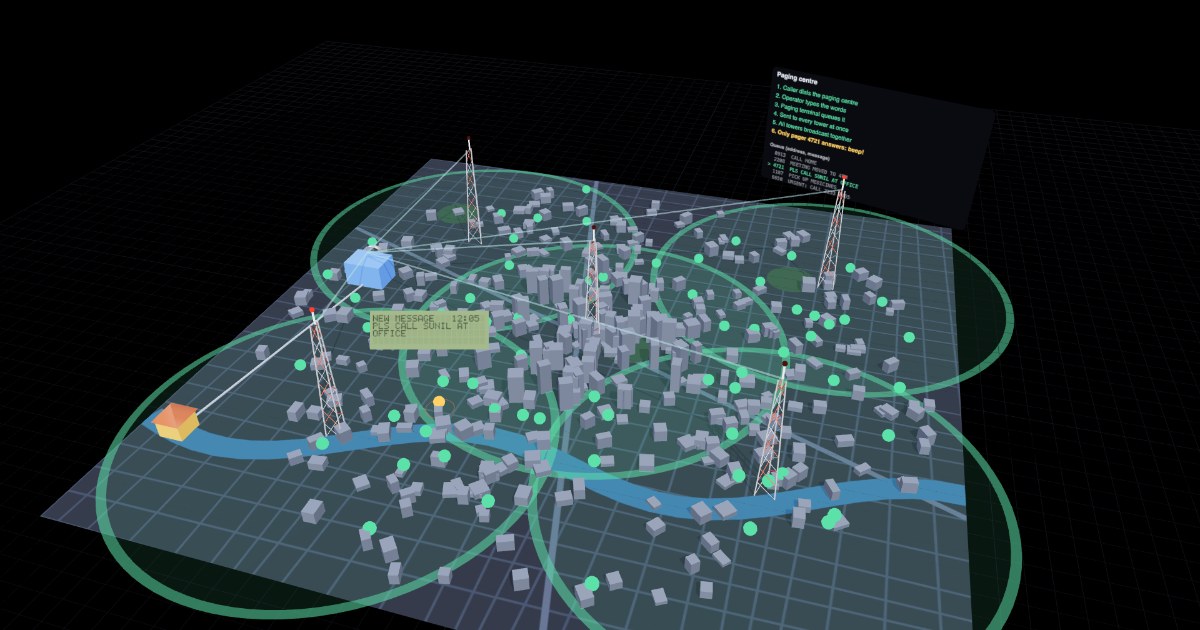
A phone sends at most about 0.2 W, so a city is covered by many towers, each with three sector antennas serving a patch called a cell. Signal fades as 1/d² in free space and faster among buildings. When a neighbouring cell is clearly stronger, the network hands your call over in milliseconds.
Bits on a wave
Phones use bands from 700 MHz (43 cm waves that reach far and pass walls) to 3.5 GHz (8.6 cm waves with more room for data), plus 26 GHz millimetre waves for 5G. Each symbol is a dot on a constellation: QPSK carries 2 bits, 256-QAM carries 8. When noise blurs the dots, the phone falls back to a simpler pattern.
1G to 5G, and India's leap
Analogue voice gave way to digital GSM and texts, then the mobile web, 4G video and 5G. India's first call was on 31 July 1995. After Jio launched in 2016, TRAI figures show a gigabyte of data falling from about ₹269 in 2014 to about ₹12 in 2018.
A call in five steps
Dial, then your SIM answers a random challenge with a secret key that never leaves it. The core network pages the other phone, it rings, and your voice flows as 20 ms packets, 50 a second each way. A text is 140 bytes: 160 letters, or 70 in Hindi.
Battery, safety and e-waste
A 5,000 mAh battery holds about 19 Wh. The screen, the chip and, in a weak signal, the radio drain it. Phone radio is non-ionising, far too weak per photon to damage DNA; its only proven effect is slight heating, capped in India at 1.6 W/kg over 1 g. Only about 22% of the world's e-waste is properly recycled.
The history
Eighty years from phones bolted into cars to a billion Indian connections and a supercomputer in every pocket.
A radio, a computer, a camera and a battery, squeezed into a slab less than a centimetre thick.
A mobile phone is really a two-way radio joined to a small computer. Take one apart and you find it built in layers.
On top is the cover glass, then a see-through touch layer that feels your finger, then the OLED screen. Underneath, most of the space is the flat battery. Beside it sits the mainboard, packed with chips: the system on a chip that runs your apps, the modem that speaks 4G and 5G, and the RF front-end with its power amplifier that drives the antennas.
Where are the antennas? Mostly hidden in the metal frame. Those thin plastic lines on the sides cut the frame into pieces, and each piece is tuned to catch certain radio bands. There are several, top and bottom, so your hand can't block them all at once.
Add the cameras (see CameraClear), speakers, microphones, a vibration motor and the SIM tray, and that's the whole phone.
Why it's called a "cell" phone, and how your call jumps from tower to tower without dropping.
A phone's radio is weak: at most about 0.2 watts. It can't reach a tower 50 km away. So the network covers a city with lots of towers, each serving a small patch called a cell. Draw the patches and they tile the map like a honeycomb. That's why it's called a cellular phone.
A tower usually has three sector antennas, flat panels each facing a different way and covering a third of the circle around it.
The signal fades fast with distance. In empty space its power falls as 1/d²: twice as far, a quarter of the power. In a city, buildings and trees eat even more, closer to 1/d³·⁵. Your phone measures every tower it can hear. When a neighbour gets clearly stronger than the one you're using, the network moves you over in a few milliseconds. That's a handover, and on a call you never notice it.
Cells next to each other must use different channels, or they'd drown each other out. In 2G, groups of 7 cells shared out the channels and the pattern repeated (frequency reuse). 4G and 5G can reuse the same channel in every cell, using clever coding and scheduling to cope with the interference.
How a phone packs bits into a wave, and why low bands travel far while high bands carry more.
Your voice, your videos and your messages all travel as radio waves: electric and magnetic ripples moving at the speed of light (see WaveClear). Their frequency is how many times they wiggle each second. Indian phone bands run from 700 MHz to 3.5 GHz, and 5G adds 26 GHz millimetre waves.
The wavelength is λ = c / f. At 700 MHz a wave is 43 cm long, longer than your phone. At 3.5 GHz it is under 9 cm. Low bands bend round obstacles, pass through walls better and reach further, so one tower covers a big area. High bands have much more room (wider channels), so they carry more data, but over shorter distances.
How do bits ride on a wave? The phone nudges the wave's size and timing (phase). Each allowed combination is a dot on a map called a constellation, and each dot stands for a group of bits. QPSK has 4 dots (2 bits each). 256-QAM has 256 dots (8 bits each), so it is four times faster, but its dots sit so close that a little noise makes the receiver pick the wrong one. So your phone switches pattern every millisecond: dense when the signal is clean, simple when it's noisy.
Each generation is a new rulebook for the radio. Speeds rose about four thousand times in thirty years.
Every ten years or so, engineers agree a new rulebook for how phones and towers talk. Each is called a generation.
1G (from 1979) sent your voice as a plain analogue wave, like FM radio. Anyone with a scanner could listen in. 2G (GSM, 1991) turned voice into digital numbers, encrypted it, and added SMS text messages. India began here: the first call was on 31 July 1995 in Kolkata. Early on, you even paid to receive a call.
3G brought the mobile web. 4G LTE (2009) switched to all-internet data using OFDM, splitting a channel into hundreds of narrow subcarriers, plus MIMO, several antennas sending at once. 5G (2019) uses wider channels, antennas with dozens of elements that aim beams, and new bands.
In India, the big change came in September 2016, when Reliance Jio launched 4G with free calls and very cheap data. Everyone else cut prices. According to TRAI, 1 GB of mobile data cost about ₹269 in 2014, ₹12 in 2018 and under ₹10 by 2023. Hundreds of millions of people came online for the first time, on their phones.
From tapping the green button to hearing "hello": a check on your SIM, a search for the other phone, and fifty packets a second.
When you tap call, your phone is already registered: the network knows roughly where it is. Here is what happens next.
1. Dial. Your phone asks the nearest tower for a channel and sends the number to the core network, the operator's computers that run the show.
2. Prove who you are. Your SIM holds a secret key that is never sent anywhere. The network sends a random number; the SIM scrambles it with the key and sends back the answer. Only the right SIM gets it right. This is how nobody else can make calls on your number.
3. Find the other phone. The core knows which group of towers the other phone last checked in with, and pages it through all of them. 4. Ring. The phone answers the page and rings. Setting up a call takes about 2 to 3 seconds on 4G.
5. Talk. Your voice is sliced into 20-millisecond pieces, compressed and sent as packets, 50 a second each way. For a natural chat the delay should stay under about 150 ms. The landline version of this story is in TelephoneClear.
A text message (SMS) is tiny: 140 bytes, enough for 160 letters. It was designed to squeeze into the network's control channel, and an SMS centre stores it until the other phone can take it.
Where the battery goes, why a weak signal drains it, and what phone radio can and can't do to your body.
A phone battery is rated in mAh (how much charge it holds). Multiply by its voltage, about 3.85 V, to get energy: a 5,000 mAh battery holds about 19 watt-hours, enough to run a 10 W LED bulb for two hours (see CurrentClear for how a lithium-ion cell works).
The biggest drains are the screen (more when bright) and the chip (a game can burn 2 to 3 W). The radio is sneaky: when the tower is far or you're indoors, your phone turns up its transmitter, up to 0.2 W out, which takes about 0.7 W from the battery. That's why your battery dies fast in a basement or on a train.
Is phone radiation dangerous? Phone signals are non-ionising: each packet of radio energy (a photon) is about a million times too weak to knock an electron off an atom and damage DNA, unlike X-rays or strong UV (compare XrayClear). The one proven effect is gentle heating, like HeatClear's warm objects. So limits cap the SAR, the power soaked up per kilogram of body. In India it's 1.6 W/kg averaged over 1 gram of tissue. Large studies, including a 2024 review for the WHO, found no link between phone use and brain cancer. Using earphones or speaker mode lowers your exposure further if you want to.
E-waste. In 2022 the world threw away 62 million tonnes of electronics, and only about 22% was properly recycled. Old phones hold gold, copper and cobalt. Give them to an authorised recycler, not the bin.
In pieces of the metal frame. The frame is cut into sections by thin plastic breaks, and those sections work as antennas.
What takes up most of the space inside a phone?
The battery. The flat lithium-ion battery fills most of the middle of the phone.
What does the modem do?
Turns data into radio signals and back. It speaks the language of the network: 4G, 5G and the rest.
Why does a city have so many towers?
A phone's weak radio can only reach a nearby tower, and each cell can serve only so many people. Small cells keep phones close to a tower, and let the same channels be reused across the city.
In free space, what happens to the signal power when you go twice as far?
Falls to a quarter. Power spreads over a sphere whose area grows as d², so twice as far means a quarter of the power.
What is a handover?
Moving your connection to a stronger cell without dropping. When a neighbour is clearly stronger (here by 3 dB), the network moves you to it in milliseconds.
What is the wavelength of a 3 GHz radio wave? (c = 300,000 km/s)
10 cm. λ = c / f = 300,000,000 ÷ 3,000,000,000 = 0.1 m.
Why can a 700 MHz tower cover a bigger area than a 3.5 GHz one?
Lower frequencies lose less power in the city and through walls. Longer waves are weakened less by distance, buildings and walls.
Your signal gets noisy. What does your phone do?
Switches to a simpler pattern like QPSK. Simple patterns have dots far apart, so noise can't confuse them. Fewer bits per symbol, but they arrive intact.
What was the big change from 1G to 2G?
Voice became digital, and texts arrived. 2G turned voice into encrypted digital data and added SMS.
About how much did 1 GB of mobile data cost in India in 2014, according to TRAI?
₹269. About ₹269 per GB in 2014, falling to about ₹12 by 2018 after Jio's launch.
When was India's first mobile phone call?
1995. 31 July 1995: West Bengal's Chief Minister Jyoti Basu, in Kolkata, called Union Telecom Minister Sukh Ram in Delhi.
How does the network know it's really your SIM?
The SIM answers a random challenge using a secret key that never leaves it. Only a SIM holding the right key can turn the random number into the expected answer.
How many characters fit in one SMS using the basic alphabet?
160. 140 bytes × 8 bits ÷ 7 bits per character = 160 characters. Unicode text, like Hindi, fits 70.
How often does your phone send a voice packet during a call?
Every 20 milliseconds. Speech is cut into 20 ms frames, so 50 packets a second go each way.
Why does your battery drain faster when the signal is weak?
The phone turns up its transmitter to reach the tower. Uplink power control raises the transmit power as the path loss grows, up to 0.2 W.
Why can't phone radio waves break DNA like X-rays can?
Each photon carries about a million times too little energy to ionise. A 3.5 GHz photon has about 0.000015 eV; knocking off an electron takes about 10 eV.
What is India's SAR limit for phones?
1.6 W/kg averaged over 1 g of tissue. India adopted the stricter 1-gram measure, the same as the US, from September 2012.
Words worth knowing
Cell
The patch of ground served by one tower antenna; many cells tile a city like a honeycomb.
Handover
Moving a phone's connection to a stronger cell without dropping the call.
Path loss
How much weaker a radio signal gets between tower and phone, in decibels.
Wavelength
The length of one wave: λ = c / f, 43 cm at 700 MHz and 8.6 cm at 3.5 GHz.
QAM
A way of sending several bits per symbol by setting a wave's size and phase to one of many grid points.
SIM
A tiny smart card holding a secret key that proves to the network who you are.
SMS
A 140-byte text message carried on the network's control channel: 160 letters, or 70 in Unicode.
SAR
Specific absorption rate: radio power absorbed by the body, limited in India to 1.6 W/kg over 1 g of tissue.
Non-ionising radiation
Radiation whose photons are too weak to knock electrons off atoms, like radio and visible light.
Fork it. Teach with it.
This box is plain HTML, CSS and JavaScript, with no build step and no accounts. Run it yourself and it sends nothing anywhere. The code is MIT. The words, images and videos are CC BY 4.0, so you can reuse them anywhere if you credit “Glassbox, glassbox.how/e/mobileclear”.