The desert behind the actor is a wall of LEDs, redrawn 24 times a second for exactly where the camera stands. An LED volume is a curved wall and ceiling of LED panels around a small real set. A game engine draws a 3D place on it.
The desert behind the actor is a wall of LEDs, redrawn 24 times a second for exactly where the camera stands. Step inside a working LED volume: move the tracked camera, change the sunset, pull focus onto the pixels, and move a mountain from the brain bar.
VirtualProdClearOpened 7 Sept 202615 min to playFree · no sign-up
In 60 seconds
A room made of screens
An LED volume is a curved wall and ceiling of LED panels around a small real set. A game engine draws a 3D place on it. The real floor and props are matched to the virtual ground, so the camera films one seamless world, final in camera. A green screen is cheaper and more flexible, but gives no real light or reflections.
The wall is drawn for one camera
The camera is tracked by infrared cameras on the truss. The patch of wall it sees, the inner frustum, is redrawn from the lens's exact position every frame, so near things slide and far mountains stay put: true parallax. Switch tracking off and the world slides like a painted backdrop.
The screen is also the light
Millions of LEDs light the set with whatever they show. A sunset makes faces warm; a night city throws neon; chrome reflects the real world instead of green. But a wall peaks around 1,800 nits, only a few thousand lux, against about 100,000 lux from the sun, so film lights still add fill and sunlight.
Dots, delay and limits
The wall is a grid of LEDs about 2.3 to 2.9 mm apart. If it is in focus, the grid beats against the sensor's grid and makes moiré, so the wall is kept soft. Tracking and rendering take several frames, around 8 on early stages, so fast pans need overscan. LEDs also make narrow-band colour.
The brain bar
Engine operators, tracking and screen technicians sit at the brain bar. They move the sun, repeat golden hour all day and move a mountain in seconds. The virtual art department built the world weeks before. Genlock makes camera, engine and LEDs tick together so no tear rolls through the shot.
From rear projection to Hyderabad
Rear projection put filmed roads behind cars from 1930. Front projection, Oblivion's projected sky and Gravity's light box led to The Mandalorian's StageCraft volume in 2019. Since 2020 hundreds of stages have opened, including Annapurna Studios' LED stage in Hyderabad. Driving shots are one of their biggest uses.
The history
From a projector behind a screen in 1930 to walls of LEDs that redraw a world for every move of the camera.
A curved LED wall shows a 3D place around a small real set.
In virtual production the actors stand on a small real set, and the rest of the world is shown around them on a giant curved wall of LED screens, plus a screen ceiling. This room of screens is called an LED volume. The picture on it is a real 3D place, built by artists and drawn live by a game engine such as Unreal Engine (see CGIClear for how real-time rendering works).
The trick is at the seam. Real sand, rocks and props on the floor are painted to match the ground on the wall, so the camera can't tell where the set ends and the screen begins. The camera films it all at once: what you see through the lens is the final shot, which is why this is also called in-camera VFX.
The older way is a green screen (see VFXClear): film the actor in front of flat green, then replace the green with the world months later. It is cheaper and flexible, but the actor sees nothing, the light is wrong, and green light spills onto skin and shiny things. An LED wall gives real light, real reflections and a world the actors can react to, but everything must be built and decided before the shoot.
Only the patch the lens sees gets the true perspective.
A picture on a flat wall has one problem: move the camera and a real mountain far away should hardly move, while a rock close by should slide past. A printed backdrop can't do that. An LED wall can, because it is redrawn for the camera 24 or more times a second.
The camera is tracked. Infrared cameras on the truss watch a crown of reflective balls on it (as in MocapClear), so the engine always knows exactly where the lens is and where it points. The engine then draws the world from that very spot, and paints the result onto the patch of wall the lens can see. This patch is the inner frustum (a frustum is the pyramid of space a camera sees). Every LED in it shows whatever lies behind it along the line to the lens, so through the camera the wall vanishes and a deep world with true parallax appears.
The rest of the wall, the outer frustum, shows the world from one fixed point at lower quality. The camera never looks at it directly: its job is to light the set. The inner patch is drawn a bit bigger than the lens needs (overscan), so quick moves don't show its edge.
Change the world on the wall and the actor is lit by it, at once.
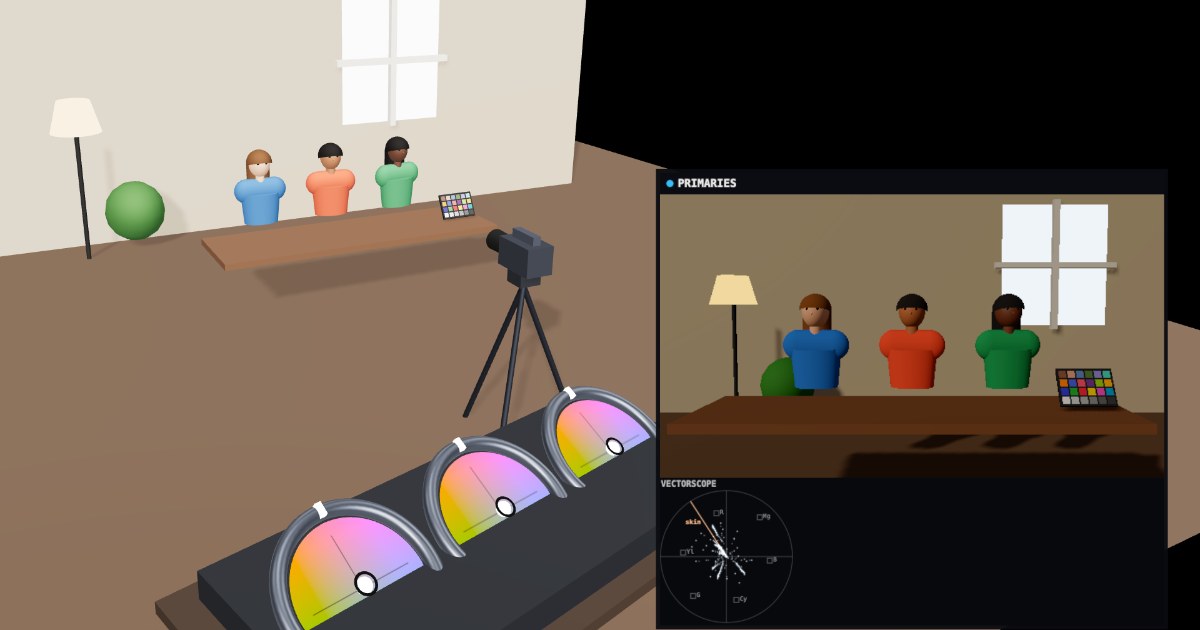
Each LED is a tiny coloured lamp, and a wall has millions of them. So the wall doesn't just show the world: it lights the set with it. A sunset on the screens throws warm orange light on the actor's face; a city at night throws blue and pink neon. Nobody has to fake it with filters (see LightingClear for how film lights are normally set).
Shiny things show it best. A chrome helmet, a car door or a pair of glasses reflects the wall, so the reflections are correct in camera. With a green screen, that same helmet would reflect a big green wall, and artists would have to paint every reflection out later.
Change the location and the light changes instantly: a sunset can last all day. There are limits. Behind the camera there is no wall, so the face gets little light from the front, and a wall is far dimmer than the real sun. Crews still add film lights for fill and for hard sunlight.
A wall is made of dots, runs a little late and can’t be the sun.
Up close, an LED wall is a grid of tiny red, green and blue dots on a black face. The gap from one dot to the next is the pixel pitch, around 2.3 to 2.9 mm on film stages. A camera sensor is a grid too. When the two grids line up badly, you get moiré: wavy rainbow stripes that were never there.
The cure is focus. The actors are sharp and the wall is a few metres behind them, slightly out of focus. The blur washes out the dots before they reach the sensor, so the wall looks like a smooth picture. Focus on the wall itself, or stand too far back with a wide lens, and the dots come back.
The wall is also a little late. Tracking, drawing and sending pixels to the screens takes several frames (about 8 on early stages). When the camera whips round, the inner frustum trails behind, and overscan must be big enough to hide the lag.
Last, a wall has limits: about 1,500 to 1,800 nits at most, which is nothing next to the sun, and LEDs make light in three narrow colours, which can make skin and fabrics look slightly off. So hard sunlight and some colours still come from film lights.
A team at a desk runs the engine and changes the world between takes.
Just off the stage sits the brain bar: a row of desks and screens where engine operators run the virtual world. They are the stage’s crew for everything that isn't physical.
If the director says “move that mountain left” or “give me the sunset again”, an engine operator drags the mountain or turns the sun, and the wall changes in seconds. The world itself was built weeks earlier by the virtual art department (VAD): artists who model, texture and light the locations, often from photos and scans of real places, and check them in VR before the shoot.
Other seats run the tracking system (where the camera is) and the LED processors that feed the screens. Everything must tick together. Genlock is a shared timing pulse, so the camera shutter, the engine and every LED panel start each frame at the same instant. Without it, the wall can change picture while the shutter is open, and a tear or dark band rolls through the shot.
Films, series, ads and driving shots, from Hollywood to Hyderabad.
Putting actors in a car and moving the world behind them is an old trick. From the 1930s, studios used rear projection: a projector behind a translucent screen played a filmed road behind a car on the stage. It was dim and flat, and the car's windows and paint reflected only a dark studio.
LED volumes do this far better. The street scrolls past on the wall, and the car's glass, chrome and paint reflect passing street lights and signs, with light sweeping across the actors' faces. Crews call these process shots or car process, and they are now one of the most common uses of LED stages.
LED volumes are used for series (The Mandalorian, shot on ILM's StageCraft stage from 2019, made the idea famous), films, ads and music videos. Since 2020 hundreds of stages have been built worldwide. India has them too: Annapurna Studios in Hyderabad opened an LED stage with Qube Cinema in 2022 to 2023, and more have followed in Mumbai and elsewhere.
Is it cheaper than a location? Sometimes. You skip travel, weather and waiting for the light, but you pay for the stage and weeks of building the world first. It works best for places that are hard, dangerous or impossible to reach, and for scenes you need to repeat.
A stage surrounded by LED screens showing a live 3D world. The walls (and often the ceiling) are LED screens that a game engine fills with a 3D place around a small real set.
Why is the real floor painted to match the ground on the wall?
So the camera cannot see where the real set ends and the screen begins. The seam between real props and the screen is hidden when the colours and textures match.
Which of these does an LED wall give that a green screen does not?
Real light and reflections from the world on the actor. The screen glows with the world, so it lights the actor and shows up in shiny surfaces. A green screen only throws green light.
Why must the camera be tracked?
So the engine can draw the world from the camera’s exact position. The inner frustum is drawn from wherever the lens is. Without that position, the perspective would be wrong.
The camera slides 1 m sideways. What should a mountain 200 m away do in the picture?
Hardly move at all. Far things shift very little when you move (parallax). The tracked wall reproduces this; a painted backdrop can’t.
What is the outer frustum mainly for?
Lighting and reflections on the set. The camera doesn’t look at it directly. It shines the world’s light and colours onto the actors and props.
Why does the actor’s face turn orange when a sunset is on the wall?
The LEDs themselves shine orange light onto the actor. The wall is made of millions of small lamps, so whatever it shows also lights the set.
An actor wears a chrome helmet in front of a green screen. What do you see in the helmet?
A big green reflection that must be fixed later. Chrome reflects its surroundings, and the surroundings are green. With an LED wall it reflects the world instead.
Why do LED stages still use film lights?
Walls cannot match the sun’s brightness, and there is no wall behind the camera. A wall at 1,800 nits gives a few thousand lux at most, while the sun gives about 100,000. And the camera side is open.
Why is the LED wall usually kept a little out of focus?
So the blur hides the grid of LEDs and stops moiré. Defocus blurs each LED into its neighbours before the light reaches the sensor, so there is no fine grid left to clash with the sensor grid.
A stage has 8 frames of latency at 24 fps. How long is that?
About a third of a second. 8 ÷ 24 = 0.33 s. In that time a fast pan can turn the camera well past the old inner frustum.
Why can’t the wall replace the sun?
Its peak brightness is about a million times lower than the sun’s disc. A wall reaches roughly 1,800 nits; the sun’s disc is about 1.6 billion. Hard sunlight still needs a real lamp.
What does the virtual art department do?
Builds the 3D locations before the shoot. The VAD models, textures and lights the virtual places weeks before filming.
What does genlock do?
Makes camera, engine and screens start every frame together. A shared timing pulse keeps every device in step, so the wall never changes picture mid-exposure.
The director wants the sunset to last all day. What happens?
The operator keeps the virtual sun where it is. The sun is just a setting in the engine. It can stay at golden hour for every take.
What made rear projection look less real than an LED wall?
It was dim and flat, and gave no light or reflections around the car. Only one screen behind the car glowed, faintly. The car’s paint and glass reflected a dark studio.
Why are driving scenes a popular use of LED stages?
The moving street lights and reflections on the car are captured in camera, safely, on a stage. The car stays still and safe while the world scrolls past, lighting and reflecting on the car and faces.
When is an LED stage most worth it?
For places hard or impossible to reach, or scenes you must repeat. You pay for the stage and for building the world first, so it pays off when a location is hard to reach or the light must be repeated.
Words worth knowing
LED volume
A stage surrounded by LED walls and often a ceiling, showing a live 3D world.
In-camera VFX
Capturing the finished effect through the lens on set, instead of adding it later.
Camera tracking
Measuring where the camera is and where it points, many times a second.
Inner frustum
The patch of wall the camera sees, drawn in full quality from the camera's own position.
Outer frustum
The rest of the wall, drawn from a fixed point and used mainly for light and reflections.
Parallax
Near things shift more than far things when the viewpoint moves; it is how depth shows.
Pixel pitch
The distance between neighbouring LED pixels, around 2.3 to 2.9 mm on film stages.
Moiré
False stripes when the LED grid and the camera sensor's grid interfere.
Genlock
A shared timing signal so camera, engine and screens start every frame together.
Fork it. Teach with it.
This box is plain HTML, CSS and JavaScript, with no build step and no accounts. Run it yourself and it sends nothing anywhere. The code is MIT. The words, images and videos are CC BY 4.0, so you can reuse them anywhere if you credit “Glassbox, glassbox.how/e/virtualprodclear”.