How do screenplays and storyboards work?

Before a camera rolls, a film already exists twice: as a script where one page is about one minute, and as a comic strip of every shot. Screenplays use 12-point Courier and fixed margins for headings, action, names and dialogue, so one page runs about one minute.

Before a camera rolls, a film already exists twice: as a script where one page is about one minute, and as a comic strip of every shot. Write a scene, board it from a 3D camera, cross the 180-degree line and play your own animatic.

StoryboardClearOpened 26 Aug 202614 min to playFree · no sign-up

In 60 seconds

  1. A script is a timed blueprint

    Screenplays use 12-point Courier and fixed margins for headings, action, names and dialogue, so one page runs about one minute. A 110-page script makes a film of roughly two hours.

  2. Stories have a shape

    Most films follow three acts: set-up, confrontation, resolution, with turning points that push the tension up to a climax. Indian films add an interval, with a big twist just before it.

  3. Words become pictures

    A storyboard draws every shot. Each one picks a shot size, from extreme wide to extreme close-up, an angle such as low, high or Dutch, and a move such as a pan, tilt, dolly or track.

  4. Coverage and the line

    A scene is filmed from several set-ups: a master, over-the-shoulders and close-ups. Keep every camera on one side of the line between two characters, or they swap sides on screen.

  5. Timing before shooting

    An animatic plays the panels in time with temp sound. Pre-vis rebuilds the scene in simple 3D, as big action films like Baahubali and RRR did, so costly shots are solved on a computer first.

  6. You direct

    Board a six-shot scene yourself. A checklist catches the classic mistakes: no establishing shot, jump cuts, a crossed line, no close-up, or a scene that runs far longer than its page count.

The history

120 years from Méliès's list of magic tableaux to scripts in plain text and whole films rehearsed inside a computer.

Read the full history
  1. 1902A trip to the Moon in 30 tableaux
  2. 1933Drawings pinned to a wall
  3. 1955The page that equals a minute
  4. 1955Pather Panchali in a sketchbook
  5. 1973Writers' names on the posters

The full explanation

StoryboardClear, chapter by chapter

Chapter 1

The screenplay page

Why every script looks the same, and how one page becomes about one minute.

Before a single frame is shot, a film is a screenplay: a script typed in a strict, old-fashioned layout. Every page uses 12-point Courier, a typewriter font where every letter is the same width, and fixed margins for each part.

Each scene starts with a scene heading: inside or outside (INT. or EXT.), the place, and the time of day. Then action says what we see. A character name in capitals sits above that person's dialogue, which runs in a narrow column. A parenthetical gives a hint on how to say a line, and a transition such as CUT TO: moves us on.

Why so strict? Because the layout makes a neat rule of thumb: one page ≈ one minute of screen time. A 110-page script makes a film of about two hours. Producers use it to budget, and assistant directors split every page into eighths to plan how much to shoot each day. It is only a rough guide: a page of fast chatter plays quicker, and a page that says "the battle begins" can take ten minutes.

The scene on this page is ours, and every other chapter films it: Meera, 11, her broken kite, and her grandfather on a Mumbai rooftop.

Try “The script page” in the interactive model →

Chapter 2

Story structure: the beat board

Where the big turns go, and how the tension climbs across a script.

Before writing scenes, many writers plan the beats: the big turning points of the story. They write each on an index card and pin the cards to a board, in order, so they can see the whole film at once and move things around.

The most common shape is three acts. Act I sets up the hero and their world, until an inciting incident knocks it over. Act II, the longest, is the struggle, with a midpoint twist in the middle. Act III brings the climax and the resolution. Syd Field drew this "paradigm" in 1979 for a 120-page script: roughly pages 1–30, 30–90 and 90–120.

Other maps say the same thing in more detail. Joseph Campbell's Hero's Journey (1949) found one pattern in myths from all over the world. Blake Snyder's Save the Cat (2005) gives 15 beats with page numbers. Indian films add something special: the interval. Writers place a huge twist just before it, the "interval bang", so the audience comes back from their samosas desperate to know what happens.

None of these are rules. They are tools for checking that the tension keeps rising, and that nothing sags for 20 pages.

Try “Structure” in the interactive model →

Chapter 3

From words to pictures

Shot sizes, camera angles and camera moves: turning each line of script into a drawing.

A script says what happens. A storyboard shows how the audience will see it: a comic strip of the film, one drawing per shot. The director and a storyboard artist decide, line by line, where the camera goes.

First choice: the shot size. An extreme wide shot (EWS) shows the whole place and sets the scene. A wide shot (WS) shows a whole person. A medium shot (MS) cuts at the waist. A close-up (CU) fills the frame with a face, so we feel what they feel. An extreme close-up (ECU) picks out one detail. The lens stays the same here: the camera simply moves closer.

Second: the angle. At eye level we are equals. A low angle looks up and makes someone powerful; a high angle looks down and makes them small. A Dutch angle tilts the horizon to make us uneasy.

Third: the move. A pan turns the camera left or right, and a tilt nods it up or down, both from one spot. A dolly rolls the whole camera closer, and a track slides it alongside the action. Artists draw moves as arrows on the panel.

Many directors draw their own boards. Satyajit Ray sketched his shots in notebooks; Alfred Hitchcock planned films so fully that he said the shoot was the boring part.

Try “Words to pictures” in the interactive model →

Chapter 4

Shot lists, coverage and the 180° rule

Film one moment from several set-ups, and never cross the line.

From the storyboard, the director and the cinematographer make a shot list: every camera set-up needed for each scene. Moving the camera and lights takes time, so a day is planned around set-ups, not scenes.

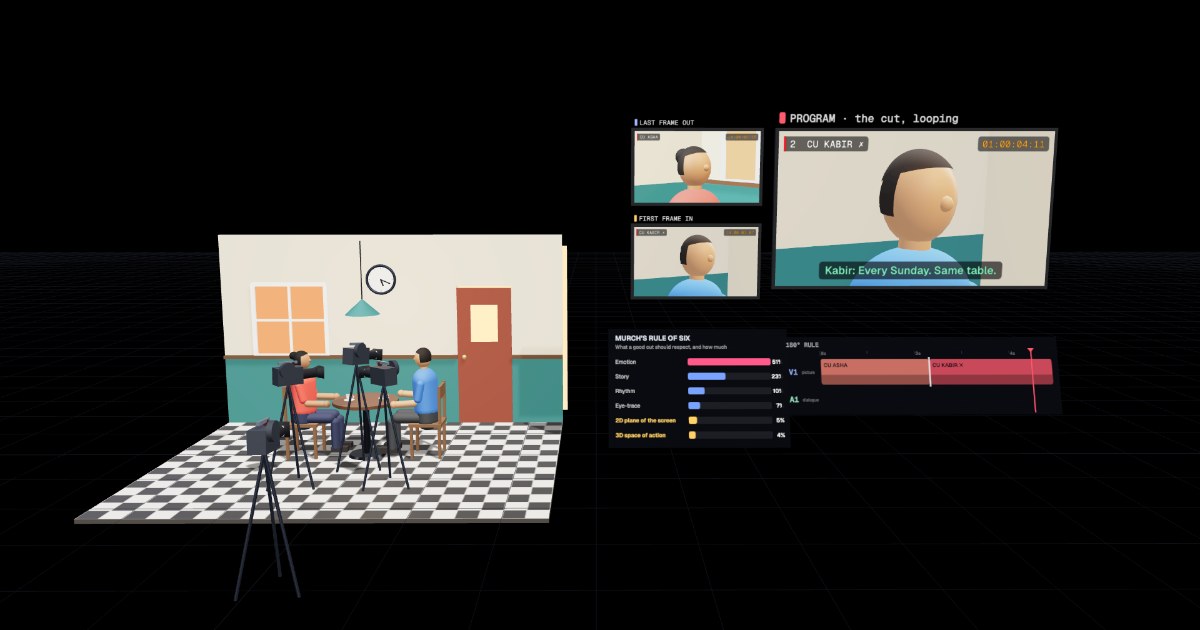
A dialogue scene is usually filmed several times over, called coverage. First a master: one wide shot of the whole scene. Then over-the-shoulder shots (OTS), looking past one person at the other. Then close-ups of each face. The editor can now cut between them and choose the best moment of every take.

All of this obeys the 180-degree rule. Imagine a line through the two characters. Keep every camera on one side of it, and Meera always stays on screen right, Nana on screen left, and they look at each other across the cut. Put a camera on the other side and they jump sides: the audience feels lost for a moment. Directors do cross the line, but on purpose, usually by moving the camera across it in a shot so we see it happen.

Try “Coverage & 180°” in the interactive model →

Chapter 5

The animatic: a film before the film

Play the storyboard in time, with temp sound, then see it in 3D pre-vis.

A storyboard on a wall has no timing. So the next step is an animatic: the panels are put on a timeline, each held for as long as its shot will last, with temp sound, rough dialogue read by anyone and borrowed music. Suddenly you can feel whether the scene drags or rushes, long before paying a crew.

Animation studios live by animatics. Disney built "story reels" of drawings in the 1930s, and Pixar still rebuilds every film as a reel again and again before animating a frame. Live-action directors use them for anything expensive or dangerous.

Pre-vis (previsualisation) goes one step further: the scene is built as a simple 3D model with virtual cameras, like this box does. George Lucas cut together old war-film dogfights to plan the space battles of Star Wars (1977). In India, Firefly Creative Studio did a lot of pre-vis for Baahubali's war scenes, so the director, fight master, cinematographer and VFX team all worked from the same plan. For RRR's animal stampede, pre-vis worked out how fast each animal would run, and those numbers drove a strip of LED lights on set so the camera and actors knew exactly where the leap would happen.

Our scene fills about half a page (29 of the 54 lines), so the page rule says it should run about 30 seconds. Does your animatic agree?

Try “Animatic & pre-vis” in the interactive model →

Chapter 6

Your turn: board the scene

Pick six shots, time them, and check your board for the classic mistakes.

Now you are the director. The scene is on the page: Meera, the torn kite, Nana and the wind. You have six shots to tell it. For each one choose the moment, the shot size, the angle, who to frame, which side of the line the camera stands, and how long it lasts.

The board starts as a rough first try, full of classic mistakes. The checklist on the right shows what an editor would grumble about: no establishing shot, jump cuts between shots that look almost the same, a camera that crosses the line, no close-up when feelings run high, and a scene that never reaches its payoff.

There is no single right answer. Great directors break every rule, but they know they are doing it. Satyajit Ray, Alfred Hitchcock and Akira Kurosawa all planned their films shot by shot on paper first, and then felt free on set.

Try “Your turn” in the interactive model →
Test yourself

Frequently asked

What does "EXT. ROOFTOP - DAY" tell the crew?

The scene is outdoors, on a rooftop, in daytime. A scene heading gives three things: INT. or EXT. (inside or outside), the place, and the time of day.

Roughly how long a film does a 100-page screenplay make?

About 100 minutes. The standard layout makes one page about one minute of screen time, so 100 pages is roughly 100 minutes.

Why are scripts typed in Courier, where every letter is the same width?

It keeps the amount of text on every page the same, so page counts stay a reliable guide to time. With a fixed-width font and fixed margins, a page always holds about the same amount of story, so pages can be used to estimate running time and plan the shoot.

In a 120-page three-act script, roughly where does Act II end?

Page 90. Syd Field's paradigm puts Act I at about pages 1–30, Act II at 30–90 and Act III at 90–120. Act II is the longest.

What is the "inciting incident"?

The event that upsets the hero's normal world and starts the story. The inciting incident knocks the hero's life off balance, so the rest of the story is about putting it right.

Why do Indian writers put a big twist just before the interval?

So the audience returns eager to see what happens next. The interval point, or "interval bang", is a cliffhanger: it keeps people hooked through the break.

Which shot best shows how a character feels?

Close-up. A close-up fills the frame with a face, so we can read every small change of expression.

You want a villain to look powerful. Which angle?

Low angle, looking up. Looking up at someone makes them tower over us, so a low angle makes a character seem strong or scary.

What is the difference between a pan and a track?

A pan turns the camera on one spot; a track moves the whole camera sideways. A pan rotates the camera on its tripod head. A track physically carries the camera alongside the action, so the view of the background changes too.

What is a master shot?

A wide shot that records the whole scene. The master covers the whole scene in one wide set-up. Closer shots are then filmed to cut into it.

In the master, Meera is on screen right. The next camera crosses the line. Where is Meera now?

On the left. Crossing the 180-degree line mirrors left and right, so the characters swap sides on screen.

Why film coverage, not just one shot?

So the editor can choose sizes and the best moments, and control the rhythm. With a master, over-the-shoulders and close-ups, the editor can cut between angles and pick the best performance from each.

What does an animatic add to a storyboard?

Timing and rough sound. An animatic holds each panel for the length of its shot, with temp sound, so you can judge the rhythm.

What is pre-vis?

Planning shots with a simple 3D model and virtual cameras. Previsualisation builds a rough 3D version of a scene so camera moves, timing and effects can be planned before the expensive shoot.

Our scene is about half a page long. By the page rule, about how long should it run?

About 30 seconds. One page is about a minute, so half a page is roughly 30 seconds.

Why start a scene with a wide shot?

It shows the audience where they are before cutting closer. An establishing shot gives the geography of the scene, so the closer shots that follow make sense.

Two shots in a row are both medium shots of Meera from the same angle. What is the risk?

A jump cut: the picture seems to jump. If the size, subject and angle barely change, the cut looks like a glitch. Change at least one of them clearly.

Your six shots add up to 90 seconds for a half-page scene. What does that suggest?

The scene will probably feel slow. Half a page is about 30 seconds by the page rule. Three times that usually means shots held too long.

Words worth knowing

Screenplay
A film script in a standard layout: 12-point Courier, fixed margins, roughly one page per minute of screen time.
Scene heading
The line that opens a scene: INT. or EXT., the place and the time of day, such as EXT. ROOFTOP - DAY.
Three-act structure
Set-up, confrontation and resolution, split roughly a quarter, a half and a quarter of the script.
Storyboard
A sequence of drawings, one per shot, showing what the camera will see.
Shot size
How much of the subject fills the frame: extreme wide, wide, medium, close-up or extreme close-up.
Coverage
Filming one scene from several set-ups, such as a master, over-the-shoulders and close-ups, so the editor has choices.
180-degree rule
Keep the camera on one side of the line between two characters so each stays on the same side of the screen.
Animatic
Storyboard panels cut together in time with rough sound, to test a scene's rhythm.
Pre-vis
Previsualisation: planning shots with a simple 3D model of the set, actors and cameras before shooting.

Fork it. Teach with it.

This box is plain HTML, CSS and JavaScript, with no build step and no accounts. Run it yourself and it sends nothing anywhere. The code is MIT. The words, images and videos are CC BY 4.0, so you can reuse them anywhere if you credit “Glassbox, glassbox.how/e/storyboardclear”.

git clone https://github.com/bdeeps/storyboardclear.git

Built with three.js (MIT), Geist, Instrument Serif (SIL OFL 1.1).

←→ previous / next box · / search

Would you like to see the full page, with the interactive model?