A film set is dark until someone decides where every shadow falls. The key light makes the shadows, a softer fill lifts them, and a back light outlines the hair and shoulders. The lighting ratio compares the lit side of a face with the shadow side: 2:1 (one stop) feels open and bright, 8:1 (three stops) moody.
A film set is dark until someone decides where every shadow falls. Drag a key light round a face, turn a hard lamp soft, dial tungsten into daylight, flip a scene from sitcom to noir, and light a dinner table where every face must still read.
LightingClearOpened 29 Aug 202615 min to playFree · no sign-up
In 60 seconds
Key, fill and back
The key light makes the shadows, a softer fill lifts them, and a back light outlines the hair and shoulders. The lighting ratio compares the lit side of a face with the shadow side: 2:1 (one stop) feels open and bright, 8:1 (three stops) moody. Rembrandt, loop, butterfly and split are key positions.
Hard and soft
Softness depends on how big the source looks from the actor. A bare Fresnel gives crisp shadows; a softbox, a diffusion frame or a bounce card makes the source big and the edges soft. For a small lamp, double the distance and you get a quarter of the light: the inverse square law.
The colour of light
Studio tungsten is 3,200 K and film daylight 5,600 K. The camera's white balance decides which one looks white. Orange CTO and blue CTB gels shift a lamp by a fixed number of mireds; full CTB passes only about a third of the light.
Mood and genre
High key (low ratio, bright background) says comedy. Low key (one hard light, deep shadow) says noir. Light from below feels wrong, a low golden-hour sun feels warm, and film moonlight is often daylight shot two stops dark and balanced blue. Good lighting is motivated by a window, a lamp in shot or the moon.
Shaping and control
Barn doors, flags, nets and negative fill take light away where it is not wanted. The gaffer runs the lamps and power, the key grip the stands and flags. A 1 kW tungsten Fresnel gives 1,436 lux at 5 m on a 30° beam; an LED Fresnel sold as its match draws 150 to 220 W.
Light a scene
Three diners, four lamps, one mood. Each face must read, bright enough to see the eyes but not glowing, and the ratio and the camera's histogram must suit the mood the director wants.
The history
Nearly two centuries from a glowing lump of lime on a London stage to LED walls that light actors with whole worlds.
Three lamps, one face. Drag them round and read the ratio.
A camera needs light, but film lighting is not about making things bright. It is about shape. A face lit flat from the front looks like a passport photo. Light it from the side and the nose, cheeks and eyes suddenly have depth.
The classic recipe uses three lamps. The key light is the main one and makes the shadows. The fill light, softer and dimmer, lifts those shadows so they are not pitch black. The back light (or rim) sits behind the actor and draws a bright edge on the hair and shoulders, so they stand out from the background.
The lighting ratio compares the lit side of the face with the shadow side. With a key of 300 lux and a fill of 300 lux, the bright side gets 600 and the dark side 300: a 2:1 ratio, one stop, cheerful and open. Drop the fill to 43 lux and you get 8:1, three stops: moody and mysterious.
Where the key sits makes the famous patterns. Rembrandt lighting, named after the Dutch painter, leaves a small triangle of light on the shadow cheek. Loop, butterfly and split are the others. The camera, lens and exposure side is in CineCameraClear, and the whole film crew is in FilmClear.
Why a big source makes soft shadows, and why light fades so fast with distance.
Why is one shadow crisp and another one blurry? It depends on how big the light looks from the actor. A bare lamp is small, so every point of a shadow is either lit or not: hard light, with sharp edges. A big source lights each edge from many directions at once, so the shadow fades gently: soft light.
Film crews make a small lamp big in three ways. Shine it through a frame of white diffusion cloth. Put it in a softbox. Or bounce it off a white card or wall. Moving a soft source closer makes it look bigger, and even softer. The sun is huge but so far away that it looks tiny (half a degree), which is why sunlight is hard. Clouds turn the whole sky into one giant softbox.
Distance also changes brightness, very quickly. For a small lamp, double the distance and you get a quarter of the light, two stops darker. That is the inverse square law: light spreads over an area that grows with the square of the distance. Big soft sources bend the rule when they are close.
In India, cameraman Subrata Mitra is widely credited with pioneering bounce lighting on Satyajit Ray's films in the 1950s, bouncing lamps off white cloth to copy soft daylight.
Tungsten, daylight, white balance and the gels that make them match.
White light is not all the same white. A candle is orange, a film studio lamp is yellowish, and daylight is bluish. Film crews describe these colours by colour temperature, in kelvin (K): the temperature a glowing piece of metal would need to glow that colour. Studio tungsten lamps are made for 3,200 K. Daylight for film is 5,600 K. Oddly, the “warm” colours have the lower numbers.
Your eyes quietly adjust to most light, so a room lit by bulbs still looks white to you. A camera does not guess. You set its white balance to tell it which light should look white. Set 3,200 K and tungsten looks white, but daylight looks blue. Set 5,600 K and daylight looks white, but tungsten looks orange.
To make lamps match, crews clip coloured plastic called gels in front of them. CTO (colour temperature orange) turns daylight into tungsten. CTB (colour temperature blue) turns tungsten into daylight, but it eats light: full CTB lets through only about a third. Gels are rated in mireds (a million divided by the kelvin), because one gel shifts every lamp by the same number of mireds.
Mixing colours on purpose is a classic look: a warm lamp inside a room, with cool blue light from the window. Modern LED lamps can dial in any kelvin, and even any colour, with a knob.
Noir, sitcom, horror, golden hour and moonlight, from the same five lamps.
Before anyone speaks, the light has already told you what kind of film you are watching. High-key lighting is bright and even, with soft shadows and a light background: comedy, adverts, the family sitcom. Low-key lighting is mostly darkness, with one hard light and deep shadows: crime, mystery and 1940s film noir, with stripes of light through window blinds.
Break nature's rules and people feel uneasy. The sun and lamps shine from above, so light from below the face turns its shadows upside down: the horror look. A low golden-hour sun from behind feels warm, nostalgic and romantic. And moonlight in films is often really daylight: shot day for night, two stops dark and balanced blue.
Good cinematographers make light motivated: it should seem to come from something in the story, like a window, a table lamp in shot (a practical) or the moon. The audience may never notice the real lamps, because each one has an excuse. In India, V. K. Murthy's beam of real sunlight, bounced into a dark studio with two big mirrors for Kaagaz Ke Phool (1959), is a famous example of light telling the story.
Barn doors, flags, nets and negative fill. Tungsten, HMI and LED. The gaffer and the grip.
A good lighting crew spends as much time taking light away as adding it. Barn doors, the four hinged flaps on a lamp, trim the edges of the beam. A flag is a black cloth on a stand that throws a shadow exactly where light is not wanted, such as on the wall behind an actor. A net or scrim is an open mesh that dims a light without softening it: a single net cuts about half a stop, a double about one stop.
Even a white wall is a light. It bounces soft light into the shadows. Put up a big black flag on the dark side instead, called negative fill, and the shadows get deeper and the face gets more shape.
The gaffer is the chief lighting technician: they choose and place the lamps and run the power. The key grip leads the grips, who rig the stands, flags, nets and frames. Together they build what the director of photography designs (see FilmClear).
Lamps have changed. A classic 1 kW tungsten Fresnel turns most of its power into heat. An HMI makes daylight-coloured light about four times more efficiently. Modern LED Fresnels sold as a match for a 1 kW tungsten lamp draw about 150 to 220 W, stay fairly cool and can dial any colour. A lamp you can see in shot, like a table lamp, is called a practical.
Three actors, four lamps, one mood. Can every face still be seen?
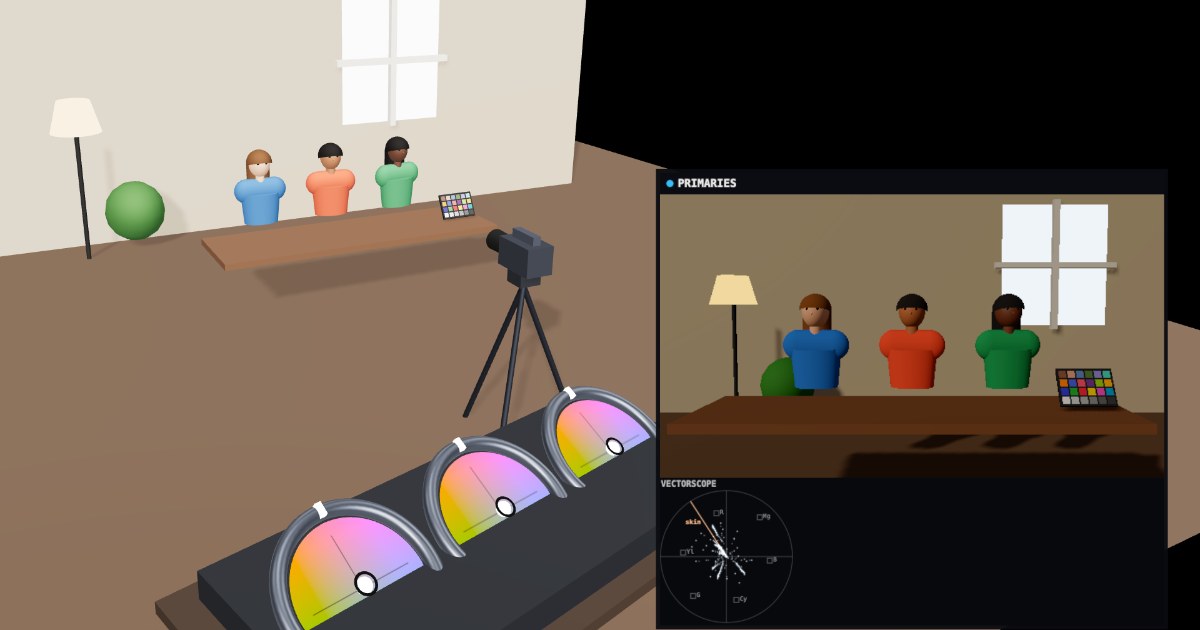
Now you are the director of photography. The scene: three people at a dinner table. The director wants a mood, and you have four lights. A key Fresnel you can move round the table, a soft fill by the camera, a back light behind the far chair, and a practical pendant lamp hanging over the table, which also motivates the rest.
The hard part is lighting three faces at once. A key that shapes one face beautifully may leave another in flat front light, or in total darkness. Every face has to read: bright enough to see the eyes, not so bright that it glows. The readout meters each face like a DoP would, and checks the lighting ratio.
The histogram counts the pixels in the camera view from black on the left to white on the right. A high-key scene piles up on the right, a noir scene on the left. Cinematographers also watch it so nothing important clips to pure white or sinks into pure black.
The key. The key is the main, strongest light, so it sets where the shadows fall. The fill only softens them.
The lit side of a face gets 800 lux and the shadow side 100 lux. The lighting ratio is…
8:1, three stops: moody. 800 ÷ 100 = 8, and 8 = 2 × 2 × 2, three stops. Deep shadows like that feel moody or mysterious.
What does a back light do?
It outlines the hair and shoulders so the subject stands out from the background. Coming from behind, it draws a bright rim on the edges of the subject and separates them from the dark background.
What makes a light soft?
A source that looks big from the subject. Softness comes from the size of the source as seen by the subject. Moving it further away makes it look smaller, and harder.
A small lamp gives 800 lux at 2 m. At 4 m it gives about…
200 lux. Double the distance, a quarter of the light: 800 ÷ 4 = 200 lux, two stops less.
Why is direct sunlight hard, even though the sun is enormous?
It is so far away that it looks tiny, about half a degree. What counts is the angle the source fills. The sun covers only about 0.5° of the sky, so its shadows are crisp.
The camera is set to 5,600 K white balance. How does a 3,200 K tungsten lamp look?
Orange. The lamp is warmer than the white balance expects, so it records orange.
Which gel turns a tungsten lamp into a daylight match?
Full CTB. CTB (colour temperature blue) raises a 3,200 K lamp to about 5,600 K, but it costs about 1.5 stops of light.
Which is cooler (bluer)?
5,600 K. Higher kelvin means bluer light. Daylight at 5,600 K is cooler than tungsten at 3,200 K.
Low-key lighting has…
A high lighting ratio and deep shadows. “Low key” means mostly dark tones: a strong key, very little fill and a dark background, so the ratio is high.
Why does light from below a face look scary?
Natural light almost always comes from above, so the shadows look upside down. We are used to light from the sky and ceilings. From below, the shadows of the nose and brows flip upwards and the face looks wrong.
What is “motivated” light?
Light that seems to come from a real source in the scene, like a window or lamp. Each lamp is given a believable excuse, such as a window, a practical lamp or the moon, so the lighting feels natural.
You want to dim a lamp by about one stop without making it softer. You use…
A double net. A double net passes about half the light, one stop, and keeps the light hard because the source size does not change.
What does negative fill do?
Removes bounced light on the shadow side so shadows get deeper. A black surface absorbs light instead of bouncing it back, so the shadow side of the face gets darker.
A 1 kW lamp on 230 V mains draws about…
4.3 A. Current = power ÷ voltage = 1,000 ÷ 230 ≈ 4.3 A. A 16 A socket can run three such lamps, not four.
A histogram piled up on the left means the picture is…
Mostly dark. The left of a histogram is black and the right is white, so a pile on the left means mostly dark tones: low key.
What does it mean that a face “reads”?
It is lit well enough for the audience to see its expression. Even in a dark scene, the audience must see the eyes and expression. That is the one rule lighting must not break.
Why is lighting three people at one table harder than one person?
Each face points a different way, so one key light hits each face at a different angle. A key that is a nice side light for one actor can be flat front light for another and a back light for the third.
Words worth knowing
Key light
The main light on a subject, which sets the direction of the shadows.
Fill light
A softer, dimmer light that lifts the shadows made by the key.
Back light
A light behind the subject that draws a bright rim on hair and shoulders.
Lighting ratio
The lit side of a face compared with the shadow side, such as 2:1 or 8:1.
Hard and soft light
Small sources make sharp-edged shadows; large sources make gentle ones.
Inverse square law
Double the distance from a small lamp and the light falls to a quarter.
Colour temperature
The colour of a light in kelvin: tungsten 3,200 K, daylight 5,600 K.
White balance
The camera setting that decides which colour of light records as white.
Motivated light
Light that seems to come from a real source in the scene, like a window or lamp.
Fork it. Teach with it.
This box is plain HTML, CSS and JavaScript, with no build step and no accounts. Run it yourself and it sends nothing anywhere. The code is MIT. The words, images and videos are CC BY 4.0, so you can reuse them anywhere if you credit “Glassbox, glassbox.how/e/lightingclear”.