A spinning shutter that is dark half the time, glass filters that throw away nine stops of sunlight, and a crew member whose whole job is turning one focus wheel. A cinema camera is a plain body holding a sensor behind a heavy prime lens on a PL mount.
A spinning shutter that is dark half the time, glass filters that throw away nine stops of sunlight, and a crew member whose whole job is turning one focus wheel. Film a tiny 3D set through a working cinema camera and see what makes moving pictures different.
CineCameraClearOpened 28 Aug 202615 min to playFree · no sign-up
In 60 seconds
A sensor in a box, with a rig around it
A cinema camera is a plain body holding a sensor behind a heavy prime lens on a PL mount. Rods, a follow focus, a matte box, a monitor and a V-mount battery bolt on, and it rides on a fluid head, tripod and dolly. On film, a claw pulled each frame into the gate; a 1,000 ft magazine lasted about 11 minutes.
24 frames, each open for 1/48 s
Cinema samples time 24 times a second. A rotary shutter is open for part of each frame: at 180° that is half, 1/48 s, which gives natural motion blur. Narrow angles look crisp and jittery, wide ones smear. Shoot at 120 fps and play at 24 for 5× slow motion; shoot one frame every 2 s for a time-lapse.
Sensor size and lens decide the look
A bigger sensor sees wider with the same lens, so you use a longer lens and get shallower focus. Cinema lenses use T-stops so exposure matches between lenses, and a focus puller moves the thin slice of sharpness between actors. Anamorphic lenses squeeze a wide picture sideways, giving oval bokeh and streak flares.
Keep the shutter, cut the light
Because the shutter stays at 180°, bright sun can be about 9 stops too much. ND filters in the matte box cut it evenly. Modern cameras hold about 14 to 17 stops of dynamic range, which only survives if you record log instead of Rec.709. Waveforms and false colour check exposure on set.
How the camera moves changes the shot
Pans and tilts turn on a tripod; dollies and tracks travel on rails and show parallax; cranes lift the camera high; Steadicams and gimbals float it while someone walks; drones fly it. A dolly zoom, rolling in while zooming out, keeps the actor the same size while the background stretches.
Terabytes a day, copied three times
Digital cameras write RAW or ProRes files to media cards, as much as 2 TB an hour for RAW. The DIT copies every card to several drives, checks them with checksums and makes small proxies for the edit, which is later relinked to the originals for the grade.
The history
From twelve cameras and a galloping horse in 1878 to digital sensors, drones and phones, with film still refusing to die.
A sensor in a box, a heavy lens, and a lot of helpers bolted on.
A cinema camera is built like the still camera in CameraClear: a lens throws an image onto a sensor. The difference is that it takes 24 pictures every second, for hours, and a whole crew works around it. So the camera is a plain box and everything else bolts on.
The prime lens (one fixed focal length) locks into a steel PL mount. Two rods under it carry a follow focus, a geared wheel that the focus puller turns so their hand never touches the lens. In front sits a matte box: a hood that keeps stray light out and holds glass filters. A monitor shows the shot, the eyepiece (EVF) is for the operator, and a V-mount battery on the back powers it all. The rig sits on a fluid head and tripod, here on a dolly that rolls along track.
Before about 2010 most films were shot on 35 mm film. A magazine on top fed film down through a gate behind the lens. A claw pulled the film down one frame, held it still for the exposure, then pulled again, 24 times a second. A 1,000 ft magazine lasted only about 11 minutes.
Frame rate sets how time is sampled. Shutter angle sets the blur in each frame.
A movie is a row of still pictures. Cinema shows 24 frames per second (fps), fast enough that your brain sees smooth motion (see FilmClear for how films are made from them).
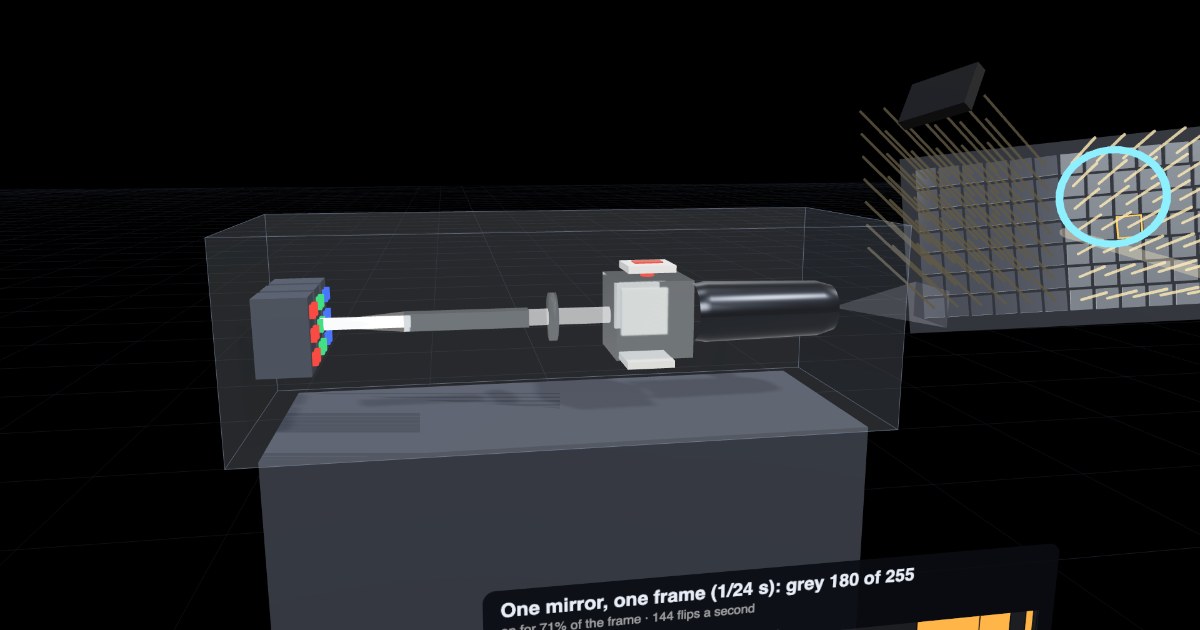
Film cameras have a spinning rotary shutter: a disc with a slice cut out. While the open slice passes, light reaches the film. While the solid part passes, the claw moves the next frame in. The size of the slice is the shutter angle. A 180° shutter is open half the time, so each frame is exposed for 1/48 s at 24 fps. That gives the soft motion blur people think of as “the film look”. Digital cameras have no disc, but they switch the sensor on for the same fraction of each frame, and still talk in degrees.
A narrow angle (45°) freezes each frame into crisp, jittery snapshots, as in the battle scenes of Saving Private Ryan (1998). A wide angle (360°) smears everything like a dream. Shoot at 120 fps and play at 24, and one real second lasts five: slow motion. Take one frame every two seconds and you get a time-lapse, 48 times faster than life.
What the lens and sensor size decide: how much you see and how much is sharp.
CameraClear shows how focal length and aperture work in any camera. Cinema adds three twists.
Sensor size. Most films were shot on Super 35 film, about 25 mm wide, and many digital cameras copy that size. Cheaper and older shows used Super 16, half as wide. Newer large-format cameras are 36 mm wide, “full frame”. A bigger sensor sees wider with the same lens, so to frame a face the same way you use a longer lens, and that makes the background blurrier.
T-stops, not f-stops. Cinema lenses are marked in T-stops: the f-stop corrected for the light the glass really lets through, so every lens in a set gives the same exposure. The smaller the number, the thinner the slice of sharp focus.
The focus puller. With a slice only a few centimetres deep, someone must turn the focus as actors move. The 1st AC measures distances, marks them on the follow focus, and “pulls” focus live, often without looking through the camera.
Anamorphic lenses squeeze a wide picture sideways onto the sensor, and the edit stretches it back to 2.39:1. Out-of-focus lights turn into tall ovals and bright lights throw long streak flares.
ND filters, EI, log recording and the scopes that check them.
In CameraClear you balance exposure with shutter speed, aperture and ISO. A cinema camera mostly can't touch the shutter: 180° at 24 fps is 1/48 s, or the motion looks wrong. The aperture is chosen for depth of field. So in bright sun the picture is about 9 stops too bright.
The fix is ND filters (neutral density): grey glass in the matte box that cuts light without changing colour. ND 0.3 is one stop, ND 0.9 three stops, ND 2.1 seven. The camera's sensitivity is called EI (exposure index), the cinema word for ISO.
Dynamic range is how many stops, from darkest shadow to brightest highlight, a camera can hold at once. Every stop is twice the light. Modern cinema cameras hold about 14 to 17 stops. But a Rec.709 video recording clips highlights only about 2.5 stops above middle grey. So cameras record log: a flat, grey-looking curve that squeezes every stop into the file, to be given its final look later in the grade (see GradeClear).
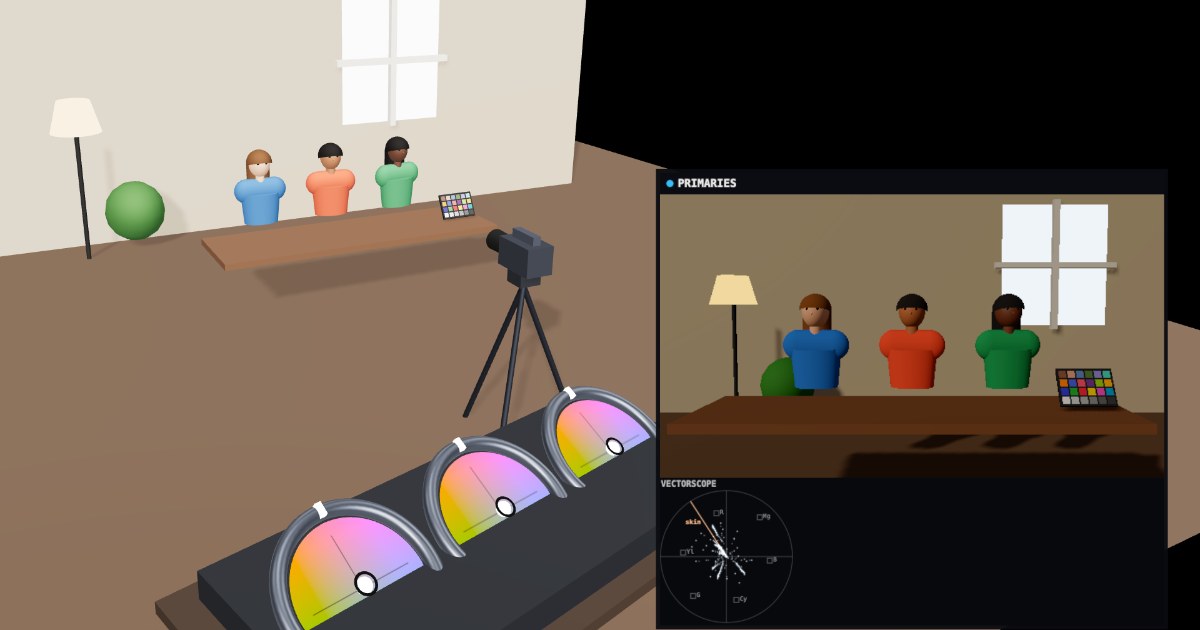
On set, the DIT and cinematographer judge exposure with a waveform (brightness across the picture, 0 to 100) and false colour, which paints middle grey green, skin pink, clipping red and crushed black purple.
Every support makes a different move, and every move feels different on screen.
A still camera catches one moment. A cinema camera can move during the shot, and the move is part of the story. Each kind needs its own support, run by the grip department.
On a tripod the camera only turns: a pan (sideways) or a tilt (up and down). On a dolly it travels on track: dolly in to push towards a face, or track sideways alongside the action, where near things slide past faster than far ones. A crane or jib swings it high over the set.
The Steadicam (1975) let an operator walk anywhere while a vest, a spring arm and a balanced sled soaked up the steps. Handheld keeps the shake on purpose. Motorised gimbals now do the Steadicam's job in a small package, and drones fly shots that once needed a helicopter.
The strangest move is the dolly zoom: roll towards the actor while zooming out, so they stay the same size but the background seems to stretch away. Alfred Hitchcock used it in Vertigo (1958) to show dizziness.
What happens to the pictures between the sensor and the editor.
A film camera's footage went to a lab to be developed. A digital camera writes files to a media card, and a new crew member takes over: the DIT (digital imaging technician).
Cameras can record RAW, the sensor's numbers with almost nothing decided yet, or a finished video file such as ProRes. RAW keeps the most freedom for the grade but is huge: roughly 2 terabytes an hour on a modern large-sensor camera. ProRes 422 HQ in 4K is about a sixth of that.
When a card is full, the DIT copies it to at least two, often three, separate drives, checks every copy against the original with checksums, and only then lets the card be wiped and used again. The DIT also makes proxies: small copies that editors can play on a laptop. The edit is cut with proxies, then relinked to the full-quality files for the grade and VFX (see GradeClear and FilmClear).
India moved to digital fast. Digital cinema networks such as Qube and UFO Moviez were sending films to cinemas as files by the mid-2000s, long before many other countries, and through the 2010s most Indian productions swapped film cameras for digital ones.
Turns the lens focus ring through gears, so focus can change smoothly. The focus puller turns the wheel; its gear turns the lens ring. Nobody has to touch the lens.
In a film camera, what happens while the shutter is closed?
The claw pulls the next frame down into the gate. The film must be still during the exposure, so it is moved only while the shutter blocks the light.
35 mm film runs 16 frames per foot. How long does a 1,000 ft magazine last at 24 fps?
About 11 minutes. 1,000 ft × 16 = 16,000 frames. At 24 a second that is 667 s, about 11 minutes.
At 24 fps with a 180° shutter, how long is each frame exposed?
1/48 s. 180° is half a turn, so the shutter is open for half of each 1/24 s frame: 1/48 s.
You shoot at 120 fps and play it back at 24 fps. What do you see?
Five times slower. Each real second became 120 frames, which take 5 seconds to play at 24 a second.
Why can a car wheel on screen look as if it spins backwards?
The camera samples it at fixed moments, and each spoke lands just short of where the last one was. If each frame catches the spokes a little short of the previous positions, your eye links them into slow backwards motion.
You swap a Super 35 camera for a full-frame one and keep the same lens. What changes?
The picture gets wider. A bigger sensor catches more of the image the lens makes, so it sees wider. You would pick a longer lens to frame the same shot.
Why are cinema lenses marked in T-stops?
T-stops include the light lost in the glass, so exposure matches between lenses. Two lenses at f/2 can pass slightly different amounts of light. At T2 they match, so shots cut together.
What shape do out-of-focus lights take through a 2× anamorphic lens?
Tall ovals. The lens squeezes sideways, so the blur spots end up taller than they are wide once the picture is stretched back.
On a sunny day a cinematographer wants to keep a 180° shutter at 24 fps and a wide aperture. What do they add?
ND filters. ND filters cut the light without changing the shutter or the aperture, so both the motion blur and the depth of field stay as planned.
Why record in log instead of Rec.709?
Log keeps many more stops of highlight and shadow for the grade. Rec.709 clips only about 2.5 stops over middle grey. Log squeezes the full range of the sensor into the file.
In false colour, what does red usually mean?
Clipped highlights with no detail. Red marks the very top of the range, where detail is lost. Green is middle grey and pink is a stop over, where skin often sits.
What is the difference between a pan and a track?
A pan turns the camera on the spot; a track moves the whole camera sideways. A pan turns on the tripod head. A track moves the camera along, so near and far things shift against each other.
What did the Steadicam let camera operators do?
Walk or run with the camera and still get smooth shots. The vest, spring arm and balanced sled soak up the operator’s steps, so the camera floats.
In a dolly zoom, the camera moves towards the actor. What must the lens do to keep them the same size?
Zoom out (shorter focal length). Getting closer makes the actor bigger, so the lens widens to cancel it. The background, far away, grows much less, and seems to rush away.
What does a DIT do with a full media card?
Copies it to several drives, checks every copy, then clears it. The footage must exist safely in more than one place, verified, before the card is reused.
Why do editors often work with proxies?
They are small enough to play smoothly on ordinary computers. Proxies are light copies. The finished film is relinked to the full-quality originals.
Roughly how much data is an hour of ARRIRAW from a large 4.6K sensor at 24 fps?
About 2 TB. About 4.5 gigabits every second adds up to around 2 terabytes an hour.
Words worth knowing
Frame rate
How many pictures a camera takes each second. Cinema plays at 24 fps.
Shutter angle
The fraction of each frame the shutter is open, as a slice of a 360° disc. 180° at 24 fps is 1/48 s.
Overcranking
Shooting faster than playback, which gives slow motion. 120 fps played at 24 is 5× slower.
Crop factor
How much smaller a sensor is than 36 × 24 mm full frame. Super 35 is about 1.4 to 1.5×.
T-stop
An aperture number corrected for light lost in the lens, so all cinema lenses expose alike.
Depth of field
The zone from near to far that looks sharp. Long lenses, wide apertures and big sensors make it thin.
Anamorphic lens
A lens that squeezes the picture sideways onto the sensor, stretched back later to a wide 2.39:1.
ND filter
Neutral density glass that cuts light without changing colour. Each 0.3 of density is one stop.
Log recording
A flat-looking curve that keeps all the sensor's stops for the colour grade.
DIT
The digital imaging technician, who copies, checks and backs up footage on set and makes proxies.
Fork it. Teach with it.
This box is plain HTML, CSS and JavaScript, with no build step and no accounts. Run it yourself and it sends nothing anywhere. The code is MIT. The words, images and videos are CC BY 4.0, so you can reuse them anywhere if you credit “Glassbox, glassbox.how/e/cinecameraclear”.