How does the nervous system work?

A brain, a finger-thick cable down your back and nerves that reach your toes carry messages at up to 120 metres a second. The brain and spinal cord are the central nervous system. From them run 31 pairs of spinal nerves and 12 pairs of cranial nerves, joining into big nerves like the sciatic and the vagus.

A brain, a finger-thick cable down your back and nerves that reach your toes carry messages at up to 120 metres a second. Fire a neuron, send a puff of chemicals across a synapse, race your own reaction time against a knee jerk, and slide from calm to fright.

NervousClearOpened 19 Aug 202615 min to playFree · no sign-up

In 60 seconds

  1. The wiring in every part of you

    The brain and spinal cord are the central nervous system. From them run 31 pairs of spinal nerves and 12 pairs of cranial nerves, joining into big nerves like the sciatic and the vagus. The cord is only about 45 cm long and ends at your waist.

  2. A spark that runs down a wire

    Each neuron is a battery at about −70 mV. At threshold, sodium rushes in and potassium flows out: a 2 ms all-or-nothing spike. Bare axons carry it at about 1 m/s; myelinated ones make it jump between nodes at up to about 120 m/s.

  3. Crossing the gap

    At a synapse the spike releases neurotransmitter across a 20 nm gap. Glutamate says go, GABA says stop, and a neuron fires only when enough go signals add up. At the neuromuscular junction acetylcholine never misses: one spike, one twitch.

  4. Faster than thinking

    The knee jerk turns around in the spinal cord through one synapse in about 30–40 ms. Pulling back from heat takes about 70 ms. Choosing to react to a light takes about 200–250 ms, so no one beats a reflex.

  5. Fight or flight, rest and digest

    The autonomic system runs your organs. Sympathetic nerves from a chain beside the spine speed the heart, widen the pupils and pause digestion; the parasympathetic vagus slows the heart and gets digestion going. At rest it holds your heart below its own pace of about 100 a minute.

  6. Protecting the wiring

    Brain and cord cells mostly can't regrow. Know the stroke signs (FAST: call 112 or 108), seizure first aid (stay, keep safe, on their side), wear a helmet and seat belt, and sleep. For your own health, see a doctor.

The history

From an Egyptian scroll and a squealing pig to squid axons, dream experiments and a bridge across a broken spinal cord.

Read the full history
  1. 1600 BCEThe first written words about the brain
  2. 1791A frog’s leg twitches
  3. 1888Neurons are separate cells
  4. 1921An experiment from a dream
  5. 1949India’s first neurology and neurosurgery department
  6. 1974NIMHANS is born

The full explanation

NervousClear, chapter by chapter

Chapter 1

The wiring in every part of you

A brain, a cable down your back, and nerves that reach from your scalp to your toes.

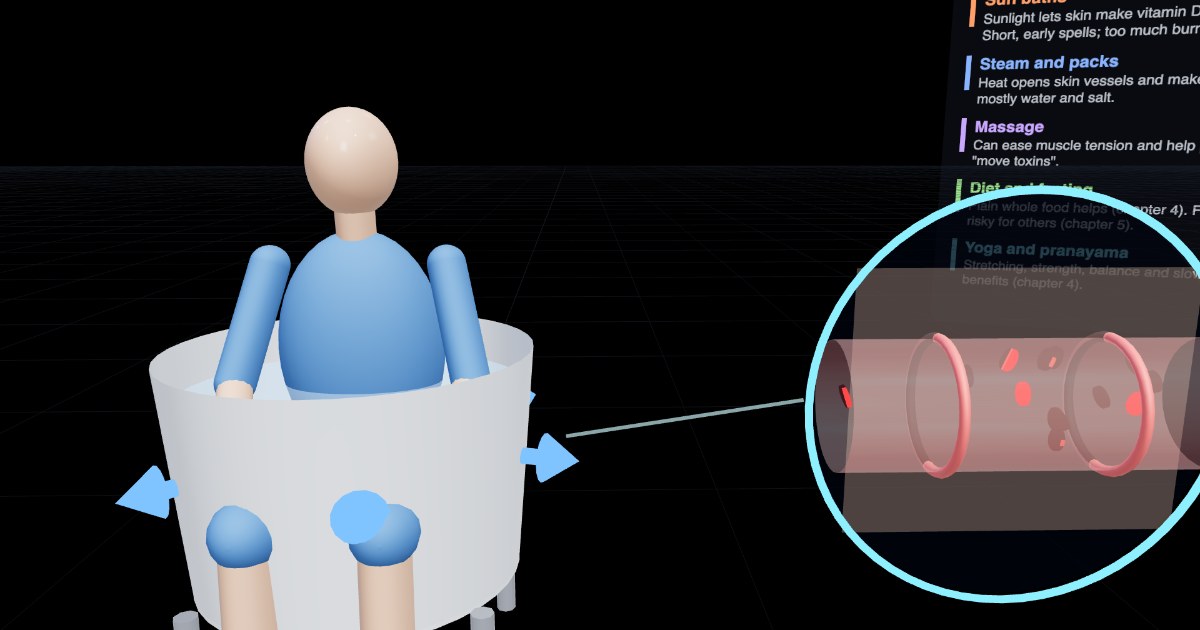
Your nervous system is your body's wiring. It carries messages as tiny electrical pulses, and it has two parts. We are facing the person, so their right side is on your left.

The central nervous system (CNS) is the brain and the spinal cord. The brain decides; BrainClear shows its regions in depth. The spinal cord is a cable about 45 cm long, as thick as your finger, inside the bones of your back. It does not reach the bottom of your spine: it ends at about your waist (the L1–L2 bones), and the lower nerve roots hang down like a horse's tail, the cauda equina.

The peripheral nervous system (PNS) is everything else: the nerves. 31 pairs of spinal nerves leave the cord between the bones, one pair per level: 8 in the neck, 12 in the chest, 5 in the lower back, 5 in the sacrum and 1 at the tailbone. They join into big nerves: the ulnar nerve (the one you hit on your "funny bone"), the femoral nerve in the front of the thigh, and the sciatic nerve, the thickest in your body, about as wide as your thumb.

12 pairs of cranial nerves leave the brain directly, for your eyes, face, ears and tongue (see EyeClear, EarClear and TongueClear). One of them, the tenth, is special: the vagus nerve wanders all the way down to your heart, lungs and gut.

A nerve is a bundle of thousands of axons, the long wires of nerve cells. Some carry messages in (sensory: touch, pain, where your limbs are; see SkinClear) and some carry orders out (motor: move this muscle).
Try “The whole wiring” in the interactive model →

Chapter 2

A spark that runs down a wire

Salt, a battery in every cell, and a pulse that jumps from gap to gap.

A nerve is made of the long wires of neurons, nerve cells. Each has short branches called dendrites that collect messages, a cell body (soma), and one long axon that sends the message on. A motor neuron's axon can run from your lower spine to your big toe: about a metre long, but thinner than a hair.

Every neuron is a tiny battery. Pumps keep sodium (Na⁺) mostly outside and potassium (K⁺) mostly inside, so the inside sits at about −70 mV: the resting potential.

When the voltage rises past about −55 mV, the threshold, sodium gates snap open and Na⁺ rushes in. The inside swings to about +35 mV in half a millisecond. Then potassium gates open, K⁺ flows out, and the voltage falls back, dipping a little below rest. That flip, over in about 2 ms, is an action potential, or spike. It is all or nothing: a stronger push gives more spikes, not bigger ones.

Each spike triggers the next patch of axon, so it travels. Bare axons are slow, about 0.5–2 m/s, a brisk walk. Many axons are wrapped in fatty myelin, with little bare gaps called nodes of Ranvier. The spike jumps from node to node, up to about 120 m/s, faster than a racing car. Thicker axons are faster too. BrainClear shows the same spike starting inside the brain.

That is why a stubbed toe hurts twice: a sharp first pain on fast Aδ fibres, then a dull ache on slow C fibres a second later.

Try “The signal” in the interactive model →

Chapter 3

Crossing the gap

Where one neuron talks to the next, or to a muscle, with a puff of chemicals.

Neurons don't quite touch. Between the end of one axon and the next cell is a gap about 20 nanometres wide, a thousandth of a hair: the synaptic cleft. The whole junction is a synapse.

When a spike reaches the axon terminal, calcium flows in and tiny bubbles called vesicles fuse with the membrane, spilling thousands of molecules of neurotransmitter into the gap. They cross in less than a millionth of a second and click into receptors on the far side, opening gates there. The whole hand-over takes about half a millisecond. Then the transmitter is cleared away, ready for the next spike.

Different transmitters do different jobs. Glutamate is the main excitatory ("go") signal: it nudges the next cell towards threshold. GABA is the main inhibitory ("stop") signal: it pulls it away. One input moves the voltage by less than 1 mV, so a neuron only fires when many go signals beat the stop signals. Dopamine works more slowly, turning other signals up or down; it matters for movement, motivation and learning.

Where a motor nerve meets a muscle is a special synapse, the neuromuscular junction. It uses acetylcholine (ACh), and it is built never to fail: each spike releases about 125 vesicles, far more than needed, so every spike makes the muscle fibre fire and twitch. MuscleClear shows what happens inside the muscle next. BrainClear shows synapses inside the brain.

Try “Synapses” in the interactive model →

Chapter 4

Faster than thinking

A short cut through the spinal cord moves you before your brain knows why.

Some jobs are too urgent to wait for the brain. A reflex is an automatic reaction wired through the spinal cord: the message comes in, turns around in the cord, and goes straight back out.

The knee jerk is the simplest. A tap below the kneecap stretches the thigh muscle. Stretch sensors called muscle spindles fire; the message runs up a fast sensory nerve, into the back of the cord, and connects through one synapse to the motor neuron for the same muscle. The muscle contracts and your leg kicks. At the same time an inhibitory interneuron tells the opposite muscle, the hamstring, to relax. The whole loop takes about 30–40 ms. Doctors tap your knee to check this circuit is intact.

Touch something hot and a withdrawal reflex pulls your hand back. It uses a few more synapses, and pain nerves are slower, so it takes about 70 ms. The pain message also travels up to your brain, but you only feel "hot!" after your hand has started moving.

Compare that with choosing to react. Seeing a light, deciding and pressing a button takes most people about 200–250 ms: your eyes, brain and muscles all have to take part. So a knee jerk is about seven times faster than a deliberate reaction, and even the slower hot-hand reflex is about three times faster.

Try “Reflexes” in the interactive model →

Chapter 5

Fight or flight, rest and digest

Two sets of wires run your organs without asking you.

Right now your heart is beating, your gut is digesting and your pupils are adjusting to the light, and you are not deciding any of it. That is the autonomic nervous system, the automatic part. It has two branches that pull in opposite directions, like an accelerator and a brake.

The sympathetic branch (orange) is fight or flight. Its nerves leave the spinal cord in the chest and lower back and pass through a chain of little knots, ganglia, beside the spine. It speeds up the heart, opens the airways, widens the pupils, makes you sweat, dries your mouth, slows digestion, and tells the adrenal glands on top of your kidneys to pour adrenaline into the blood.

The parasympathetic branch (green) is rest and digest. Most of it travels in the vagus nerve. It slows the heart, narrows the pupils, and gets saliva and digestion going. In fact your heart's own pacemaker would beat about 100 times a minute; at rest the vagus holds it back to about 60–80.

Most organs get both, and the balance between them sets how they run. A sudden fright flips it in under a second; adrenaline keeps you jumpy for minutes afterwards. Slow, deep breathing is one of the few ways you can nudge the balance back yourself. HeartClear and RespirationClear show the heart and breathing in detail.

Try “On autopilot” in the interactive model →

Chapter 6

Protecting the wiring

Strokes, seizures, injuries, the diseases people fear, and the everyday things that help.

Nerve cells in the brain and spinal cord mostly cannot regrow, so the best medicine is protection and quick help. This chapter explains common problems; it cannot tell you what is going on in your own body. For that, see a doctor.

A stroke is a blocked or burst blood vessel in the brain. Think FAST: Face drooping, Arm weakness, Speech slurred, Time to call an ambulance: 112 or 108 in India. In a big stroke the brain can lose about 2 million neurons a minute, and clot-busting treatment works best in the first few hours.

Epilepsy means repeated seizures, storms of electrical activity in the brain. It affects about 50 million people, about 10 million of them in India, and most can be seizure-free with treatment. If someone has a seizure: stay with them, time it, move hard things away, cushion the head, and when the jerking stops, roll them onto their side. Never put anything in their mouth or hold them down. Call an ambulance if it lasts over 5 minutes.

A spinal cord injury cuts the cable: messages can't pass the damaged level, so the higher it is, the more of the body is affected. Parkinson's disease is the slow loss of dopamine-making cells, causing tremor and slowness. Alzheimer's disease slowly damages memory and is the most common cause of dementia.

Everyday things matter. Sleep lets the brain clear waste and store what you learned: teenagers need about 8–10 hours. A helmet on a two-wheeler cuts the risk of a head injury by about two thirds, and a seat belt cuts front-seat deaths by nearly half. And pins and needles after sitting cross-legged is a squeezed nerve waking up; if numbness or tingling comes without pressure, or won't go away, see a doctor.

Try “Keeping it healthy” in the interactive model →

Test yourself

Frequently asked

Which two parts make up the central nervous system?

Brain and spinal cord. The CNS is the brain and spinal cord. The nerves that branch out from them are the peripheral nervous system.

How many pairs of spinal nerves do you have?

31. 31 pairs: 8 cervical, 12 thoracic, 5 lumbar, 5 sacral and 1 coccygeal. (12 is the number of cranial nerve pairs.)

Where does the spinal cord end?

At about waist level, the L1–L2 bones. The bones keep growing after the cord stops, so in adults it ends at about L1–L2. Below that the nerve roots hang down as the cauda equina.

What rushes into a neuron to make the spike go up?

Sodium (Na⁺). Sodium gates open at threshold and Na⁺ floods in, flipping the inside from −70 mV to about +35 mV. K⁺ flowing out brings it back down.

Why does myelin make signals faster?

The spike jumps from node to node instead of creeping along. Myelin insulates the axon, so the spike only has to be remade at the bare nodes of Ranvier. It leaps between them.

You squeeze a nerve harder. What changes?

More spikes per second. Spikes are all or nothing: always about the same size. A stronger stimulus makes a neuron fire more often.

What carries the signal across the synaptic cleft?

Neurotransmitter molecules. The spike makes vesicles release neurotransmitter, which crosses the gap and binds receptors on the next cell.

What does GABA usually do to the next neuron?

Holds it back from firing. GABA is the main inhibitory transmitter. It pulls the voltage away from threshold.

Why does every spike in a motor nerve make its muscle fibre fire?

Far more acetylcholine is released than needed. The neuromuscular junction has a big safety factor: the end-plate potential is about three times what is needed.

Where does the knee-jerk message turn around?

In the spinal cord. The sensory nerve connects straight to the motor neuron in the spinal cord. The brain is not needed.

About how long does the knee jerk take?

About 30–40 ms. About a metre of fast nerve, one synapse and the muscle getting going: tens of milliseconds.

Why is choosing to react slower than a reflex?

The signal has to go through the eyes and brain, which decide. A deliberate reaction runs through the senses, the brain’s decision-making and back out, about 200–250 ms.

Which branch speeds up your heart and widens your pupils?

Sympathetic. The sympathetic branch is fight or flight: faster heart, wider pupils, more sweat, digestion paused.

Which nerve carries most of the rest-and-digest signals?

The vagus nerve. The vagus (cranial nerve X) runs from the brainstem to the heart, lungs and gut.

Why does your heart beat about 70 times a minute at rest, not 100?

The vagus nerve is gently braking it. The heart’s pacemaker alone would beat about 100 a minute. Steady vagal tone holds it back.

Someone’s face droops on one side and their speech is slurred. What should you do?

Call an ambulance straight away. These are FAST signs of a stroke. Every minute counts, so call 112 or 108 at once.

Someone is having a seizure. Which is right?

Move hard things away and turn them on their side when it stops. Keep them safe, time it, and roll them onto their side afterwards. Never put anything in their mouth or restrain them.

Why does a spinal cord injury in the neck affect more of the body than one in the lower back?

Signals to and from everything below the injury are cut off. The cord is a cable. Everything wired in below the damaged level loses its link with the brain.

Words worth knowing

Central nervous system
The brain and spinal cord.
Peripheral nervous system
All the nerves outside the brain and cord that link them to the body.
Neuron
A nerve cell: dendrites collect signals and a long axon sends them on.
Action potential
A 2-millisecond, all-or-nothing voltage spike that travels along an axon.
Myelin
A fatty wrapping that makes the signal jump from node to node, much faster.
Synapse
The junction where a neuron passes its message on with a chemical neurotransmitter.
Reflex arc
Sensor, sensory nerve, spinal cord, motor nerve, muscle: an automatic loop that skips the brain.
Sympathetic and parasympathetic
The fight-or-flight and rest-and-digest branches of the automatic nervous system.
Vagus nerve
Cranial nerve X, which runs from the brainstem to the heart, lungs and gut.

Fork it. Teach with it.

This box is plain HTML, CSS and JavaScript, with no build step and no accounts. Run it yourself and it sends nothing anywhere. The code is MIT. The words, images and videos are CC BY 4.0, so you can reuse them anywhere if you credit “Glassbox, glassbox.how/e/nervousclear”.

git clone https://github.com/bdeeps/nervousclear.git

Built with three.js (MIT), Geist, Instrument Serif (SIL OFL 1.1).

←→ previous / next box · / search

Would you like to see the full page, with the interactive model?