How does the immune system work?

Every day your marrow makes about 100 billion new defenders. Immune cells are born in the red bone marrow, T cells are trained in the thymus, and they gather in about 600 lymph nodes, the tonsils, the spleen and the gut's Peyer's patches.

Every day your marrow makes about 100 billion new defenders. Push a dirty splinter into the skin and watch neutrophils eat the bacteria, find the one B cell whose receptor fits a virus, and slide a crowd past measles' 93% herd-immunity line.

ImmuneClearOpened 23 Aug 202615 min to playFree · no sign-up

In 60 seconds

  1. An army spread through your body

    Immune cells are born in the red bone marrow, T cells are trained in the thymus, and they gather in about 600 lymph nodes, the tonsils, the spleen and the gut's Peyer's patches. Lymph vessels link them and return 2–3 litres of fluid a day to the blood.

  2. Walls, fire and hungry cells

    Skin, the airway's mucus escalator and stomach acid stop most germs. When a splinter breaks through, vessels widen and leak (redness, heat, swelling) and neutrophils squeeze out to swallow bacteria. Above about 100,000 bacteria the fight can be lost.

  3. Learning the enemy

    A dendritic cell carries pieces of a virus to a lymph node and shows them to helper T cells. The one B cell whose receptor fits multiplies into plasma cells that pour out Y-shaped antibodies, and killer T cells destroy infected cells. The first time takes about a week.

  4. Memory, and training without the danger

    Memory cells answer a second attack in a day or two, with 10–100 times more antibody. Vaccines give the same memory without the illness. When 1 − 1/R0 of people are immune, about 93% for measles, outbreaks fizzle. India has been polio-free since 2014.

  5. The body's drain and filter

    Blood pressure pushes fluid out of capillaries; what isn't drawn back, 2–4 litres a day, drains into dead-end lymph capillaries, is pumped by moving muscles past valves, filtered in lymph nodes and returned to a neck vein. Nodes swell when they fight.

  6. When defences misfire

    Allergies are overreactions, autoimmune diseases like type 1 diabetes attack the body itself, and HIV attacks helper T cells but can be controlled with free treatment. Antibiotics kill bacteria, not viruses. Wash hands, sleep, stay vaccinated, and see a doctor.

The history

From plague survivors in Athens and smallpox scabs in China to cowpox, eating cells, antibodies, and the end of smallpox and polio in India.

Read the full history
  1. 430 BCESurvivors don’t catch it twice
  2. 1882Cells that eat invaders
  3. 1890Antitoxin: blood that fights a poison
  4. 1975Monoclonal antibodies
  5. 1985The Universal Immunisation Programme
  6. 2021Covaxin, India’s own COVID-19 vaccine

The full explanation

ImmuneClear, chapter by chapter

Chapter 1

An army spread through your body

Lymph vessels and nodes, the thymus, spleen, tonsils and bone marrow.

Your immune system is not one organ. It is an army of cells and a network of places where they are made, trained and gather. We are facing the person, so their right side is on your left.

Every immune cell is born in the red bone marrow, inside the hip bones, breastbone and spine. The marrow makes about 100 billion white cells a day (see SkeletonClear for bones). Some of them, the T cells, travel to the thymus, a small organ behind your breastbone, to be trained. It is biggest around puberty and then slowly shrinks.

Threading through the whole body is a second set of pipes beside the blood vessels: the lymphatic system. Thin lymph vessels collect clear fluid, called lymph, that leaks out of the blood. On its way back, lymph passes through about 600 lymph nodes, bean-shaped filters packed in your neck, armpits, belly and groin. Two ducts pour it back into big veins near your neck (see CirculationClear).

Guard posts sit where germs get in. The tonsils and adenoid watch your mouth and nose. Peyer's patches watch your gut, where trillions of friendly microbes live (see DigestionClear). The spleen, under your left ribs, filters the blood itself.
Try “The defence network” in the interactive model →

Chapter 2

Walls, fire and hungry cells

Skin, mucus and acid keep germs out. When one gets in, inflammation and eater cells hit back in minutes.

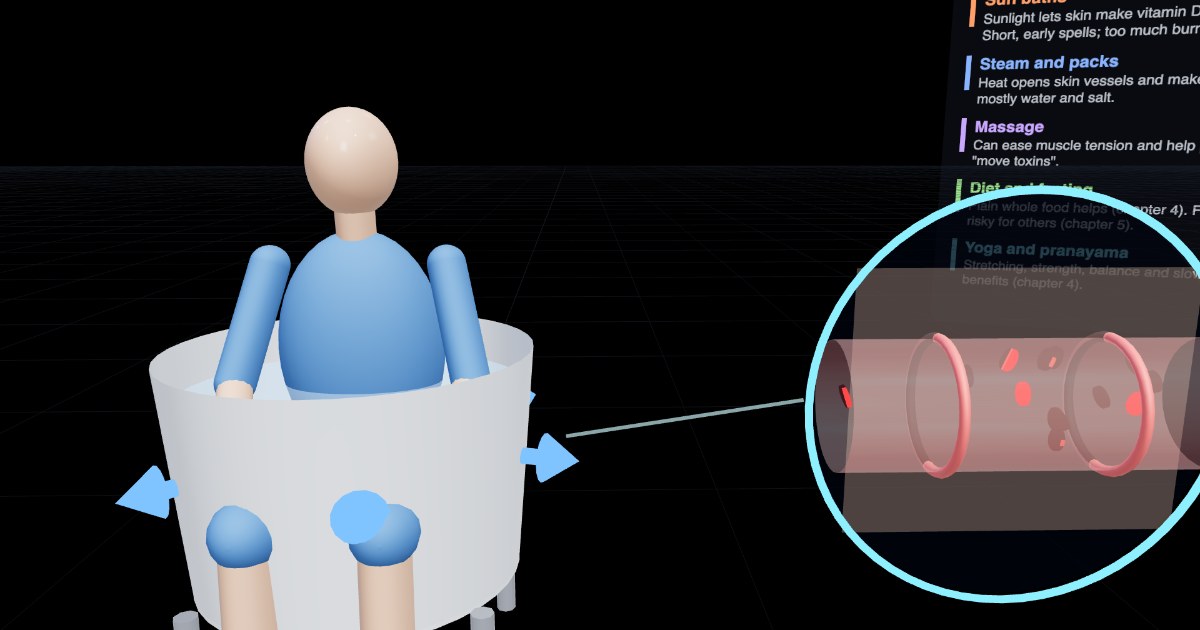
Most germs never get inside you, because your body is wrapped in walls. Skin is a tough top layer of dead cells, slightly acidic and salty (see SkinClear). Your airways are lined with sticky mucus, and tiny hairs called cilia beat 10–15 times a second to sweep it up to your throat, where you swallow it: the mucus escalator (see RespirationClear). Swallowed germs meet stomach acid strong enough to kill most of them (see DigestionClear). Tears and saliva carry germ-dissolving enzymes too.

When a wall is broken, say by a splinter, the innate immune system answers within minutes. It doesn't need to know which germ it is. Damaged cells and guard cells called macrophages release alarm chemicals. Nearby blood vessels widen and leak: the spot turns red, warm and swollen, and it hurts. That is inflammation, and it is a good sign.

The leaky vessels let neutrophils, the most common white cells, squeeze out of the blood and crawl towards the bacteria. They swallow them whole and digest them inside: phagocytosis, "cell eating". Dead neutrophils and bacteria make pus. If germs get into the blood, the brain can raise your thermostat: a fever helps immune cells work and slows some germs down.

Try “Walls and first responders” in the interactive model →

Chapter 3

Learning the enemy

T cells and B cells learn one germ’s exact shape and build weapons made for it.

The first responders fight any germ the same way. The adaptive immune system is slower, but it learns the exact shape of this germ, and it remembers. Its soldiers are two kinds of lymphocytes: T cells and B cells. They meet the enemy in your lymph nodes.

1. Catch. A dendritic cell, a scout with long arms, grabs a virus, chops it up and carries the pieces to the nearest lymph node. A piece of a germ that the immune system can recognise is called an antigen.

2. Show. The dendritic cell holds up the antigen for helper T cells to check. You have millions of different T and B cells, each with a receptor of one shape. The one whose receptor fits is switched on and sends out chemical orders.

3. Antibodies. The helper T cell wakes the one B cell whose receptor fits the antigen, like a key in a lock. It multiplies into thousands of plasma cells, each pouring out about 2,000 antibodies a second. An antibody is a tiny Y: its two tips grab the germ, which blocks it and marks it for eater cells.

4. Kill. Viruses hide inside your own cells. Killer T cells spot infected cells by the virus pieces on their surface and make them self-destruct, virus and all.

All this takes about a week the first time, which is why you feel ill for days. The second time, memory makes it far faster.

Try “Learning the enemy” in the interactive model →

Chapter 4

Memory, and training without the danger

Why you rarely get measles twice, how a vaccine teaches the same lesson safely, and how a crowd protects the few who can’t be vaccinated.

After a fight, most B and T cells die off, but some stay on as memory cells, sometimes for your whole life. If the same germ comes back, they recognise it at once. Antibodies climb within a day or two, to levels 10 to 100 times higher than the first time, and the germ is usually beaten before you even feel ill. That is immunity.

Catching a disease to get immunity is risky: measles, polio or diphtheria can disable or kill. A vaccine teaches the same lesson safely. It shows your immune system a harmless version of the germ: a killed germ (India's Covaxin), a weakened one (oral polio drops), one piece of it (hepatitis B), or a recipe for one piece (mRNA vaccines). Your body makes memory cells, and at most you get a sore arm for a day.

Vaccines also protect people who can't be vaccinated, like newborns or people on cancer treatment. If enough people are immune, a germ can't find enough new people to spread to, and outbreaks fizzle out: herd immunity. How many is "enough" depends on how contagious the germ is. Its R0 is how many people one case infects when no one is immune; the share needed is 1 − 1/R0. For measles, one of the most contagious diseases, that is about 92–95%.

India's Universal Immunisation Programme, started in 1985, gives free vaccines against 12 diseases to about 2.7 crore babies every year. Pulse Polio drives reached every child, the last case of wild polio in India was in January 2011, and India was certified polio-free in 2014.

Try “Memory and vaccines” in the interactive model →

Chapter 5

The body’s drain and filter

Fluid leaks out of your blood all day. Lymph vessels collect it, filter it through the nodes and pour it back.

Your blood doesn't stay perfectly inside its pipes. In each tiny capillary, blood pressure pushes some watery fluid out through the thin wall into the spaces between your cells: tissue fluid. It brings them food and oxygen. At the far end of the capillary, where the pressure is lower, proteins in the blood pull most of it back in (see CirculationClear).

But not all of it. What is left, about 2–4 litres a day, would pile up and make you puffy. Instead it seeps into lymph capillaries, dead-end tubes whose wall cells overlap like flaps: fluid can get in but not out. Now it is called lymph.

Lymph has no heart to pump it. It is squeezed along by the muscles around the vessels, and valves stop it flowing backwards, so walking and moving speed it up many times. On its way, lymph must pass through lymph nodes. Inside, macrophages eat germs and dead cells, and B and T cells check everything for enemies. Filtered lymph flows on into the thoracic duct and back into a vein near your neck. In the gut, lymph vessels also carry away fats from your food (see DigestionClear).

When germs arrive at a node, its lymphocytes multiply to fight them and the node swells. That is why the "glands" in your neck feel sore and lumpy when you have a sore throat. They usually go down within about two weeks. If a lump stays longer, feels hard, or comes with fevers, night sweats or weight loss, see a doctor.

Try “Lymph drainage” in the interactive model →

Chapter 6

When defences misfire, and how to help them

Allergies, autoimmunity, HIV, antibiotic resistance, and the habits that keep your army strong.

An immune system has to be strong against germs but gentle with everything else. This chapter explains common problems; it cannot tell you what is going on in your own body. For that, see a doctor.

An allergy is an overreaction to something harmless, like pollen, dust mites or peanuts. Special antibodies (IgE) sit on mast cells, which burst open with histamine: sneezing, itchy eyes, rashes or wheezing. A severe reaction, anaphylaxis, with trouble breathing or a swelling face, is an emergency: call 112 (or 108), and use an adrenaline pen if one was prescribed.

In autoimmune diseases the army attacks your own body. In type 1 diabetes it destroys the insulin-making cells of the pancreas (see PancreasClear); India has more children with it than any other country. In rheumatoid arthritis it attacks the joints.

HIV is a virus that infects the helper T cells, the army's commanders. Without treatment they slowly fall until ordinary germs become dangerous (AIDS). Daily medicines keep the virus down so people live long, healthy lives, and they are free at government ART centres in India. HIV does not spread by touching, hugging or sharing food.

Antibiotics kill bacteria but do nothing to viruses such as colds and flu. Using them when not needed helps resistant bacteria win. Take them only when a doctor prescribes them, exactly as told. And the simple things work: wash your hands with soap for 20 seconds, sleep well (teenagers need 8–10 hours), and keep your vaccines up to date.

Try “Keeping it healthy” in the interactive model →

Test yourself

Frequently asked

Where are all your immune cells born?

In the red bone marrow. Every white blood cell starts in the red bone marrow. Some then mature elsewhere, like T cells in the thymus.

What do lymph nodes do?

Filter lymph so immune cells can meet germs. Lymph flows through the nodes on its way back to the blood. Immune cells inside them catch and study germs.

Where does lymph finally go?

Back into big veins near the neck. The thoracic duct and the right lymphatic duct empty lymph into the veins where the neck and arm veins meet.

Why does the skin around a splinter go red and swollen?

Blood vessels widen and leak so defenders can get in. Inflammation widens the vessels (redness, heat) and makes them leaky (swelling), letting fluid and neutrophils reach the germs.

What does a neutrophil do to a bacterium?

Swallows and digests it. Neutrophils are eater cells. Swallowing and digesting a germ is called phagocytosis.

Which of these is NOT one of the body’s walls against germs?

Red blood cells. Red blood cells carry oxygen. Skin, mucus and cilia, stomach acid, tears and saliva are the walls.

What does a dendritic cell do?

Catches germs and shows their pieces to T cells. Dendritic cells are scouts. They carry antigen from the battle to the lymph node and present it to T cells.

Why does only one of the B cells make antibodies against this virus?

Only its receptor fits the virus’s antigen, like a key in a lock. Each B cell has a receptor of one shape. Only the one that fits is chosen to multiply: that is clonal selection.

How does the second response to the same germ compare with the first?

Faster and much bigger. Memory cells start it within a day or two, and antibody levels climb about 10 to 100 times higher.

Why does a vaccine protect you?

It trains your immune system to make memory cells, without the disease. A vaccine shows your immune system a harmless version of the germ, so memory cells are ready if the real one comes.

Measles has an R0 of about 15. Roughly what share of people must be immune for herd immunity?

About 93%. 1 − 1/15 is about 0.93, so about 93%. That is why measles needs two doses and very high coverage.

In which year was India certified polio-free?

2014. The last wild polio case was in January 2011. After three years with no cases, WHO certified the region polio-free on 27 March 2014.

Where does lymph come from?

Fluid that leaked out of blood capillaries into the tissues. Blood pressure pushes fluid out of capillaries. The part not drawn back in is collected by lymph vessels as lymph.

What moves lymph along, since it has no heart?

Squeezing muscles, with valves that stop it going back. Muscles and breathing squeeze the vessels, and valves keep the flow one way. Moving about pumps lymph much faster.

Why do the glands in your neck swell when you have a sore throat?

Immune cells in the lymph nodes multiply to fight the germs. Germs drain to the nearest nodes. Lymphocytes there multiply, and the node gets bigger and tender for a while.

What is an allergy?

The immune system overreacting to something harmless. In an allergy the immune system treats something harmless, like pollen, as an enemy and releases histamine.

Will antibiotics cure a cold?

No: colds are caused by viruses, and antibiotics only kill bacteria. Antibiotics don’t work on viruses. Taking them when not needed helps resistant bacteria spread.

Which cells does HIV attack?

Helper T cells. HIV infects helper (CD4) T cells, the commanders of the immune response. Treatment keeps the virus in check.

Words worth knowing

Innate immunity
Fast, general defences you are born with: barriers, inflammation and eater cells.
Adaptive immunity
Defence that learns each germ's exact shape and remembers it.
Lymph node
A bean-shaped filter where immune cells meet germs carried in the lymph.
Phagocytosis
When a neutrophil or macrophage swallows and digests a germ.
Antigen
A piece of a germ that receptors and antibodies recognise.
Antibody
A Y-shaped protein made by plasma cells whose two tips lock onto one antigen.
Memory cell
A long-lived lymphocyte that answers fast if the same germ returns.
Vaccine
A harmless version or piece of a germ that trains immune memory.
Herd immunity
When enough people are immune (1 − 1/R0) that a germ can't keep spreading.

Fork it. Teach with it.

This box is plain HTML, CSS and JavaScript, with no build step and no accounts. Run it yourself and it sends nothing anywhere. The code is MIT. The words, images and videos are CC BY 4.0, so you can reuse them anywhere if you credit “Glassbox, glassbox.how/e/immuneclear”.

git clone https://github.com/bdeeps/immuneclear.git

Built with three.js (MIT), Geist, Instrument Serif (SIL OFL 1.1).

←→ previous / next box · / search

Would you like to see the full page, with the interactive model?